Baphomet
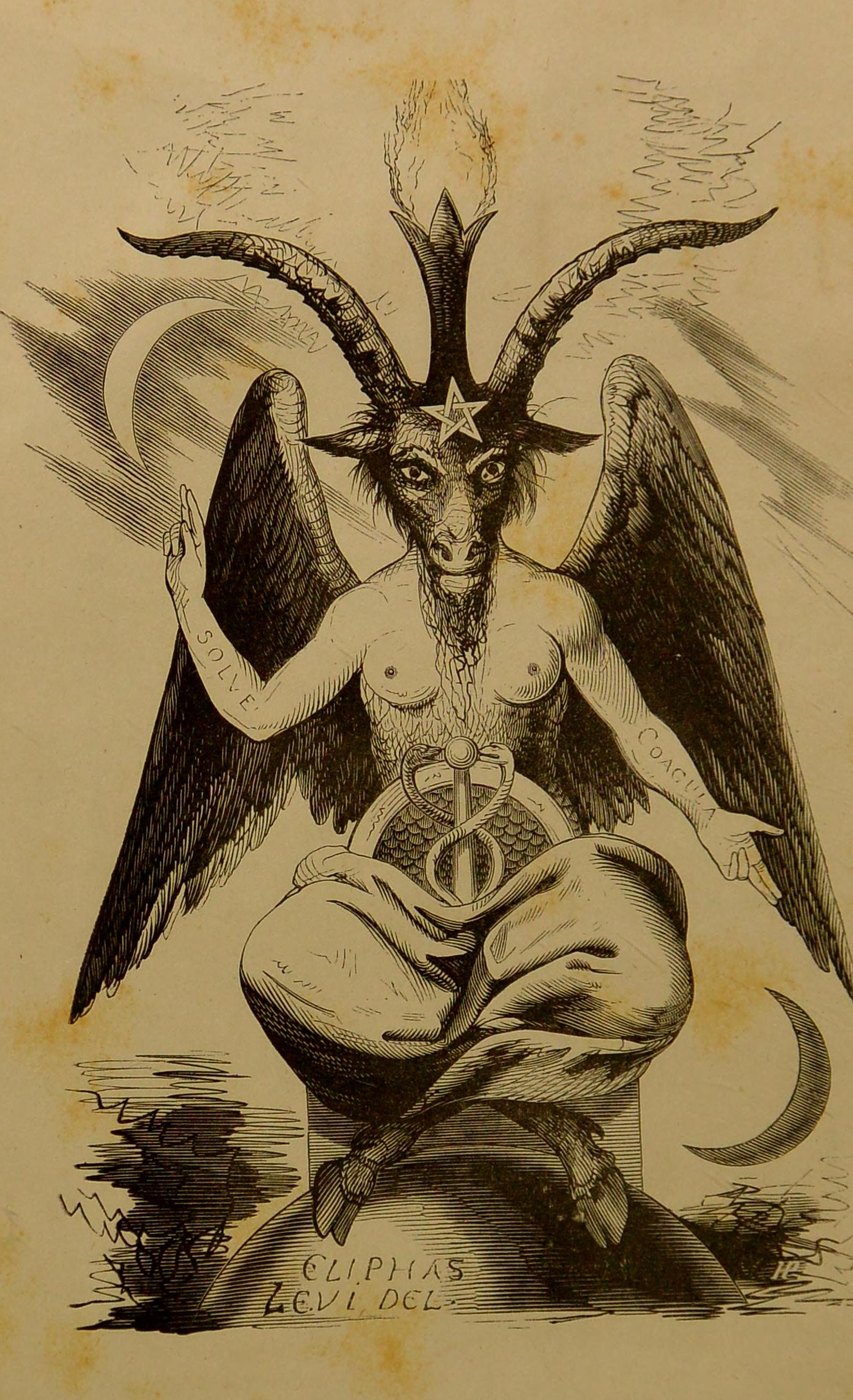
Baphomet as the central motif, filed under the Demon and the Monster, with the Pentagram, Fire, the Hand, the Sun and the Moon, the Serpent and the Dragon, the Water, and the Angel and the Wing in a secondary part. From Dogme et Rituel.
What is happening
Lévi, in Waite's translation, 1896 “Yes, in our profound conviction, the Grand Masters of the Order of the Templars worshipped the Baphomet, and caused it to be worshipped by their adepts; yes, there existed in the past, and there may be still in the present, assemblies which are presided over by this figure, seated on a throne and having a flaming torch between the horns; but the adorers of this sign do not consider, as do we, that it is the representation of the devil; on the contrary, for them it is that of the god Pan, the god of our modern schools of philosophy, the god of the Alexandrian theurgic school, and of our own mystical Neoplatonists, the god of Lamartine and Victor Cousin, the god of Spinoza and Plato, the god of the primitive Gnostic schools; the Christ also of the dissident priesthood.”
Key · 8 motifs
Tap a motif on the picture, or a line below. Its note opens under the line, with the reading its author gave it.
- Primary motif
- Secondary motifs · 7
The picture
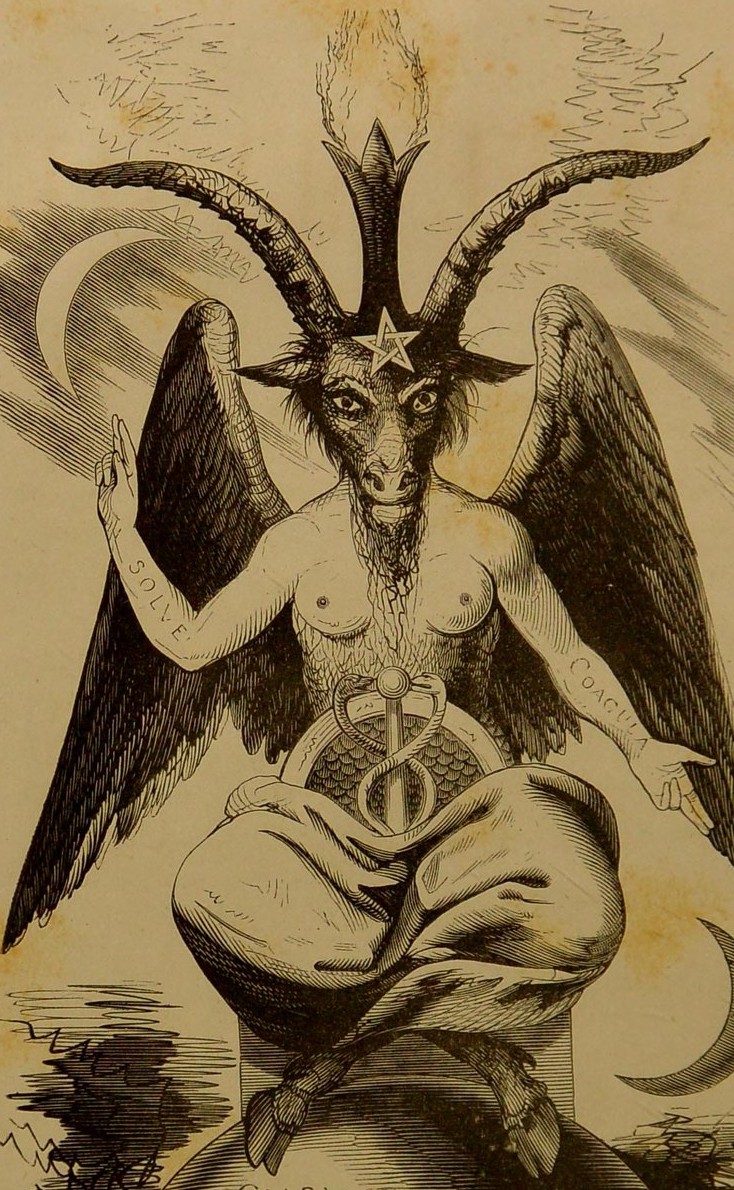
A seated figure with the head of a goat, a torch burning between its horns and a pentagram on its brow, great feathered wings, a woman's breasts, one arm raised with SOLVE lettered on it and one lowered with COAGULA, a caduceus at the groin over a scaled belly, a white crescent above at the left and a black one below at the right, seated on a globe and signed Eliphas Levi del.; Baphomet as the central motif. By eye
The reading
The picture read whole, in the archive's words, from the sources quoted on the marks. Read on, and the picture follows: the motif under discussion keeps its colour.
The most copied devil in the world was drawn by its own author to prove it was not a devil. Alphonse Louis Constant, writing as Éliphas Lévi, put this figure at the front of the second volume of Dogme et Rituel de la Haute Magie in 1856 and signed it, ‘Eliphas Levi del.’, at the foot. His text calls it ‘the exact figure of the terrible emperor of night, with all his attributes and all his characters’: the Baphomet the Templars were accused of adoring, ‘the bearded idol of the alchemists, the obscene deity of Mendes, the goat of the Sabbath’. Then he reads it, sign by sign, and every sign comes out clean.
Start at the forehead. The goat ‘bears upon his forehead the sign of the pentagram with one point in the ascendant, which is sufficient to distinguish him as a symbol of the light’. In his chapter on the pentagram Lévi lays down the rule the whole picture depends on: ‘the pentagram with two points in the ascendant represents Satan as the goat of the Sabbath; when one point is in the ascendant, it is the sign of the Saviour’. His goat wears the star point up. Whoever turned it over later, and many did, drew a different creature.
The hands make ‘the sign of occultism’, one ‘pointing upward to the white moon of Chesed’, the other ‘downward to the black moon of Geburah’, mercy and severity in the language of the Kabbalah; ‘this sign expresses the perfect harmony of mercy with justice’. The arms are lettered SOLVE and COAGULA, dissolve and bind, the two motions of the alchemical work, which Lévi elsewhere likens to the builders of the second temple ‘who bore their sword in one hand and their trowel in the other’. ‘One of the arms is feminine and the other masculine, as in the androgyne of Khunrath, whose attributes we have combined with those of our goat, since they are one and the same symbol.’ That androgyne is in this archive, on the plate of the regenerate man.
Then the body, read from the top down and the bottom up. ‘The torch of intelligence burning between the horns is the magical light of universal equilibrium; it is also the type of the soul exalted above matter, even while connecting with matter, as the flame connects with the torch.’ ‘The hideous head of the animal expresses horror of sin.’ ‘The caduceus, which replaces the generative organ, represents eternal life; the scale-covered belly typifies water; the circle above it is the atmosphere; the feathers still higher up signify the volatile; lastly, humanity is depicted by the two breasts and the androgyne arms of this sphinx of the occult sciences.’ Water, air, what rises, and at the top a human being: the figure is the elements stacked into a body, with a goat's head on it for the horror of sin.
Lévi's conclusion is a boast: ‘Behold the shadows of the infernal sanctuary dissipated! Behold the sphinx of mediaeval terrors divined and cast from his throne!’ ‘The dread Baphomet henceforth, like all monstrous idols, enigmas of antique science and its dreams, is only an innocent and even pious hieroglyph.’ It did not work. The picture escaped the book, lost its lettering and its two pages of explanation, and became the devil it was drawn to explain away. Pamela Colman Smith's Devil card of 1909 takes the goat, the torch and the caduceus from it and turns the pentagram over; Waite, who commissioned her, wrote that ‘since 1856 the influence of Eliphas Lévi and his doctrine of occultism has changed the face of this card’. The archive keeps the lettering on.
Readings quoted
Lévi, in Waite's translation, 1896 “The bull, the dog, and the goat are the three symbolical animals of Hermetic magic, resuming all the traditions of Egypt and India. The bull represents the earth or salt of the philosophers; the dog is Hermanubis, the Mercury of the sages, fluid, air, and water; the goat represents fire, and is at the same time the symbol of generation.”
Lévi, in Waite's translation, 1896 “Behold the shadows of the infernal sanctuary dissipated! Behold the sphinx of mediaeval terrors divined and cast from his throne! Quomodo cecidisti, Lucifer!”
Lévi, in Waite's translation, 1896 “How should man adore the beast, since he exercises a sovereign power over it? Let us affirm, for the honour of humanity, that it has never adored dogs and goats any more than lambs and pigeons. In the hieroglyphic order, why not a goat as much as a lamb?”
Decoded: every motif is marked, and each mark carries the reading its author gave it, quoted from the text, or says that it is observed on the picture and not read. The reading above is the archive's own, made from those sources and no others.
Almost always a composite and almost always subordinate. Note what it is made of and whether it is bound.
In plain words Lévi drew this himself, and signed it at the foot, as the picture of what he calls the terrible emperor of night: the Baphomet the Templars were accused of worshipping, the goat of the witches' sabbath, the devil of the old pictures. Then he spends two pages taking it apart sign by sign to show that, read correctly, it is not a devil at all but a diagram, ‘an innocent and even pious hieroglyph’. The goat's head is the one part he leaves ugly on purpose: it stands for the horror of sin.
Éliphas Lévi, 1856 “Nous donnons en tête de ce Rituel la figure exacte de ce terrible empereur de la nuit avec tous ses attributs et tous ses caractères.”
Lévi, in Waite's translation, 1896 “The frontispiece to this Ritual reproduces the exact figure of the terrible emperor of night, with all his attributes and all his characters.”
Lévi, in Waite's translation, 1896 “The hideous head of the animal expresses horror of sin, for which the material agent, alone responsible, must alone and for ever bear the penalty, because the soul is impassible in its nature, and can suffer only by materialising.”
Lévi, in Waite's translation, 1896 “The dread Baphomet henceforth, like all monstrous idols, enigmas of antique science and its dreams, is only an innocent and even pious hieroglyph.”
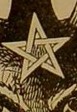
A five-pointed star drawn in one line. Count which way it points before reading it: one point up and two down is one sign, two up and one down is another.
In plain words A five-pointed star with one point up, on the forehead between the horns. For Lévi the direction settles everything: point up, the star is a sign of light and of a human figure standing; two points up, it is the goat of the sabbath. His Baphomet wears it point up, which is his way of saying, before you have read a word, that this is not the devil. When Pamela Colman Smith drew the Devil card from this figure half a century later, she turned the star over.
Éliphas Lévi, 1856 “Le bouc qui est représenté dans notre frontispice porte sur le front le signe du pentagramme, la pointe en haut, ce qui suffit pour en faire un symbole de lumière.”
Lévi, in Waite's translation, 1896 “The goat which is represented in our frontispiece bears upon his forehead the sign of the pentagram with one point in the ascendant, which is sufficient to distinguish him as a symbol of the light.”
Lévi, in Waite's translation, 1896 “The pentagram with two points in the ascendant represents Satan as the goat of the Sabbath; when one point is in the ascendant, it is the sign of the Saviour.”
Lévi, in Waite's translation, 1896 “The pentagram, which, in gnostic schools, is called the blazing star, is the sign of intellectual omnipotence and autocracy. It is the star of the magi; it is the sign of the Word made flesh; and, according to the direction of its points, this absolute magical symbol represents order or confusion, the divine lamb of Ormuz and St John, or the accursed goat of Mendes.”
Lévi, in Waite's translation, 1896 “The sign of the pentagram is called also the sign of the microcosm, and it represents what the Kabbalists of the book of Zohar term the microprosopus. The complete comprehension of the pentagram is the key of the two worlds.”
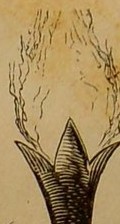
A count, a catastrophe, or the visible part of something that has no body. Note whether the flames are arranged in a number, breaking something, or standing where a figure would be.
In plain words A flame burns straight up from between the horns, on the crown of the head where a lamp would sit. Lévi calls it the torch of intelligence: the light of balance, and a picture of the soul, which rises above the body while staying attached to it the way a flame stays attached to its torch.
Éliphas Lévi, 1856 “Le flambeau de l'intelligence qui brille entre ses cornes, est la lumière magique de l'équilibre universel: c'est aussi la figure de l'âme élevée au-dessus de la matière, bien que tenant à la matière même, comme la flamme tient au flambeau.”
Lévi, in Waite's translation, 1896 “The torch of intelligence burning between the horns is the magical light of universal equilibrium; it is also the type of the soul exalted above matter, even while connecting with matter, as the flame connects with the torch.”
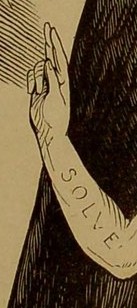
The hand as a sign in itself: what it holds, where it points, which fingers are raised. On the Hand of the Mysteries every finger carries a sign of its own.
In plain words One hand points up and the other down, and the arms are lettered SOLVE and COAGULA, dissolve and bind together, the two motions of the alchemists' work. One arm is a woman's and the other a man's, which Lévi says he borrowed from Khunrath's androgyne, a plate that hangs elsewhere in this archive. The up and the down, he says, are the white moon of mercy and the black moon of justice, held in balance.
Éliphas Lévi, 1856 “Il fait des deux mains le signe de l'occultisme, et montre en haut la lune blanche de Chesed, et en bas la lune noire de Géburah. Ce signe exprime le parfait accord de la miséricorde avec la justice. L'un de ses bras est féminin, l'autre masculin, comme dans l'androgyne de Khunrath dont nous avons dû réunir les attributs à ceux de notre bouc, puisque c'est un seul et même symbole.”
Lévi, in Waite's translation, 1896 “He makes the sign of occultism with both hands, pointing upward to the white moon of Chesed, and downward to the black moon of Geburah. This sign expresses the perfect harmony of mercy with justice. One of the arms is feminine and the other masculine, as in the androgyne of Khunrath, whose attributes we have combined with those of our goat, since they are one and the same symbol.”
Lévi, in Waite's translation, 1896 “The magical androgyne depicted in the frontispiece of the Ritual has SOLVE inscribed upon the right and COAGULA on the left arm, which corresponds to the symbolical figure of the architects of the second temple, who bore their sword in one hand and their trowel in the other.”
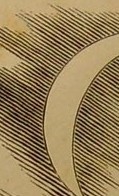
The borrowed light, the mother of the work, and the crescent a woman stands on. The one body here that every source explains against another.
In plain words A white crescent in the upper left, a black one in the lower right, and the two hands point at them. Chesed and Geburah are two of the ten sephiroth of the Kabbalah, mercy and severity; Lévi paints them as a bright moon and a dark one and has the figure hold both at once.
Lévi, in Waite's translation, 1896 “He makes the sign of occultism with both hands, pointing upward to the white moon of Chesed, and downward to the black moon of Geburah. This sign expresses the perfect harmony of mercy with justice.”
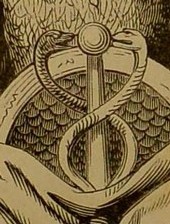
A single creature doing two opposite jobs. Note whether it is bound, killed, or eating itself.
In plain words Where the figure's sex should be there is a caduceus, the rod with two serpents twined round it that Mercury carries. Lévi says it stands for eternal life, and Waite, describing the Devil card that copies this figure, noted the same substitution. The two serpents put it in the archive under the Serpent.
Éliphas Lévi, 1856 “Le caducée, qui tient lieu de l'organe générateur, représente la vie éternelle.”
Lévi, in Waite's translation, 1896 “The caduceus, which replaces the generative organ, represents eternal life.”
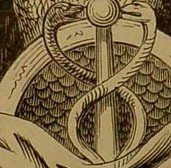
Where a thing is taken apart rather than destroyed. Note whether the figure is in the water, on it, or pouring it.
In plain words The belly is covered in fish scales. Lévi reads the body from the bottom up as a ladder of elements: scales for water, the circle above them for the air, the feathers of the wings for what rises, and the breasts and arms for humanity at the top of the ladder.
Éliphas Lévi, 1856 “Le ventre couvert d'écailles c'est l'eau; le cercle qui est au-dessus, c'est l'atmosphère; les plumes qui viennent ensuite sont l'emblème du volatile; puis l'humanité est représentée par les deux mamelles et les bras androgynes de ce sphinx des sciences occultes.”
Lévi, in Waite's translation, 1896 “The scale-covered belly typifies water; the circle above it is the atmosphere; the feathers still higher up signify the volatile; lastly, humanity is depicted by the two breasts and the androgyne arms of this sphinx of the occult sciences.”
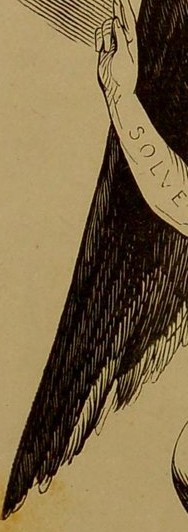
The mark of an errand rather than a nature. Note whether the wings are open, folded, or given to the figure by someone else.
In plain words Great dark wings, feathered, not a bat's. In Lévi's ladder of the body they are the volatile, the part that rises, standing above the water of the belly and the air of the circle. Smith gave her Devil bat's wings; Lévi's goat has a bird's.
Lévi, in Waite's translation, 1896 “The scale-covered belly typifies water; the circle above it is the atmosphere; the feathers still higher up signify the volatile; lastly, humanity is depicted by the two breasts and the androgyne arms of this sphinx of the occult sciences.”
Also carrying the Demon and the Monster
23 works carry it. The 6 where it is the central motif are here. The symbol.
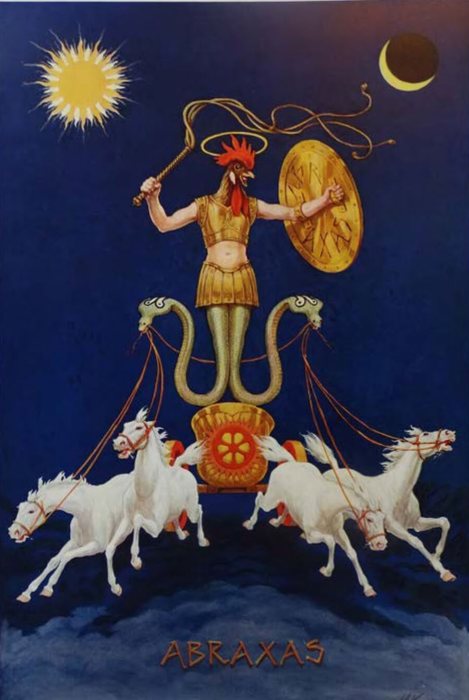 Abraxas, a Gnostic Pantheos
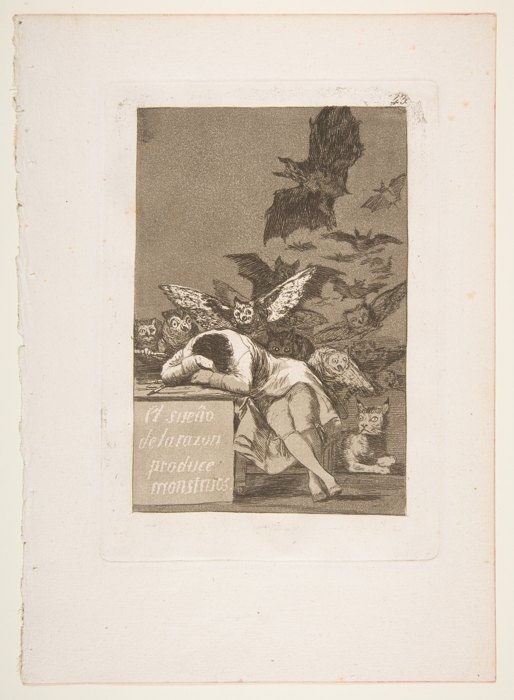 The Sleep of Reason Produces Monsters
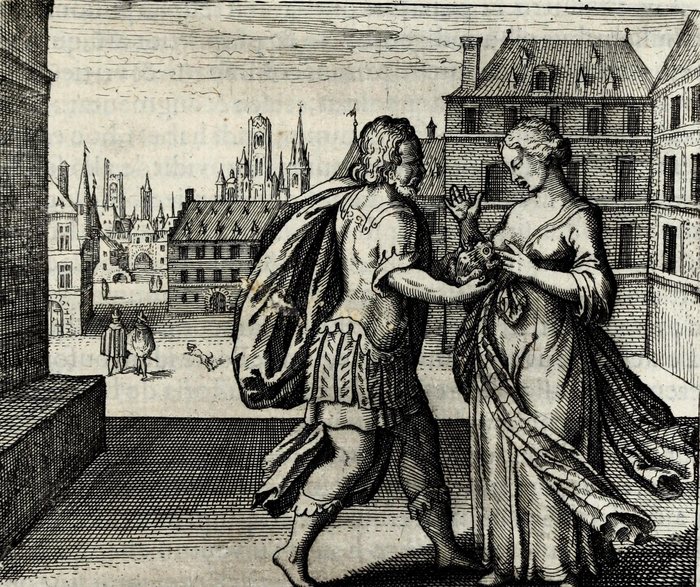 Appone mulieri super mammas bufonem, ut ablactet eum, & moriatur mulier, sitque bufo grossus de lacte
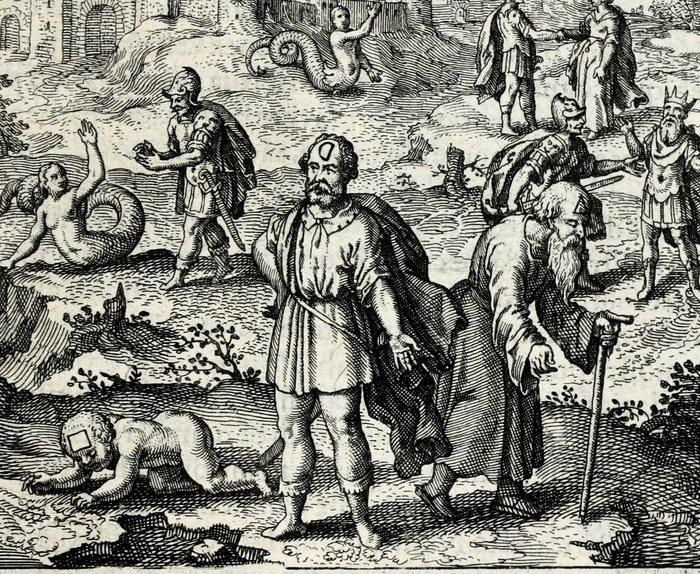 Oedypus Sphynge superata & trucidato Lajo patre matrem ducit in uxorem
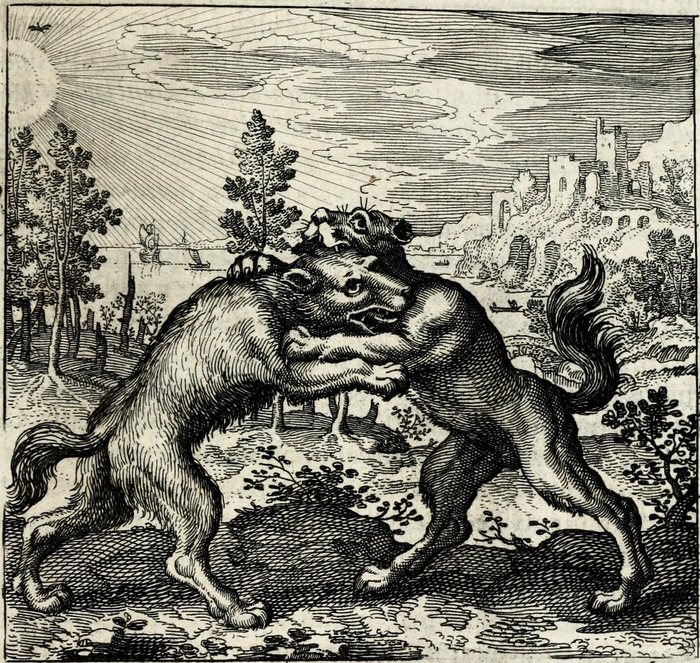 Lupus ab Oriente & Canis ab Occidente venientes se invicem momorderunt
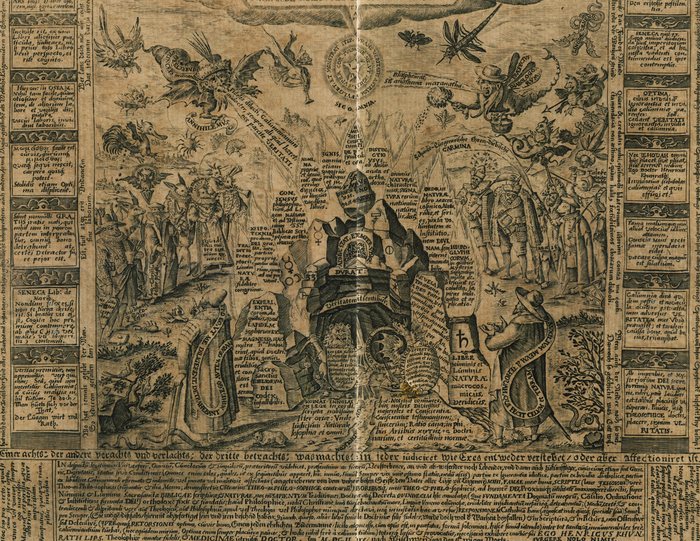 Against the slanderers, by right of retort
Where the detail is the subject
the Pentagram · Fire · the Hand · the Sun and the Moon · the Serpent and the Dragon · the Water · the Angel and the Wing
Each of these is in the picture without being what it is about. Below, one work that is about each.
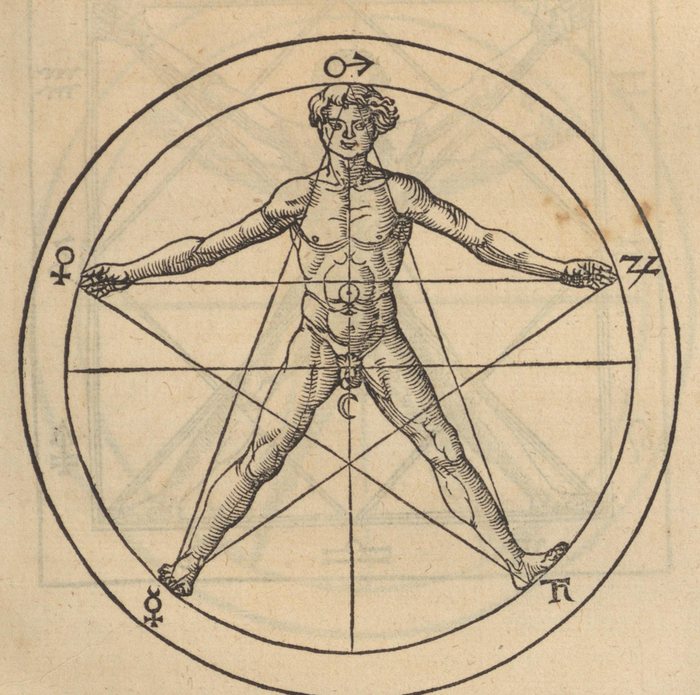 the PentagramThe Man in the Pentagram
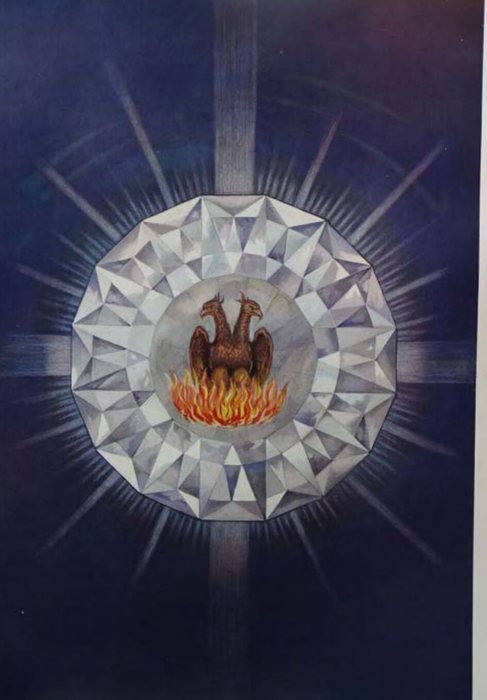 FireOccultum Lapidem, the Philosopher's Stone
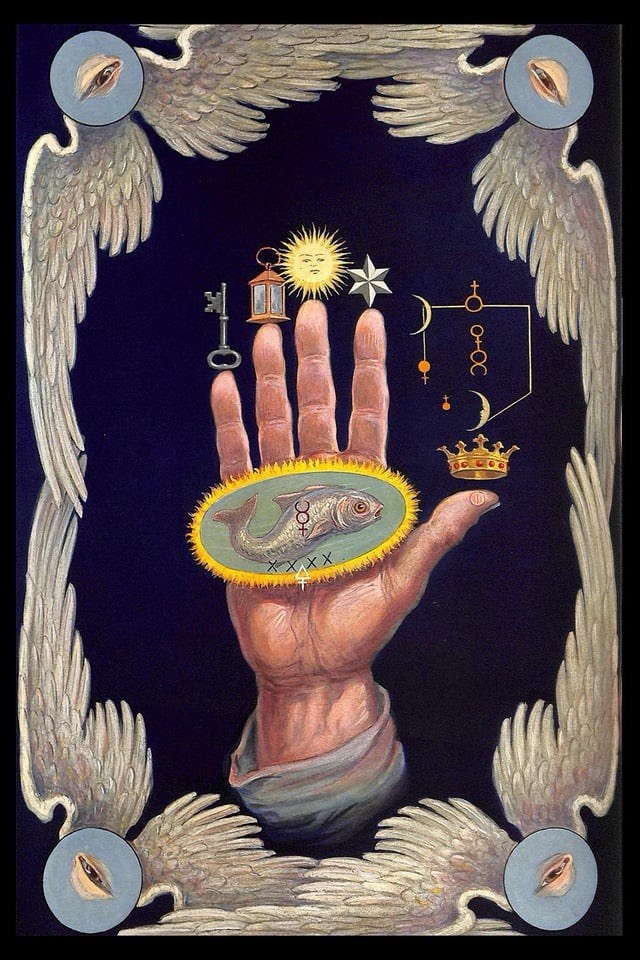 the HandThe Hand of the Mysteries
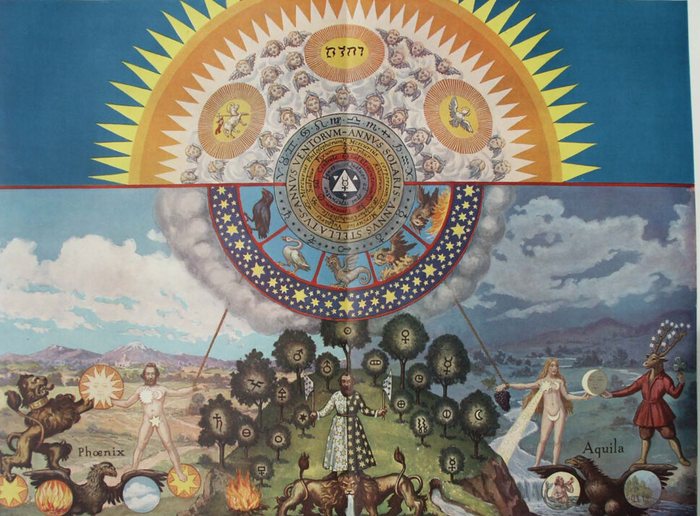 the Sun and the MoonGrand Rosicrucian Alchemical Formula
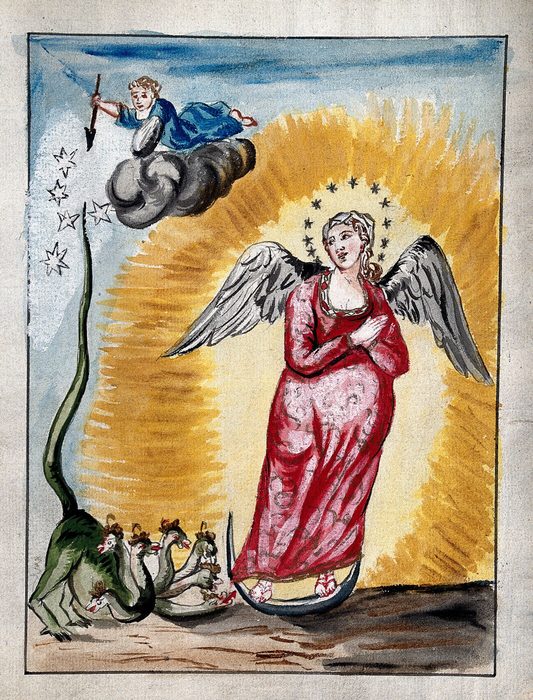 the Serpent and the DragonThe Virgin with a Dragon at Her Feet
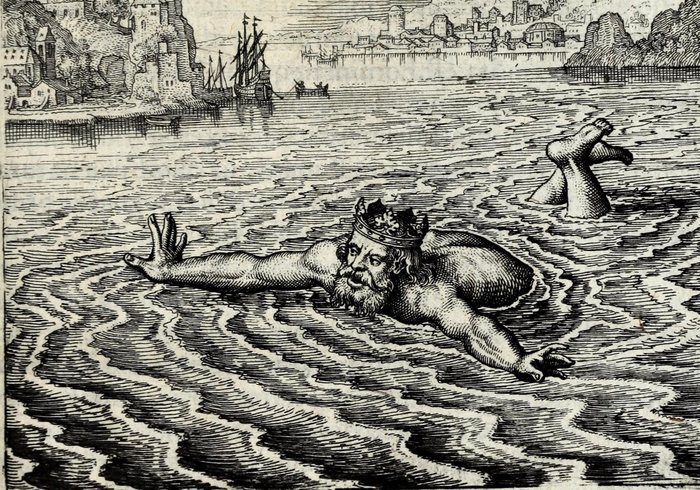 the WaterRex natans in mari, clamans altâ voce: Qui me eripiet, ingens præmium habebit
Record
One symbol a week, decoded.
This picture is free at full size from its source, linked above. What an address gets is the Sunday letter: one picture, one symbol marked on it, what it meant and who said so, and the master files of the decoded plates as they are verified. Leave any time.
Free, one letter a week, unsubscribe in one click. How the address is used.
Scroll or pinch to zoom · drag to move · double-tap for 1:1 · 853 by 1400 pixel web copy; the source file is linked under Record