Baphomet wears its star point upward, and the man who drew it wrote the rule that makes that matter
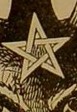
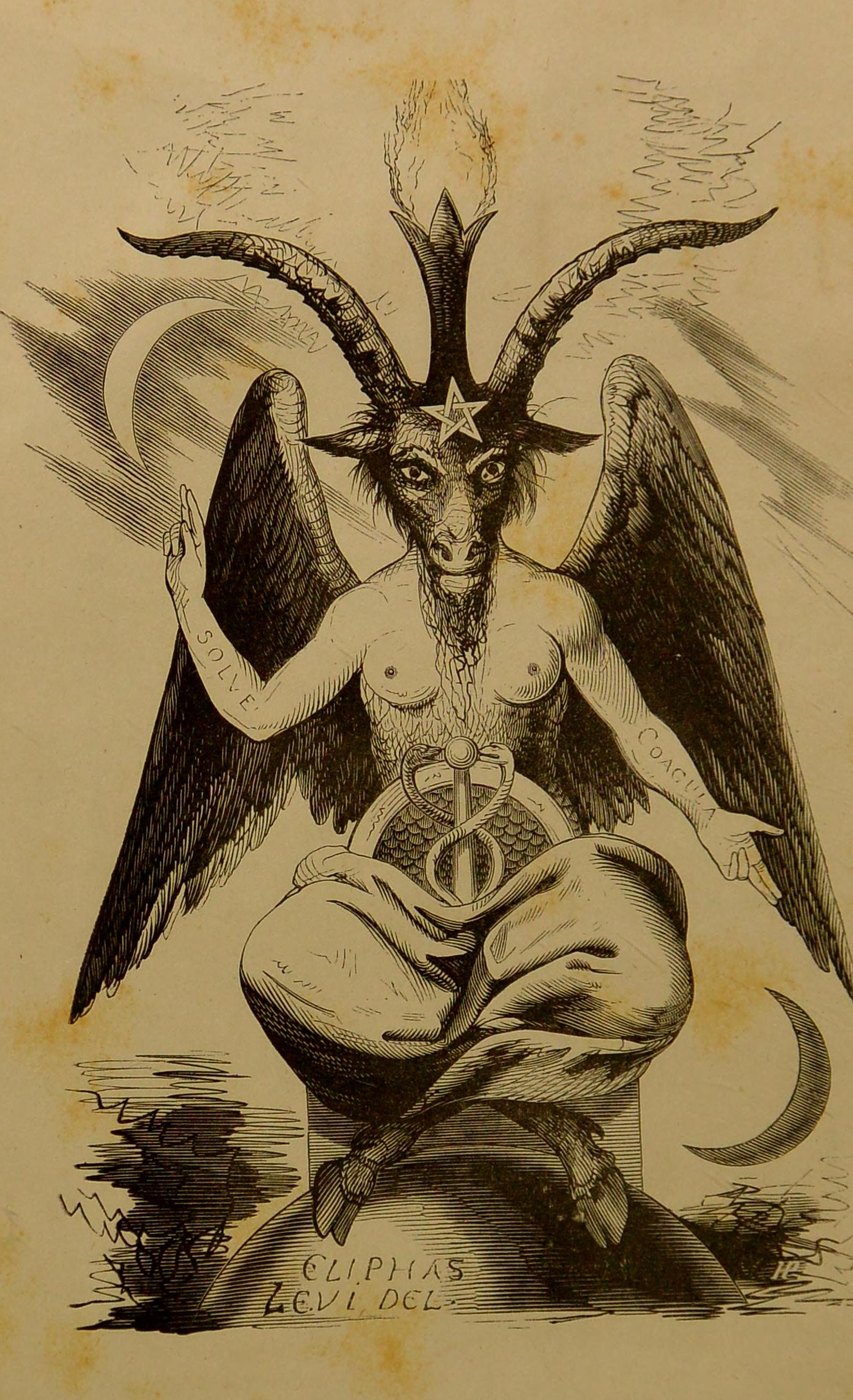
Eliphas Levi made the figure that modern pictures of the devil keep going back to, signed it, and then spent two pages explaining it part by part as a diagram of balance. In the same book he published the rule that a five pointed star with one point up is the sign of the Saviour and with two points up is Satan. Look at the goat's forehead.
Look at the goat's forehead. There is a five pointed star on it and it has one point at the top.
That detail decides more than anything else in the picture, because the man who drew the goat also wrote the rule for reading stars, and he wrote it in the same book.
The pentagram with two points in the ascendant represents Satan as the goat of the Sabbath; when one point is in the ascendant, it is the sign of the Saviour.
Eliphas Levi, in A. E. Waite's English of 1896, the Ritual, chapter V
 pentagram
Levi put the star the right way up on purpose, and he says so in the first sentence he writes about the figure, before anybody has had time to get it wrong. The correction is issued in advance and it did not work.
He drew it, signed it and then took it apart
Levi made the picture in 1856 for the frontispiece of his own book and put his name at the foot of it. A goat's head with a torch between the horns, a woman's breasts, feathered wings, a scaled belly, a caduceus where the sex would be, one arm raised and one lowered, lettered SOLVE and COAGULA. Then he wrote two pages naming every part of it in turn, and every single part turns out to be one half of a pair.
Every part of it is two things held level
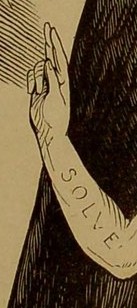
Start with the hands, because they are the clearest. One rises to a white moon and the other drops to a black one, and Levi names both: Chesed and Geburah, two of the ten sephiroth, mercy and severity. That gesture, he writes, expresses the perfect accord of mercy with justice. One hand each, so neither wins.
 hand
handThe arms themselves are a pair too. One is a woman's and one is a man's, and Levi does not leave you to work out where that came from. He admits the borrowing on the spot: the arms are taken from the androgyne of Heinrich Khunrath, whose attributes he had to combine with his goat's, because the two are one and the same symbol. Khunrath engraved that figure two and a half centuries earlier, and it is not among the ten Khunrath plates in this collection, so what you have is Levi's word for the debt rather than the object. The debt is the point. This picture arrives with a citation, and the man who drew it wrote the citation himself.
The lettering on the arms is the same idea in Latin. Solve and coagula, dissolve and bind, are the two motions of the alchemical work, and no alchemist ever thought you could do one without the other.
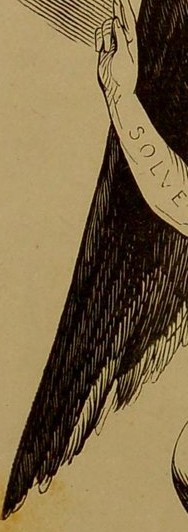
Then he climbs the body from the bottom. Scales for water, he writes, the circle above them for the atmosphere, feathers next for the volatile, and at the top two breasts and the androgyne arms, which he says stand for humanity. He calls the finished thing the sphinx of the occult sciences. Levi has built a ladder of the elements and put a person on the last rung, which makes a diagram of a hierarchy rather than a portrait of a demon.
 wings
wings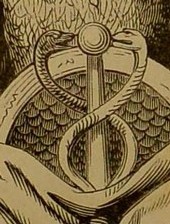 serpent
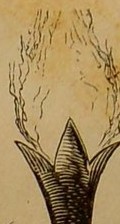 fire
fire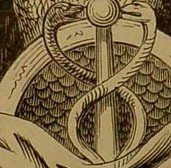 water
waterAnd the torch burning between the horns, which is the part that looks most like a devil and is glossed most carefully of all.
The torch of intelligence burning between its horns is the magical light of universal equilibrium; it is also the figure of the soul raised above matter while still holding to matter, as the flame holds to the torch.
Levi, 1856, on his own frontispiece
The head is ugly on purpose
Levi even explains the face, which is the part doing most of the work in the modern reading. The head is hideous, he writes, because it expresses horror of sin, and the material agent, being the only thing responsible, is the only thing that has to carry the penalty. He drew an ugly animal as a warning about ugliness. The figure is not being the sin. It is pulling a face at it.
And then he says it outright
The dread Baphomet henceforth, like all monstrous idols, enigmas of antique science and its dreams, is only an innocent and even pious hieroglyph.
Levi, in Waite's English, 1896
Innocent and even pious. That is the author of the image, in the book the image was made for, on the page facing it.
So how did it end up meaning the opposite
Not by conspiracy and not by anybody lying. A picture travels as a shape, and its caption does not travel with it. What a printer could lift off Levi's frontispiece was a goat with horns, wings and a torch. What no printer ever lifted was the paragraph explaining that the hands are mercy and severity, or the sentence admitting that the arms belong to Khunrath. The silhouette went round the world on its own and it reads, at a glance, as exactly the thing Levi was arguing against.
The star went with it and got turned over on the way. The modern convention puts a goat's head inside a pentagram with two points up and calls the result Baphomet, which is Levi's own published definition of Satan applied to Levi's own drawing of the opposite of Satan. Two rules from the same book, cancelled against each other by people using neither.
None of this makes the later uses wrong on their own terms. People took the picture and meant something by it, and what they meant became a real fact about the figure's life; a symbol belongs to whoever is using it. What Levi's two pages settle is narrower and harder to argue with. Anybody claiming this image was drawn as an image of Satan is contradicted by the man who drew it, in print, in the same volume, a few inches away.
And the star is still there. One point at the top, on every reprint for a hundred and seventy years, in plain view on the forehead of the most misread picture in the business.