The Hermaphrodite
the Rebis, the double thing, the androgyne
The conjunction completed. One body, two heads, and the end of the argument between sun and moon.
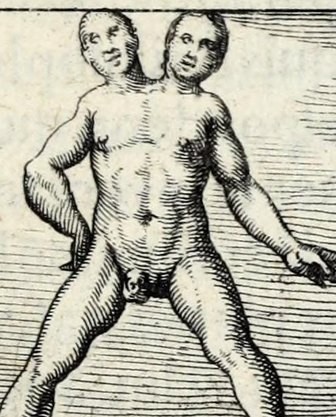
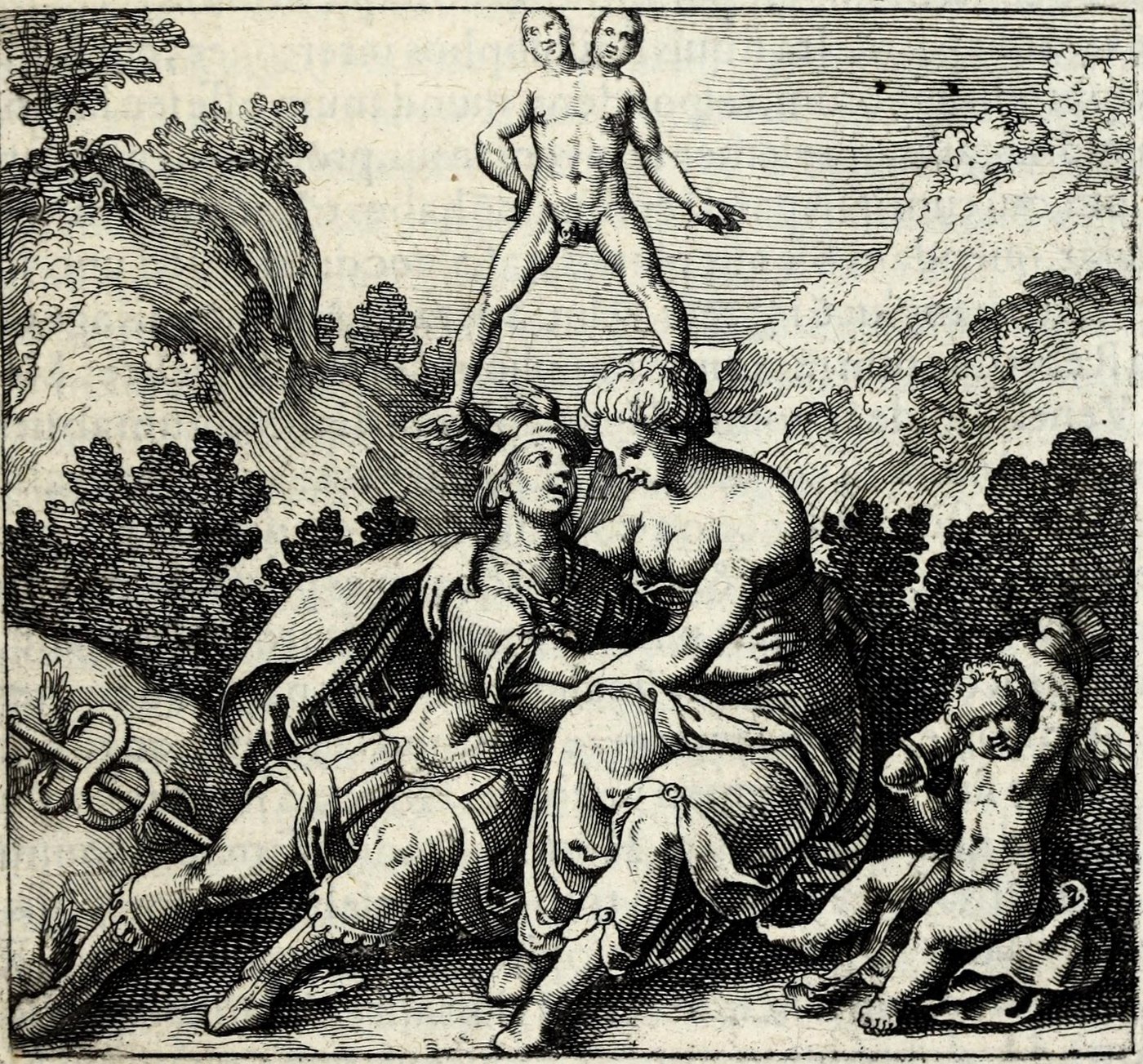
Four works here carry the hermaphrodite, and Maier's two emblems name it. The thirty-eighth shows a naked figure with two heads, a man's and a woman's, standing on a hilltop above Mercury and Venus embracing, and the epigram names it twice: “Rem geminam REBIS veteres dixere, quod uno / Corpore sit mas haec faeminaque, Androgyna”, the ancients called the twofold thing Rebis, because in one body it is male and female both, an androgyne; and “Natus enim binis in montibus HERMAPHRODITUS / Dicitur, Hermeti quem tulit alma Venus”, for the one born on two mountains is called Hermaphroditus, whom kindly Venus bore to Hermes.
The name is the recipe. Hermes and Aphrodite are the parents, and the child of their two mountains is one body of two sexes. Maier tells the reader not to be put off by it: “Ancipitem sexum ne spernas, nam tibi Regem / Mas idem, mulierque una eademque dabit”, do not despise the doubtful sex, for the same male, and the woman one and the same with him, will give you a king.
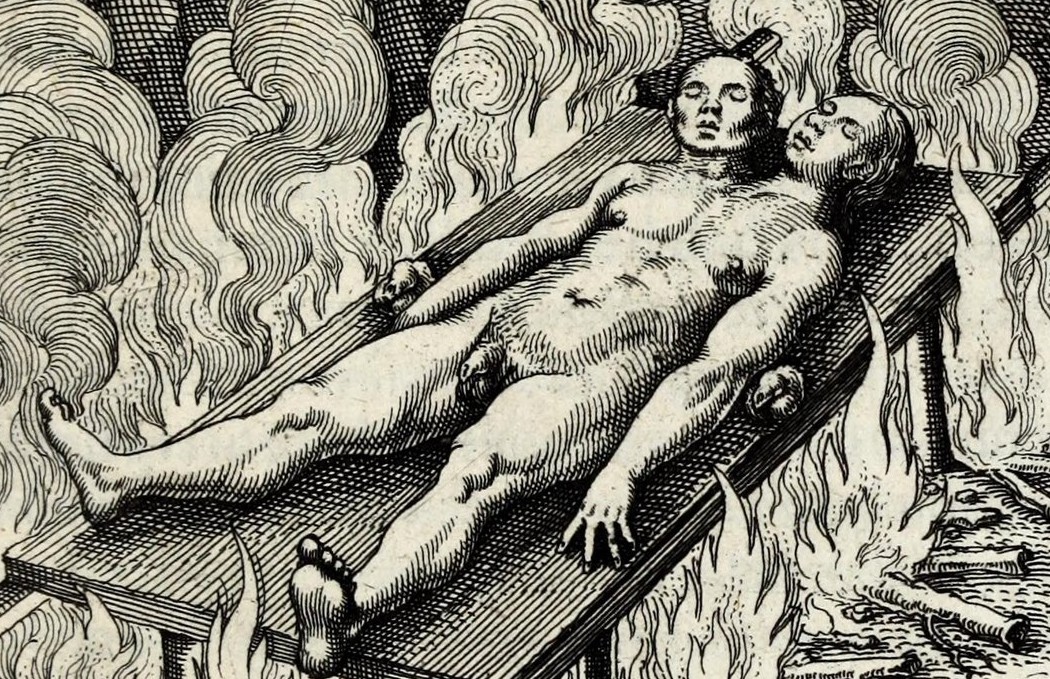
The thirty-third emblem shows the same body dead. “Ille biceps gemini sexus, en funeris instar / Apparet, postquam est humiditatis inops”, that two-headed thing of double sex, see, looks like a corpse once it is drained of moisture. It lies on a board over a fire, and the fire is the cure: “indiget igne, / Hunc illi praestes, & modo vita redit”, it needs fire; give it that, and life comes straight back. The conjunction, once made, has to be dried out and then revived.
So the hermaphrodite in this archive is a stage and not a marvel: the king and the queen of the earlier emblems made into one thing, first born on its mountain and then laid out over the fire. Maier's last couplet on the dead one is the doctrine in three clauses: “Omnis in igne latet lapidis vis, omnis in auro / Sulfuris, argento Mercurii vigor est”, all the power of the stone lies hidden in fire, all the power of sulphur in gold, and the strength of mercury is in silver.
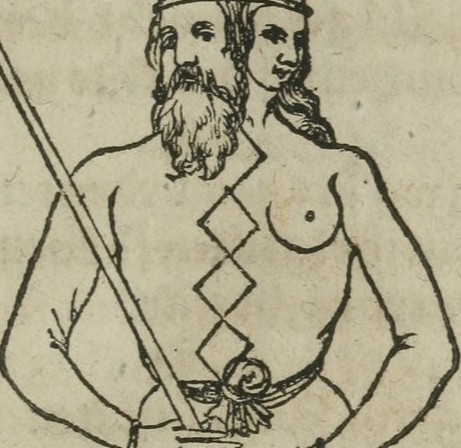
A Basel printer had the same body in print thirty-six years before Maier, in a book that names no author. Pandora, 1582, draws it three times in five pages and letters the drawings, so a reader looks each part up on the leaf facing it. The first plate stands one crowned body on a rock, a bearded head and a long-haired head growing out of one neck, a breast on one side and a flat plate on the other. The key opposite never says Rebis, never says androgyne, never says hermaphrodite. It says king and queen, and keeps them plural for three paragraphs: “Der könig vnd die königin sind großmechtig”, the king and the queen are great in power. Then it gives the reason two of them fit in one skin: “dann sie sind von einer wurtzel”, for they are of one root.
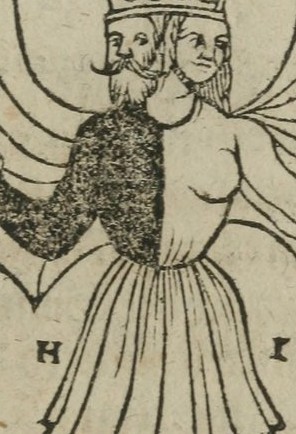
That clause does the archive a service Maier never did. Basel prints as the plain reason for the picture what this entry had been assembling out of the sequence of the emblems. Two pages on, the same book splits the body down the middle, hatches the man’s half solid black and leaves the woman’s bare, and its key names the two halves as clothing: “Durch das rot kleid / sol die Kunst werden bereit”, by the red garment shall the Art be made ready, and “Durch das weiß kleid / ist die Kunst gantz bereit”, by the white garment the Art stands wholly ready. One body wears the red and the white at the same moment.
Contested
Two authors now, and they reach for different words. Maier’s two emblems of 1618 say Rebis, androgyne and hermaphrodite. The Basel book of 1582 says king and queen, in German, and never once reaches for any of Maier’s three. Reading the one crowned body of Pandora as the same figure Maier draws is the archive’s own step, taken on the evidence of the picture.
Pandora’s title page carries no author’s name: it says only that a lover of the art rescued the book from ruin. The attributions to Hieronymus Reusner and to Franciscus Epimetheus come from library cataloguing, so they stay out of the maker line here. The Getty copy’s photograph of the key facing the second plate lies partly under the next leaf, and the archive prints from that page only the two lines it can read whole.
The Latin comes from the 1618 printing and the German from the 1582, both read off page images; the English throughout is the archive’s. The twenty woodcuts of the Rosarium philosophorum are still not held here.
Sources
- Michael Maier, Atalanta Fugiens, 1618: The mottoes and epigrams of the fifty emblems, Oppenheim 1618, read against the page images of the Getty Research Institute copy; the English is the archive's own and is marked as such on every record. Maier's discourses, in which he explains each emblem at length, are not yet transcribed.
- Pandora, das ist, Die edleste Gab Gottes, Pandora, das ist, Die edleste Gab Gottes, 1582: Printed at Basel, 1582, with no author named on the title page. The German keys facing the plates on printed pages 220, 222 and 224 were read against the page images of the Getty Research Institute copy; the English is the archive’s own and is marked as such on every record. The exposition running through the rest of the book is not yet transcribed.
On the same plate
Where it appears · 4
4 works in the archive carry the Hermaphrodite. First the 4 where it has been read, with the Hermaphrodite itself picked out.