The eye on the dollar bill was explained in 1782. The thirteen bricks were not.
Charles Thomson wrote down what every part of the Great Seal was for, and Congress voted on the explanation along with the picture. It says nothing about the courses of stone in the pyramid, because William Barton put those in a draft and Thomson struck the number out. A hundred years later the government's own adviser confirmed it in one line, and then it was decided not to cut the thing at all.
People count it. Thirteen stripes, thirteen stars, thirteen arrows, thirteen letters in ANNUIT COEPTIS, thirteen courses of stone climbing the pyramid, and from there a short walk to whatever you already believed. The counting is not the odd part. The odd part is that the man who designed the thing sat down and wrote out what every element was for, Congress voted on that explanation and adopted it along with the picture on 20 June 1782, and almost nobody has read it.
Nobody on the first committee could draw
In the summer of 1776 Congress handed the job to Benjamin Franklin, John Adams and Thomas Jefferson, and not one of them could draw. They went to see a painter. Adams wrote to Abigail on 14 August that Pierre Eugene Du Simitiere was a man “whose designs are very ingenious, and his drawings well executed”, and Du Simitiere gave the committee a crest: the Eye of Providence in a radiant triangle, its glory spreading over the shield and past the figures.
Hold a dollar while you read that. The eye arrives in 1776, six years before the seal exists, and it arrives on the front, hanging over a shield of the arms of the countries America was peopled from. There is no pyramid anywhere near it. Congress took the report, and did nothing at all for six years.
Barton counts the steps
The pyramid belongs to William Barton, who came in with the third committee in 1782 and who, as the Department of State drily puts it, had studied heraldry, which is more than the founders had. Barton drew a reverse and he was precise about it in a way the finished seal never is.
A Pyramid of thirteen Strata, (or Steps) Or. In the Zenith; an Eye, surrounded with a Glory, proper.
William Barton's device, reported to Congress 9 May 1782
Thirteen steps, counted, in the drawing and in the words. Barton put his own mottoes on it, Deo favente above and Perennis below, and he wrote his own gloss underneath: “The Pyramid signifies Strength & Duration.” That sentence is quoted everywhere as Thomson's. It is Barton's, and Thomson inherited it.
Congress was not satisfied. On 13 June it took the design away from the committee and gave it to Charles Thomson, the secretary of Congress, who had spent the revolution writing down what other men decided and had never designed anything.
Thomson takes the number out
Thomson had it finished in a week. He kept Barton's pyramid, Barton's eye and Barton's sentence about strength and duration, and he made two changes. The first is the one nobody notices.
The text Congress adopted describes that side in a few lines: a pyramid unfinished; in the zenith an eye in a triangle surrounded with a glory; Annuit Coeptis over the eye; the numerical letters MDCCLXXVI on the base; Novus Ordo Seclorum underneath. No number. Barton counted thirteen strata and Thomson wrote “a pyramid unfinished”, and that is the text that became law. Every brick anybody has ever counted on the back of a dollar was put there by an engraver working from a description that does not mention them.
His second change was the mottoes, and here he was showing off. Annuit Coeptis is a piece of audacibus adnue coeptis, favour my daring undertaking, which sits in the Aeneid at book nine, line 625, and again in the Georgics. Novus Ordo Seclorum is cut out of Magnus ab integro seclorum nascitur ordo, the great order of the ages is born anew, from the fourth eclogue. The Department of State printed both references in 1909. So the two Latin tags on the back of the dollar are a secretary of Congress editing Virgil, and he moved the grammar while he was at it: the poet asks a god to favour the undertaking, Thomson reports that he has.
What the report says the picture means
The pyramid signifies Strength and Duration: The Eye over it & the Motto allude to the many signal interpositions of providence in favour of the American cause. The date underneath is that of the Declaration of Independence and the words under it signify the beginning of the new American Aera, which commences from that date.
Charles Thomson, Remarks and Explanation, the report Congress adopted with the device, 1782
Fifty three words, and they cover the whole side. The eye is not watching anybody. It is being pointed at, by men who had just won a war they had no business winning and who wanted the record to show they knew it. Providence kept stepping in on the American side; this is the thank-you note. The date is the fourth of July and the motto under it says a new era started there.
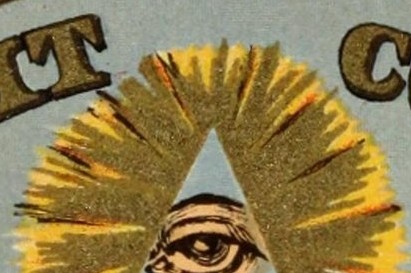 eye
eye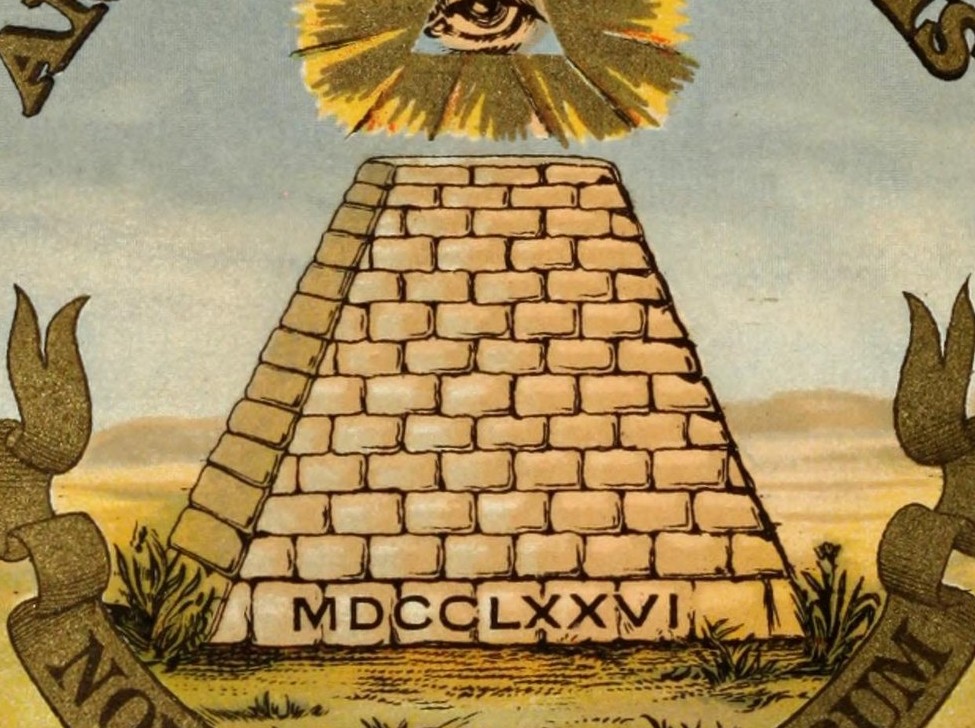 triangle
The side nobody searches is the side that answers
Turn the note over in your head to the right half, the eagle, and Thomson gets interesting. He does not explain the bird. He explains what is missing from underneath it.
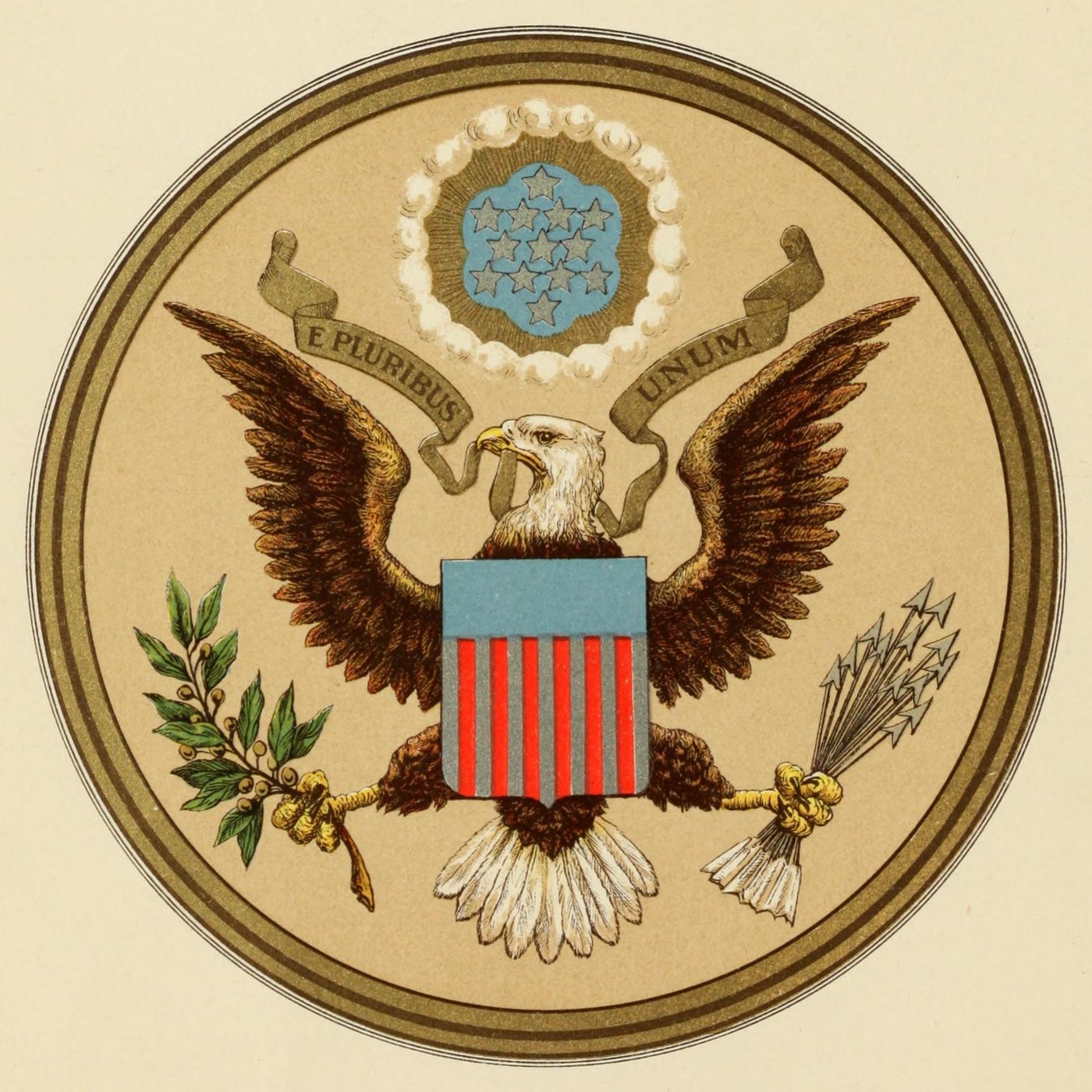
Thomson writes that the shield is borne on the eagle's breast “without any other supporters, to denote that the United States of America ought to rely on their own Virtue”. European arms are held up by lions, unicorns, angels and saints. This shield is held up by nothing, and the nothing is the whole argument. Thomson then reads the rest of it as a piece of engineering rather than a bestiary. The thirteen pales are the states, “all joined in one solid compact entire, supporting a Chief, which unites the whole & represents Congress”. The olive branch and the arrows are in one pair of feet because peace and war are the same body's business, “exclusively vested in Congress”, and exclusively is the word doing the work. The constellation over the head is “a new State taking its place and rank among other sovereign powers”.
Set the two sides together and they say one thing twice. A new state, standing on nothing but itself, at a beginning. Every element is about sovereignty and not one of them is about a secret.
Then the government counted the bricks
Here is the part that never gets told. The reverse was law from 1782 and for a century nobody cut it. In 1884 the State Department finally asked whether it should, and put the question to Charles Eliot Norton, professor of fine art at Harvard.
As to the reverse, the device adopted by Congress is practically incapable of effective treatment; it can hardly (however artistically treated by the designer) look otherwise than as a dull emblem of a masonic fraternity.
Charles Eliot Norton, advising the Department of State, 1884
The masonic reading of the dollar is not a modern invention and it did not start on the internet. It started with a Harvard art historian being rude about the design, on government paper, in 1884, and he meant it as an insult to the draughtsmanship. Justin Winsor, the librarian of Harvard, went further: the reverse was “both unintelligent and commonplace”, and, he asked, “if it can be kept in the dark as it seems to have been kept, why not keep it so?”
Norton was reaching for a comparison, and the archive holds the thing he was comparing it to. Jeremy Cross printed the All-Seeing Eye as a Masonic emblem in his monitor of 1826, forty four years after Congress adopted the seal, and the lecture beside it is not about power at all.
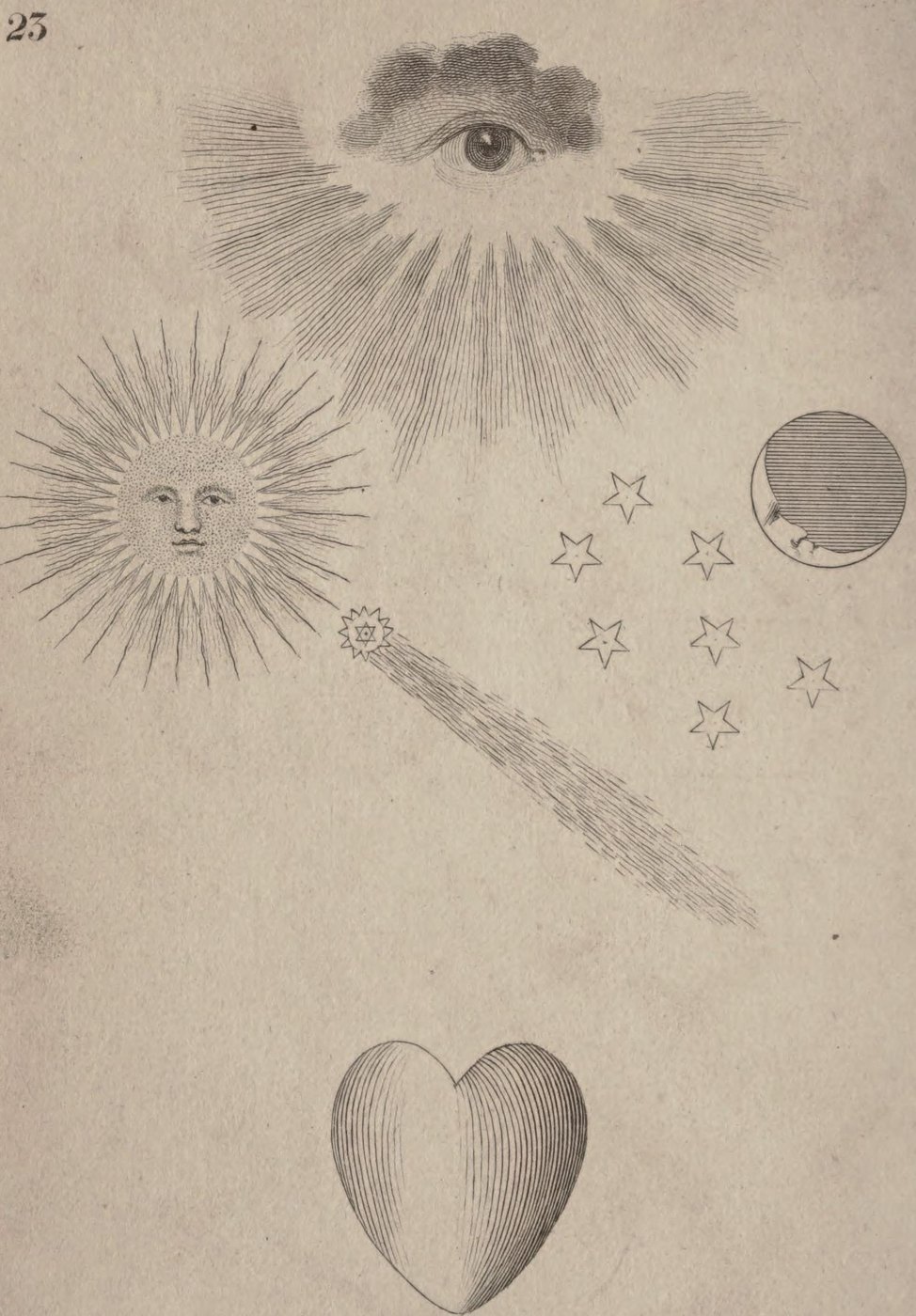
although our thoughts, words and actions, may be hidden from the eyes of men, yet that All-seeing Eye, whom the Sun, Moon and Stars obey, beholds them
Jeremy L. Cross, The True Masonic Chart, 1826 printing, page 39
Then, on 7 January 1885, an adviser named Champlin went through the Tiffany drawings clause by clause against the wording of the act, agreeing here, complaining there, calling the crest “bad, very bad, heraldically”, and arrived at the reverse.
Reverse. “A pyramid unfinished.” The law does not call for a pyramid of thirteen courses of stone.
Champlin's opinion on the Tiffany designs, 7 January 1885
One sentence, buried in a technical memorandum a hundred and forty years ago, answering the question the internet has been asking ever since. They did not cut it. No die of the reverse has ever been sunk, which means the picture on the back of the dollar is a careful drawing of an object that was never made.
Tiffany left the flowers off on purpose
The designers who drew the 1885 seal understood their audience better than Congress ever did. Explaining their olive branch, they said they had used the classical form and left the blossom off it, and their reason is the best sentence in the whole file.
the fruit (13) and the 13 leaves speak for themselves in a very clear and positive manner, but the flowers, while they suggest a growing and fruitful future, would as no special number could be used, give an uncertainty not desirable, as it would always be supposed that the particular number of flowers used must have a meaning while that meaning is not there.
Tiffany & Co. to the Department of State, on the designs of 1885
They knew. They knew that if they drew a number of anything, somebody would count it and build a meaning on top of it, and they removed the flowers so that nobody could. In the same letter they say the pyramid on the reverse was drawn to the scale of the great pyramid and turned so that the lit face is the east, which is where the Egypt in this picture actually comes from: not from 1782 and not from a lodge, but from a jewellery firm in New York making a drawing look right.
And having taken the flowers away, they drew thirteen fruit and thirteen leaves, and people have been counting those ever since.