The Emerald Tablet
Tabula Smaragdina, the Smaragdine Table, as above so below, Verba secretorum Hermetis
The short text the whole tradition quotes, and the one sentence of it everybody knows. Where it appears in this collection it is cut into something: a rock, a pair of obelisks, a tablet held out in a hand.
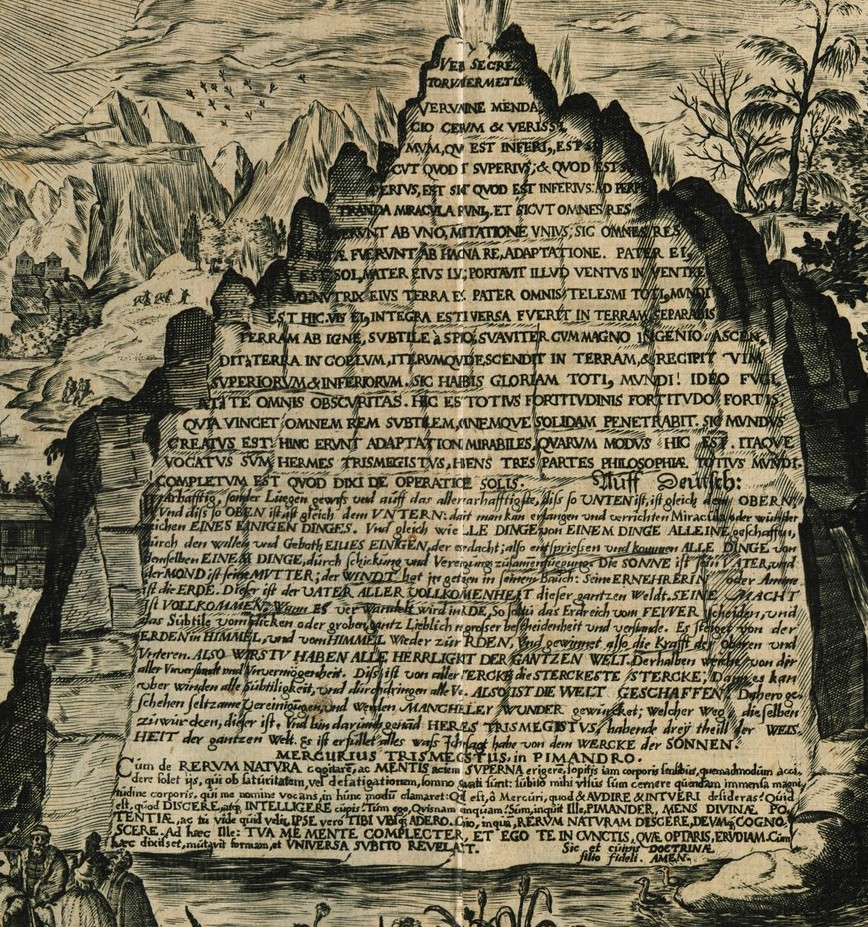
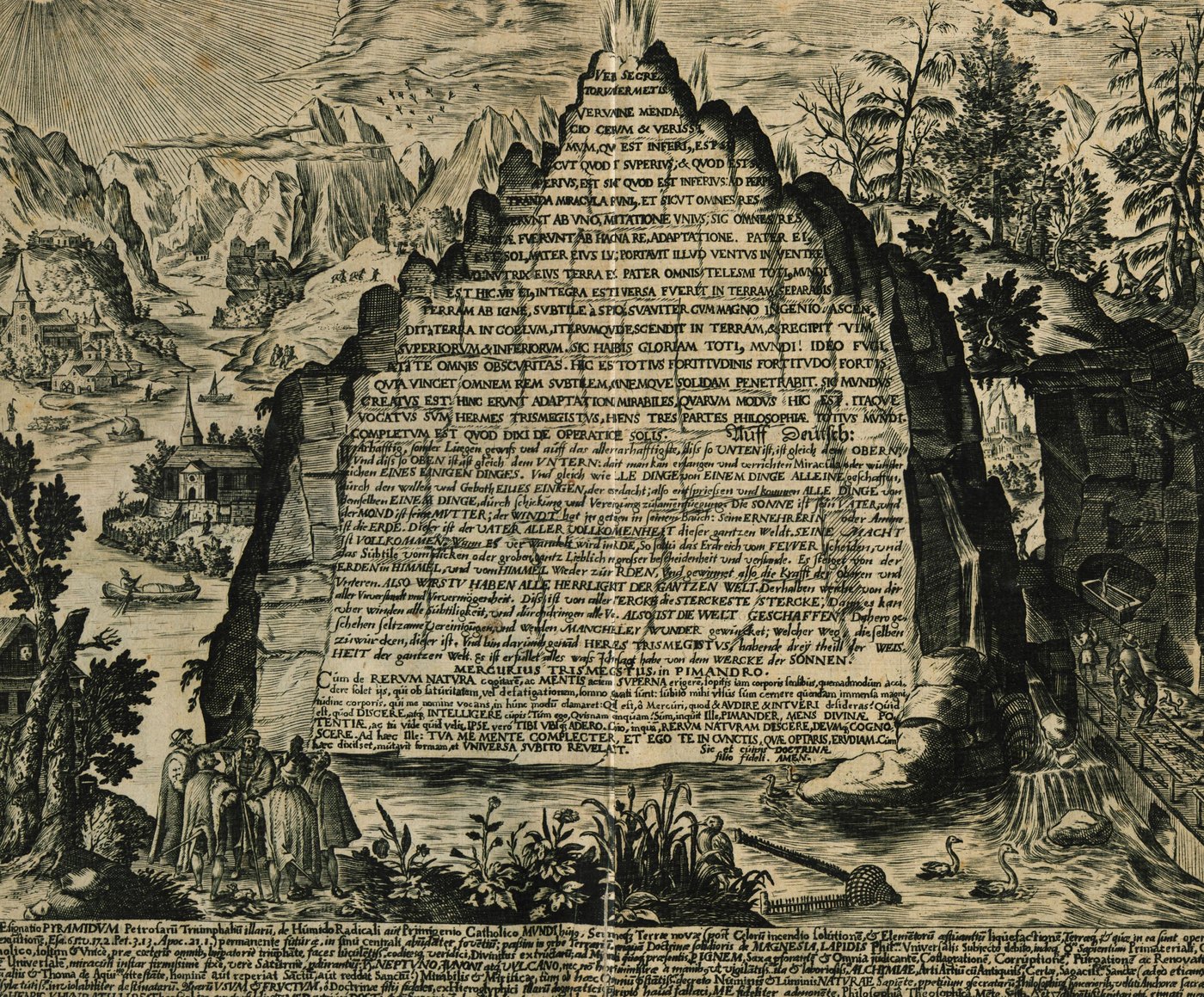
Khunrath carved it into a rock. His plate of the triumphal stone pyramids gives the text on the face of a pyramid with a flame at its apex, headed Verba secretorum Hermetis, the words of the secrets of Hermes, and it opens: Verum sine mendacio, certum et verissimum: quod est inferius, est sicut quod est superius; et quod est superius, est sicut quod est inferius, ad perpetranda miracula rei unius. True, without lying, certain and most true: what is below is as what is above, and what is above is as what is below, to accomplish the miracles of the one thing.
He puts the short form on his title page and splits it in two. Id quod inferius is cut in the ground under one obelisk and Sicut quod superius under the other, with Sol and Luna lettered beneath them, so a reader crossing the page assembles the sentence and is handed the two luminaries as the demonstration. The famous half of the tablet is used there as a caption to a picture rather than as a motto on a wall.
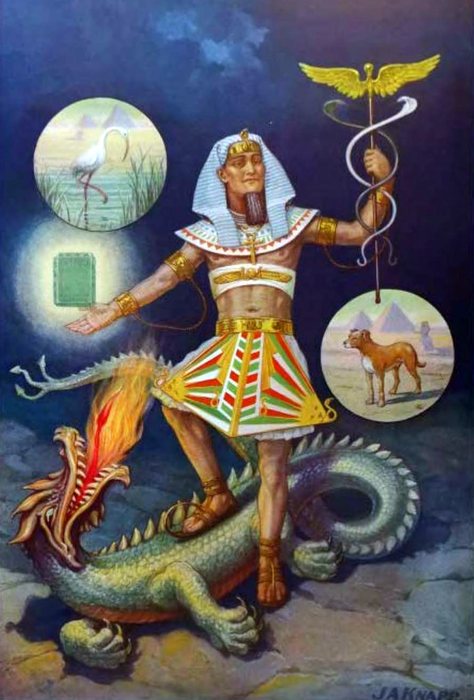
Knapp painted the object itself for Manly Hall in 1928, a green tablet held out over Hermes' left hand while his right holds the caduceus and his feet stand on the dragon. Hall's own line under it refuses every mystical reading of the thing: the Smaragdine, or Emerald Tablet, found in the valley of Ebron and generally accredited to Hermes, is in reality a chemical formula of a high and secret order. A recipe, in other words, and Hall says so in the same breath in which he calls it emerald.
Nobody in this collection reproduces the whole text except Khunrath, and nobody treats the sentence as a slogan. It is carved on the one plate, split across the feet of two pillars on another, and held out in a hand on a third, and in all three the picture is doing the arguing.
Contested
Sources
- Heinrich Khunrath, Amphitheatrum Sapientiae Aeternae, 1609: The text cut into the face of the pyramid on the plate of the triumphal stone pyramids, in Latin and in German, and the short form split between the two obelisks of the engraved title, read off the plates at the size of the archive's own images.
- Manly P. Hall, The Secret Teachings of All Ages, 1928: Hermetic Pharmacology, Chemistry and Therapeutics, on the Smaragdine Tablet as a chemical formula; and the plate of Hermes standing on Typhon, painted by J. Augustus Knapp.
On the same plate
Where it appears · 3
3 works in the archive carry the Emerald Tablet. First the 3 where it has been read, with the Emerald Tablet itself picked out.