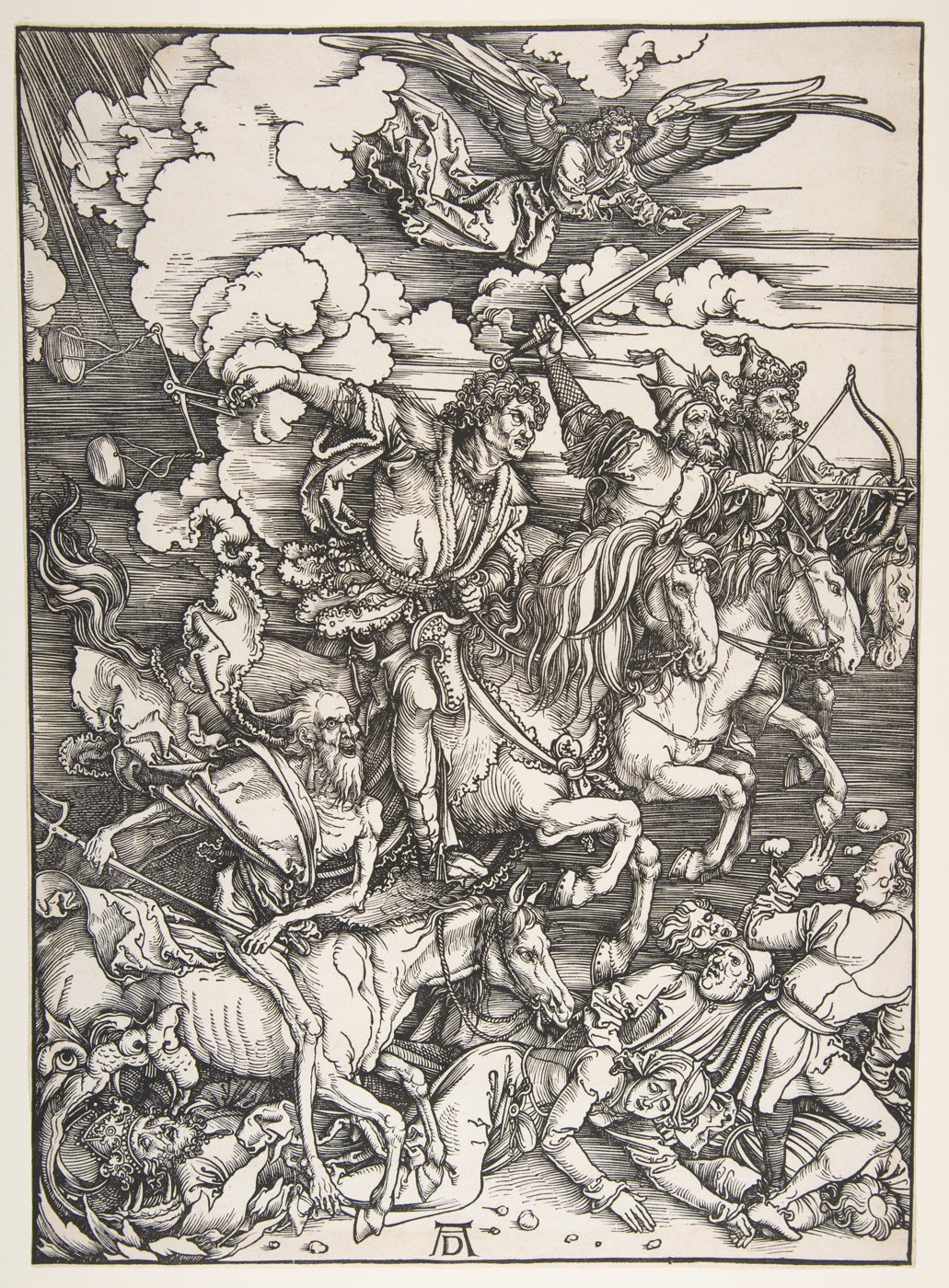
The Four Horsemen
The Horse as the central motif, with the Angel and the Wing in a secondary part. From The Apocalypse.
What is happening
Apocalypse 6:1 “And I saw that the Lamb had opened one of the seven seals: and I heard one of the four living creatures, as it were the voice of thunder, saying: Come and see.”
Apocalypse 6:8 “And power was given to him over the four parts of the earth, to kill with sword, with famine and with death and with the beasts of the earth.”
Key · 2 motifs
Tap a motif on the picture, or a line below. Its note opens under the line, with the reading its author gave it.
- Primary motif
- Secondary motifs · 1
The picture
Death, Famine, War and Conquest ride down the people; an angel above; from the Apocalypse of 1498, by eye. By eye
The reading
The picture read whole, in the archive's words, from the sources quoted on the marks. Read on, and the picture follows: the motif under discussion keeps its colour.
Dürer printed the Apocalypse in 1498 and it made his name. What he did to this chapter is visible in one glance: he made the four riders a single charge. The chapter releases them one at a time, seal by seal: a white horse, a red, a black, a pale. Dürer sends them all at once, diagonally down the page from the upper right, so that the horses' legs and the riders' weapons make a single wave that breaks on the people underneath.
The order is the chapter's, read from the back of the charge to the front. Highest and furthest is the bowman, and there was a crown given him; Dürer gives him the crown and the drawn bow. Next the rider with the raised sword, to whom it was given that he should take peace from the earth. Then the rider with the pair of scales swinging from his fist. Lowest and nearest, on a starved horse whose ribs show, an old man with a trident: and behold a pale horse, and he that sat upon him, his name was Death. The chapter adds that hell followed him, and at the lower left Dürer draws hell as a mouth in the ground with teeth, swallowing a man in a bishop's mitre. Under the hooves lie a woman, a peasant and a burgher. Power was given to him over the four parts of the earth, the text says, and the four parts are on the ground.
Above the riders, at the top right, an angel flies in with its arms open. There is no angel in the sixth chapter at this point; there is the Lamb, who opens the seals, and the four living creatures round the throne, one of whom says Come and see. The angel is Dürer's way of saying that the charge was sent, that it comes from heaven and not from the riders' own will. The archive records the figure as seen and does not give it a verse it does not have.
The print reads easily because everything in it is in the chapter, and the archive gives the chapter beside the marks. What the archive adds, and marks as its own, is only the observation that Dürer changed the tempo. John sees four separate horsemen; a reader of this woodcut sees one event, and that is why it is the one everyone remembers. The riders were understood in 1498 as conquest, war, famine and death, and the plague years of the 1490s gave the picture an audience that did not need the labels.
Decoded: every motif is marked, and each mark carries the reading its author gave it, quoted from the text, or says that it is observed on the picture and not read. The reading above is the archive's own, made from those sources and no others.
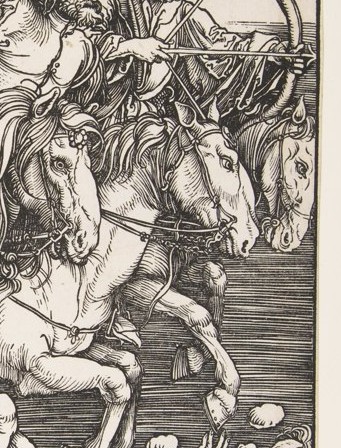
Almost never the subject. Read the rider, then read what the colour of the horse is doing.
In plain words Four horses ride down the page from the upper right, and the sixth chapter of the Apocalypse tells you who is on them: a bowman on a white horse who is given a crown, a swordsman on a red horse who takes peace from the earth, a rider with a pair of scales on a black horse, and Death on a pale horse with hell behind him. Dürer puts them in that order, top to bottom.
Apocalypse 6:2 “And I saw: and behold a white horse, and he that sat on him had a bow, and there was a crown given him, and he went forth conquering that he might conquer.”
Apocalypse 6:4 “And there went out another horse that was red. And to him that sat thereon, it was given that he should take peace from the earth: and that they should kill one another. And a great sword was given to him.”
Apocalypse 6:5 “And behold a black horse. And he that sat on him had a pair of scales in his hand.”
Apocalypse 6:8 “And behold a pale horse: and he that sat upon him, his name was Death. And hell followed him.”
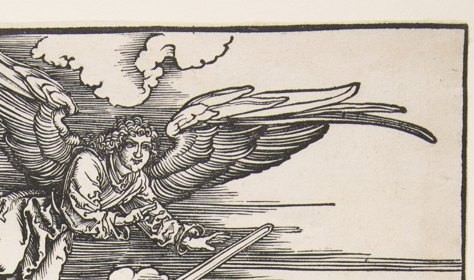
The mark of an errand rather than a nature. Note whether the wings are open, folded, or given to the figure by someone else.
In plain words An angel flies above the riders at the top right. The chapter has no angel here; it has the Lamb opening a seal and a living creature saying Come and see. The angel is Dürer's, and the archive records it as seen.
Symbolica The sixth chapter has no angel over the horsemen; Dürer put one there. Observed on the print, and left unread rather than guessed.
Also carrying the Horse
6 works. The symbol.
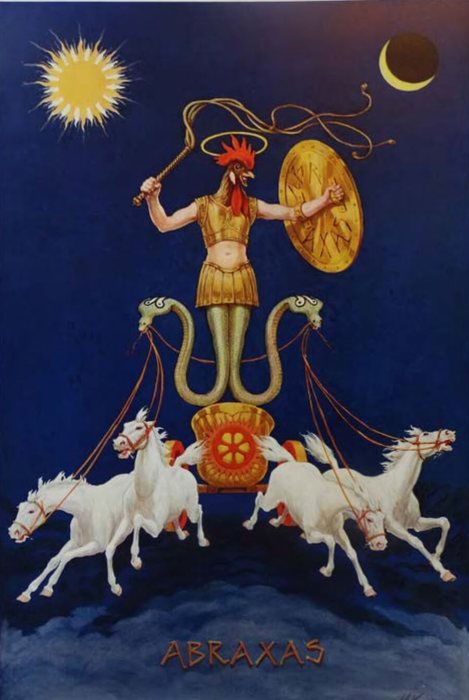
Where the detail is the subject
This is in the picture without being what it is about. Below, one work that is about it.
By the same hand
In the same series
Record
One symbol a week, decoded.
This picture is free at full size from its source, linked above. What an address gets is the Sunday letter: one picture, one symbol marked on it, what it meant and who said so, and the master files of the decoded plates as they are verified. Leave any time.
Free, one letter a week, unsubscribe in one click. How the address is used.
Scroll or pinch to zoom · drag to move · double-tap for 1:1 · 1031 by 1400 pixel web copy; the source file is linked under Record