When God appears, he appears as a hand
Across three centuries and four different books in this archive, the divine is drawn the same way: not a face, not a body, a hand coming out of a cloud. The reason is stated on one of the plates.
Look through this archive for God and you will not often find a face. What you find, again and again, in books that have nothing else in common, is a hand coming out of a cloud.
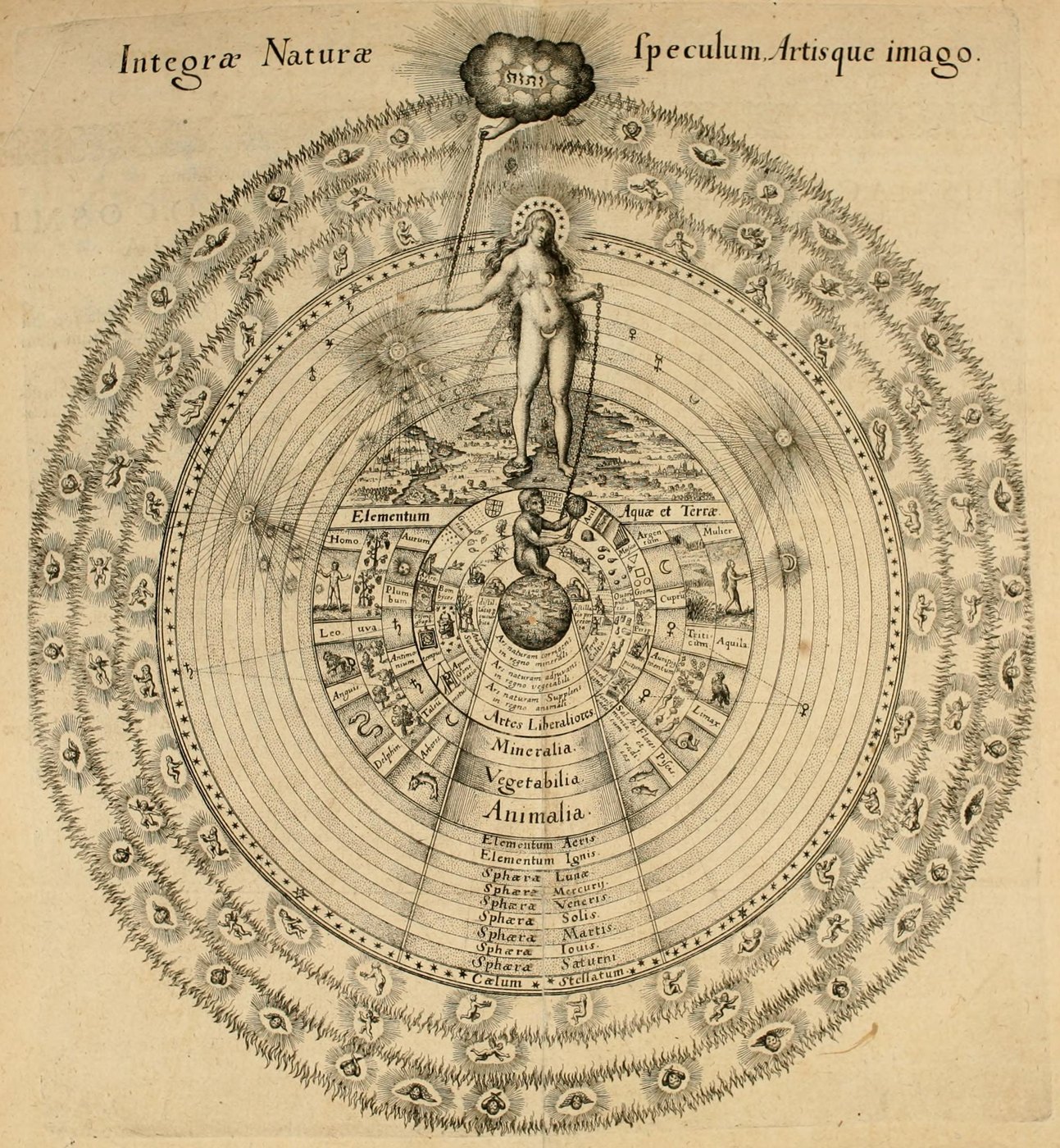
On Robert Fludd's mirror of nature, engraved in 1617, a cloud at the top of the wheel holds the four Hebrew letters of the Name, and out of the cloud a hand reaches down. It is holding a chain.
A hand issuing holds a chain, which, going down, is fastened on the hand of the universal mother.
J. B. Craven, 1902, describing the plate
A second chain runs from Nature's own hand to an ape sitting on the globe below her, so the whole picture is a hierarchy of grips: each thing is led by the one above it and leads the one beneath. Fludd is careful, in his explanation on page 8, about what Nature is in that arrangement.
Haec, inquam, Natura, non DEA, sed proxima Dei ministra.
Robert Fludd, 1617, the explanation of the emblem, page 8. This Nature, I say, is not a goddess but God's nearest servant.
Why a hand and not a face
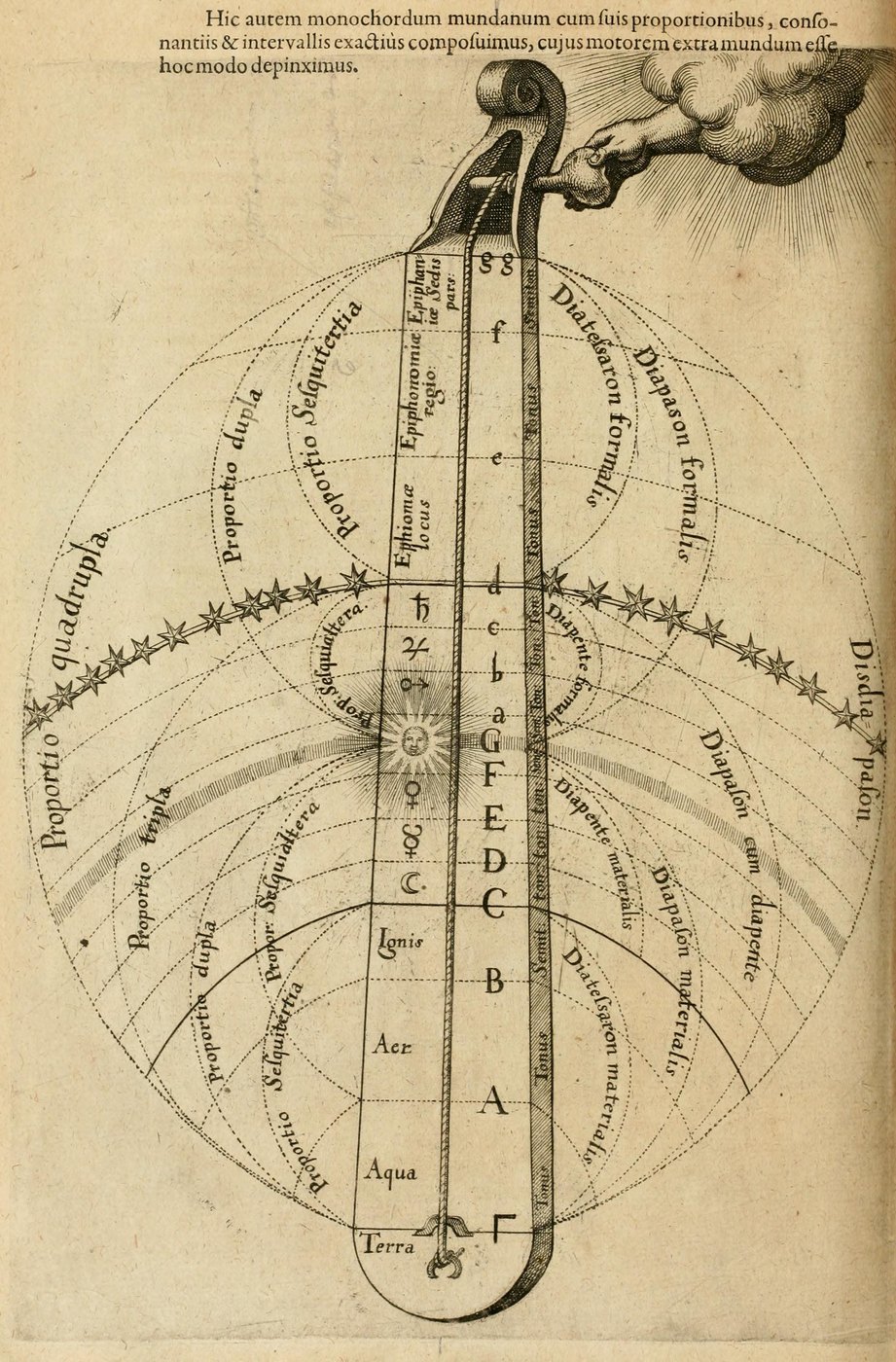
The reason is written on a different Fludd plate. On the world monochord the same hand comes out of the same cloud, this time to turn the tuning peg of a string stretched across the universe, and the caption says what the gesture is for.
Cujus motorem extra mundum esse hoc modo depinximus.
Robert Fludd, 1617. We have depicted its mover as being outside the world.
That is the whole argument in nine words. If you draw a face you have put a thing inside the picture, and the picture is the world. A hand entering from outside the frame is the only way to draw a cause that is not one of its own effects. The player is not one of the notes.
The same gesture, copied
A German manuscript of about 1735, which the Wellcome holds and this archive files as the Gemma, copies the gesture onto its tree of the knowledge of good and evil. A hand reaches down out of a cloud above the tree. Two more reach up from a winged globe below, to pick the fruit.
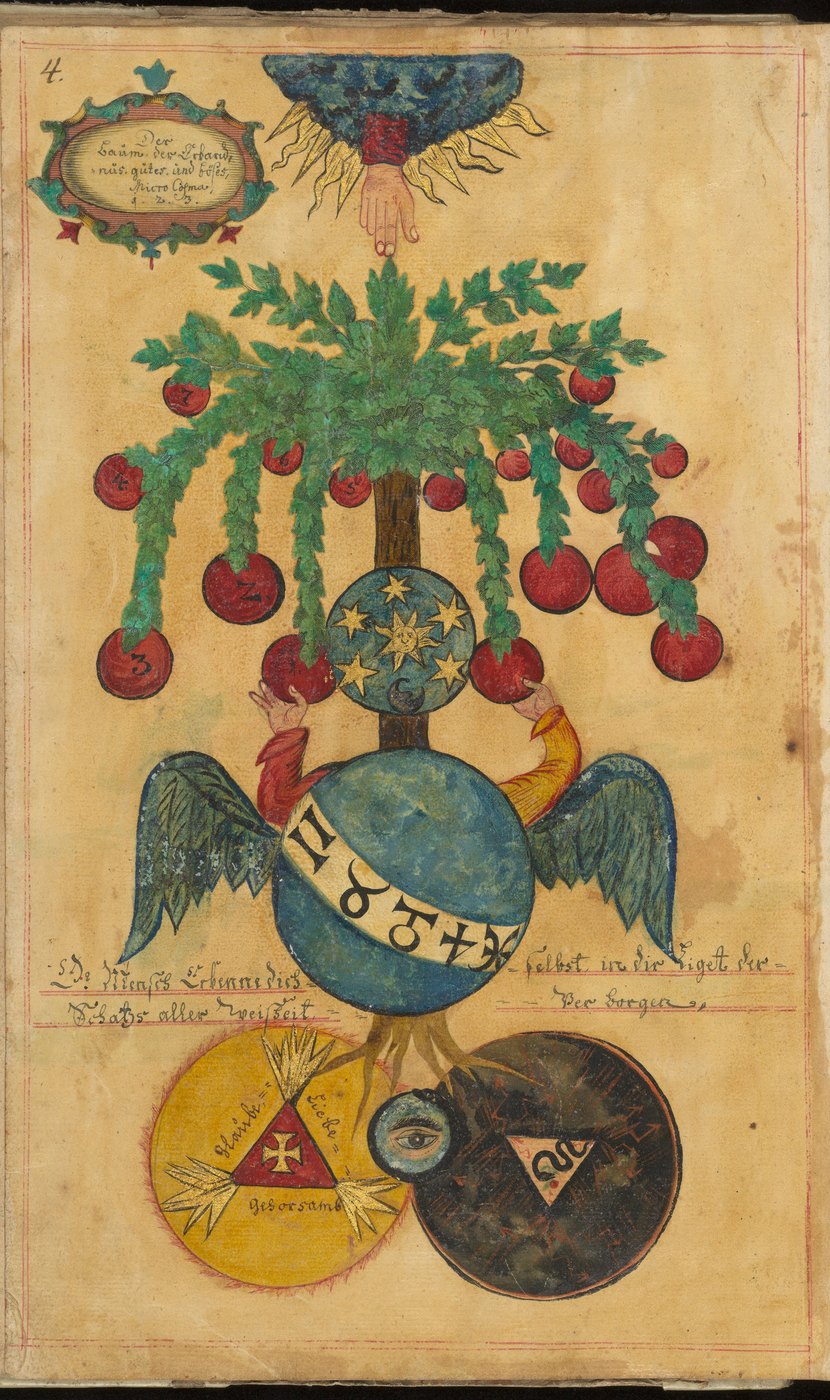
Above, the hand that planted. Below, the hands that take. Nothing in that page needs a caption, and its writer does not give it one.
Hands as grammar
By 1911 the gesture had become a language with tenses. A. E. Waite, writing the notes to the cards Pamela Colman Smith drew, expects a reader to conjugate hands rather than simply recognise them.
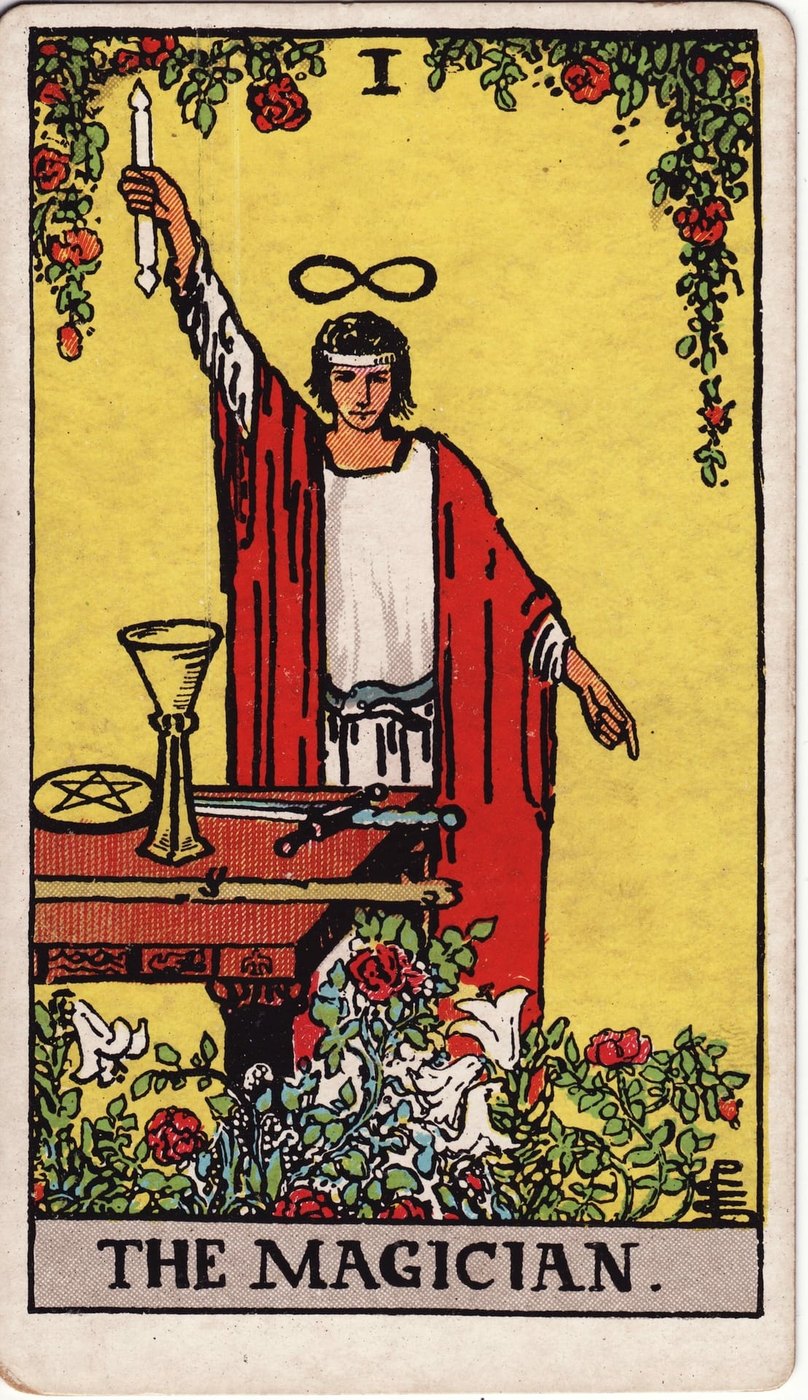
In the Magician's right hand is a wand raised towards heaven, while the left hand is pointing to the earth. This dual sign is known in very high grades of the Instituted Mysteries; it shews the descent of grace, virtue and light, drawn from things above and derived to things below.
A. E. Waite, 1911
The hand is no longer God's. It belongs to a man, and what it does is route something that came from elsewhere. Read that against Fludd's chain and the shape is identical: the power arrives from outside and is passed down a line. What changed in three hundred years is who is holding the middle of the chain.
Four makers, three centuries, one solution
Calling these four pictures one tradition handing a motif along would be easy and wrong. Fludd states his reason. The Gemma's writer states nothing. Waite is describing a card and is not thinking about Fludd at all. The narrower claim is the better one: four makers, in four books, across three centuries, reached for the same solution to the same problem, which is how to draw something that is not in the picture.
The hand is the answer they all found. Everything else about their systems disagrees.