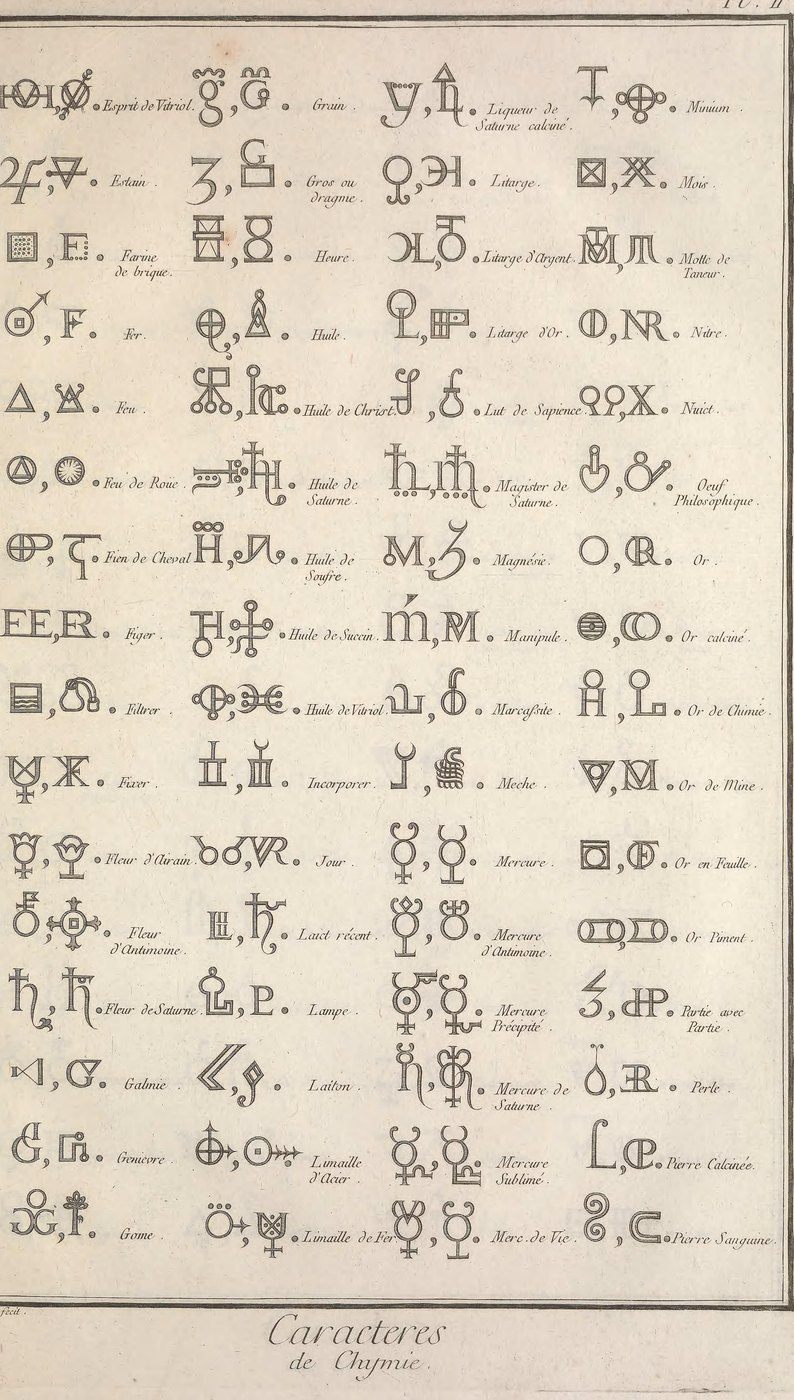
Caracteres de Chymie, plate II
The characters of chemistry as the central motif, filed under the Heavens, with the Sun and the Moon, Fire, and the Vessel in a secondary part. From Encyclopédie, Recueil de planches, 1763.
What is happening
The Encyclopédie, 1763 “La premiere de ces Planches montre le laboratoire chimique, avec la table des rapports, et les quatre suivantes, les caracteres chimiques, avec leur explication; les instrumens, fourneaux, vaisseaux, et autres ustensiles du laboratoire en remplissent seize autres. Il en reste trois, dont deux représentent les crystallisations des principaux sels; et la troisieme et derniere de toutes est un emblème des procédés du grand œuvre.”
Symbolica, 2026 The Encyclopédie's French, put into English here: The first of these plates shows the chemical laboratory, with the table of affinities, and the four following, the chemical characters, with their explanation; the instruments, furnaces, vessels and other utensils of the laboratory fill sixteen more. Three remain, of which two show the crystallisations of the principal salts, and the third and last of all is an emblem of the processes of the great work.
Key · 4 motifs
Tap a motif on the picture, or a line below. Its note opens under the line, with the reading its author gave it.
- Primary motif
- Secondary motifs · 3
The picture
A printed table of chemical signs in four columns, from esprit de vitriol to pierre sanguine, each substance or operation given two or more characters with its French name engraved beside them; the characters of chemistry as the central motif. By eye
The reading
The picture read whole, in the archive's words, from the sources quoted on the marks. Read on, and the picture follows: the motif under discussion keeps its colour.
This is a page from the great reference book of the eighteenth century, and it is a dictionary of signs. The chemistry section of the Encyclopédie's plates opens, its editors say, with the laboratory and the table of affinities, ‘and the four following, the chemical characters, with their explanation’. The explanation is the plate itself: ‘the name of the thing is beside the character that stands for it’. Read down the columns and you have the shorthand a chemist of 1763 was expected to know.
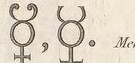
Most of the signs are older than chemistry. Iron is written with the sign of Mars, tin with Jupiter's, quicksilver with Mercury's, and the compounds of lead carry Saturn's sign, because the alchemists had given each of the seven metals the planet that ruled it, and the notation outlived the belief. By 1763 a working chemist wrote the sign of Mars for iron without thinking of a god; the Encyclopédie printed the sign because his books were full of it.
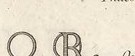
Gold is the sun, a circle with a point at its centre, and the plate gives it a second form, a monogram, as it gives most things two or three ways of being written. Then gold calcined, gold of chemistry, gold of the mine, gold in leaf, and or piment, orpiment, the golden paint that is a compound of arsenic. The variants are the point of the table: the same substance turns up in different books under different marks, and here they are set side by side.
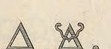
Fire is a triangle with its point up, and on the first plate of the set water is the same triangle turned over. Beside it the feu de roue, the fire of the wheel, the fiercest degree of heat the old furnaces knew, is a triangle ringed with flame. The furnace itself, the athanor, and the philosophical egg, the sealed glass in which the work was done, are on these plates too, written like anything else.
One line gives the table away. Between nuit, night, and or, gold, sits the oeuf philosophique, the philosophical egg, the alchemists' vessel, with two signs of its own. The encyclopaedists had to print alchemy's vocabulary because the books their readers would open used it, and they closed the chemistry plates, they say, with ‘an emblem of the processes of the great work’. Within a generation chemists were writing names instead of marks, and this page became what it is in the archive: a key to the old books.
Decoded: every motif is marked, and each mark carries the reading its author gave it, quoted from the text, or says that it is observed on the picture and not read. The reading above is the archive's own, made from those sources and no others.
A diagram of everything, drawn so that a person can be found inside it. Note where the human figure stands in the scheme.
In plain words Iron carries the sign of Mars, tin the sign of Jupiter, quicksilver the sign of Mercury, and the salts of lead the sign of Saturn. The alchemists gave each metal the planet that ruled it, and the chemists of 1763 kept the shorthand long after they had stopped believing the astrology in it.
The plate, 1763 “Fer. Estain. Mercure. Fleur de Saturne.”
The Encyclopédie, 1763 “Le nom de la chose est à côté du caractere qui la désigne.”
Symbolica, 2026 The Encyclopédie's French, put into English here: The name of the thing is beside the character that stands for it.
Gold, the perfected metal, and the illuminated intellect. The most overloaded symbol in the tradition.
In plain words Gold is written with the sun's sign, a circle with a point at its centre, and beside it a monogram that meant the same thing. The rows below spell out gold's varieties, calcined, of chemistry, of the mine, in leaf, each with its own mark.
The plate, 1763 “Or. Or calciné. Or de Chimie. Or de Mine. Or en Feuille.”
The Encyclopédie, 1763 “Le nom de la chose est à côté du caractere qui la désigne.”
A count, a catastrophe, or the visible part of something that has no body. Note whether the flames are arranged in a number, breaking something, or standing where a figure would be.
In plain words A plain triangle is fire, and a triangle with a ring of flame round it is the fiercest fire of the furnace, the feu de roue. On the first plate of the set, water is the same triangle turned upside down.
The plate, 1763 “Feu. Feu de Roüe.”
The Encyclopédie, 1763 “Le nom de la chose est à côté du caractere qui la désigne.”
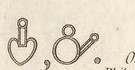
Never the subject. What is inside it is.
In plain words The philosophical egg is the sealed glass vessel in which alchemists kept their matter through the whole work, named for its shape and for what was supposed to hatch. The Encyclopédie writes it between night and gold without comment, one term among hundreds.
The plate, 1763 “Oeuf Philosophique.”
The Encyclopédie, 1763 “Le nom de la chose est à côté du caractere qui la désigne.”
Also carrying the Heavens
61 works carry it. The 6 where it is the central motif are here. The symbol.
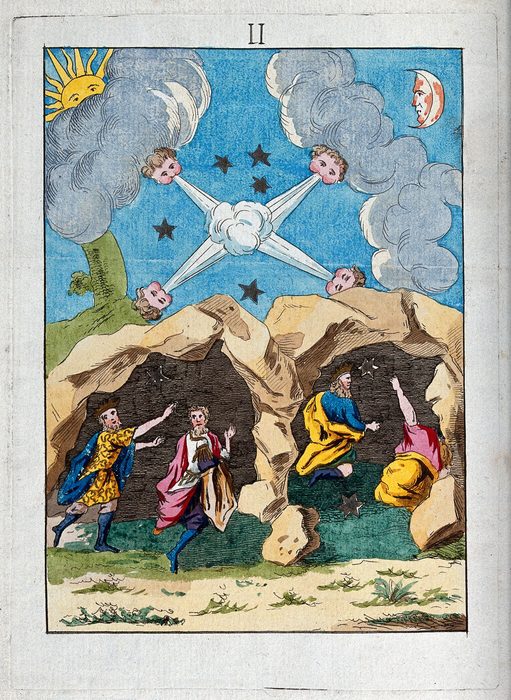
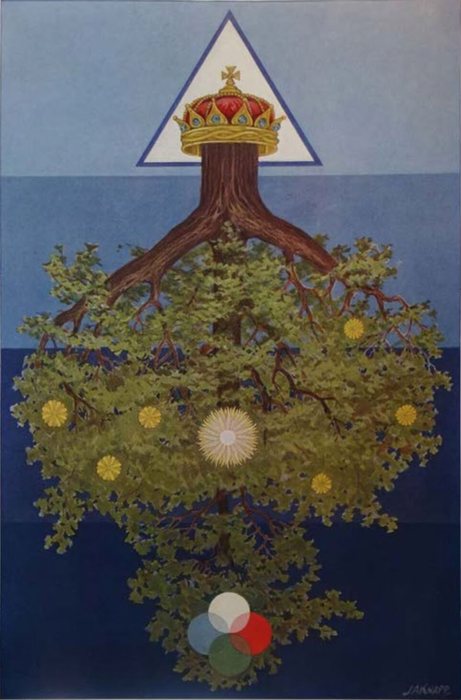
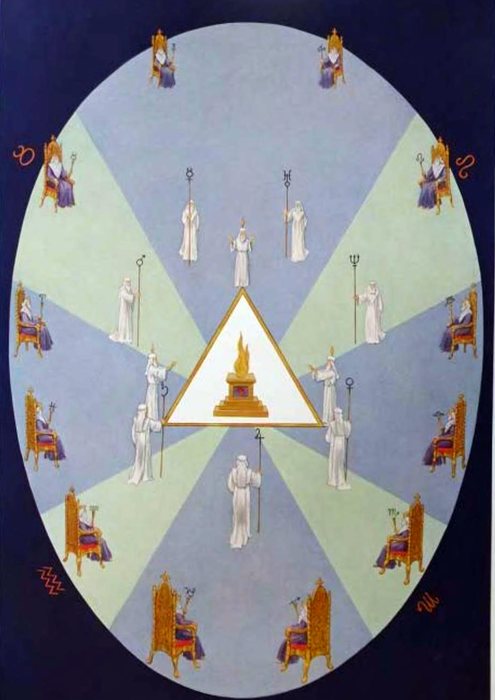
Where the detail is the subject
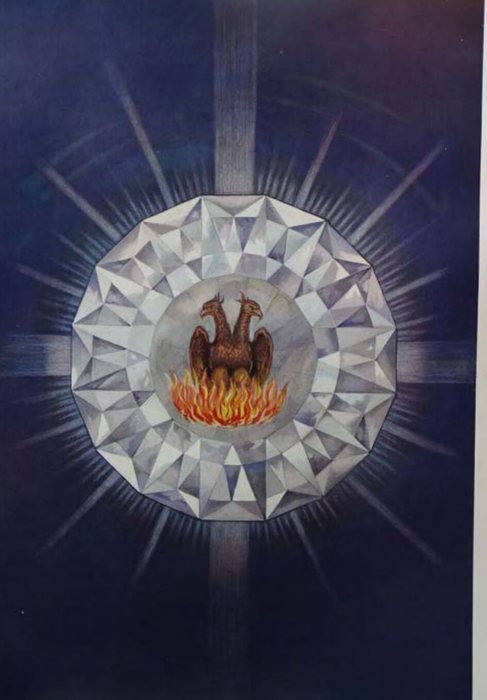
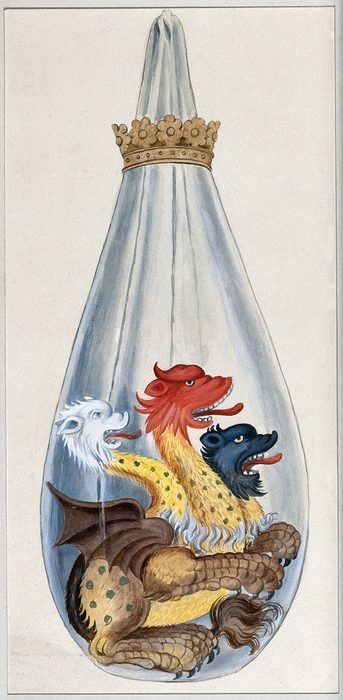
the Sun and the Moon · Fire · the Vessel
Each of these is in the picture without being what it is about. Below, one work that is about each.
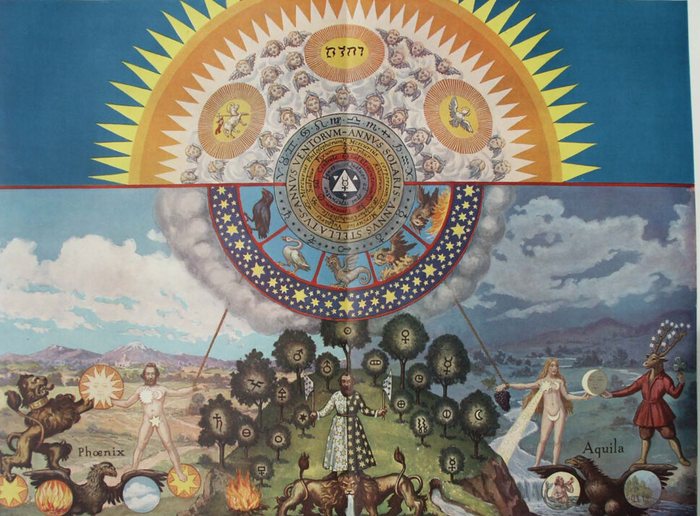
Record
One symbol a week, decoded.
This picture is free at full size from its source, linked above. What an address gets is the Sunday letter: one picture, one symbol marked on it, what it meant and who said so, and the master files of the decoded plates as they are verified. Leave any time.
Free, one letter a week, unsubscribe in one click. How the address is used.
Scroll or pinch to zoom · drag to move · double-tap for 1:1 · 794 by 1400 pixel web copy; the source file is linked under Record