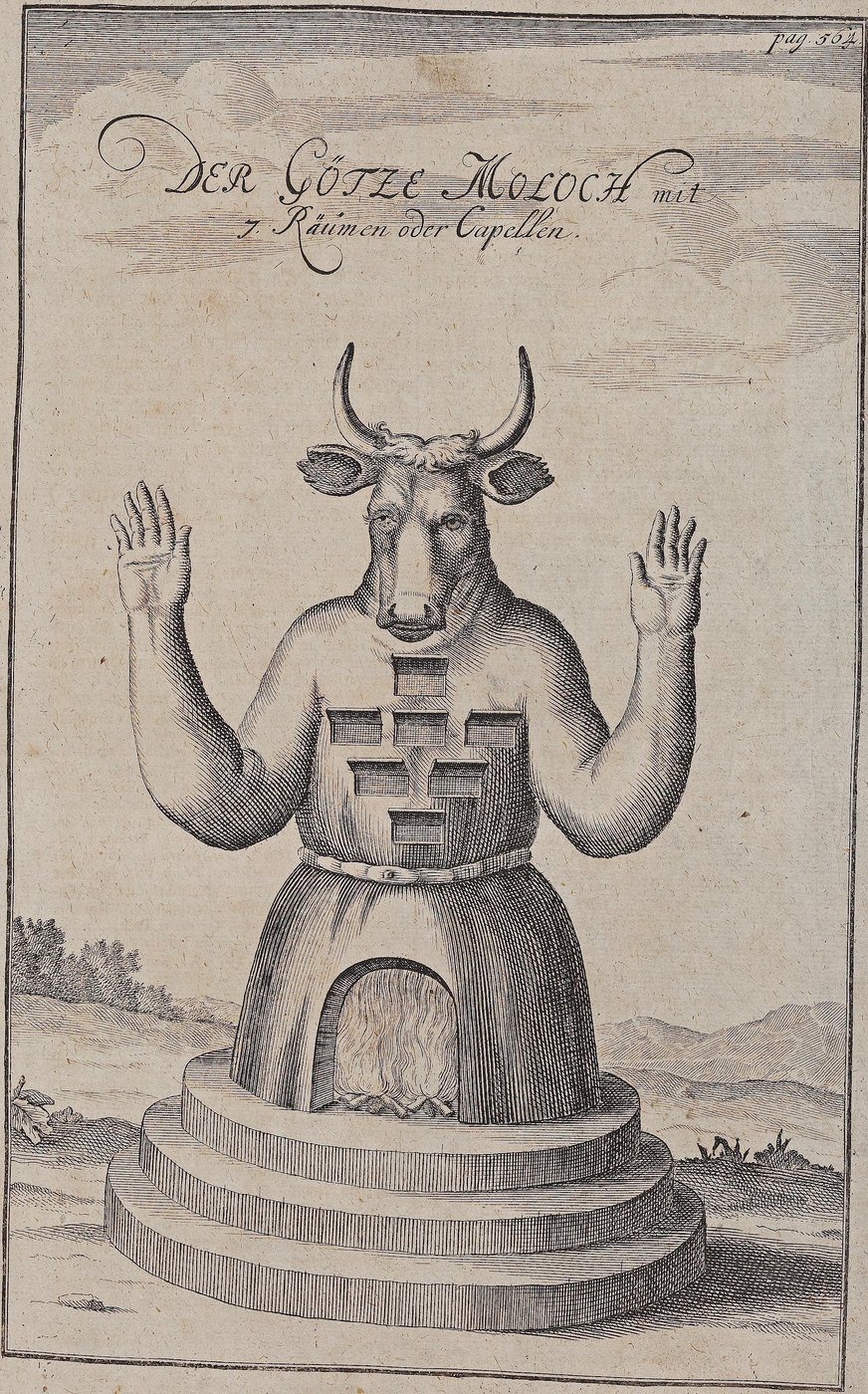
The idol Moloch with seven chambers
The idol Moloch as the central motif, filed under the Demon and the Monster, with the Vessel, Fire and the Hand in a secondary part. From Lund's Jewish Antiquities.
What is happening
Johann Lund, 1738 “ist mit zierlichen, und zur Erleuterung helffenden Figuren; wie auch aller Capitel wohlgefasseten Summarien und Marginalien, vermittelst dreyzehen-jähriger Mühe und Forschung sorgsamst ausgearbeitet”
Symbolica Lund died before the book reached this form. The title page has Heinrich Muhlius supplying the preliminary report and Johann Christoph Wolf revising the whole and adding the notes, working from the author's own manuscript. The Moloch pages carry both hands: Lund's text, and an editor's footnote pointing at where the picture came from.
Johann Lund, 1738 “Beym Braunio siehet man l. c. p. 476. zwene Abrisse, deren einer mit unsers Auctoris seinem überein kömmt. Noch einen andern findet man in Hr. Conr. Mel Antiquar. sacr. p. 22.”
Key · 4 motifs
Tap a motif on the picture, or a line below. Its note opens under the line, with the reading its author gave it.
- Primary motif
- Secondary motifs · 3
The picture
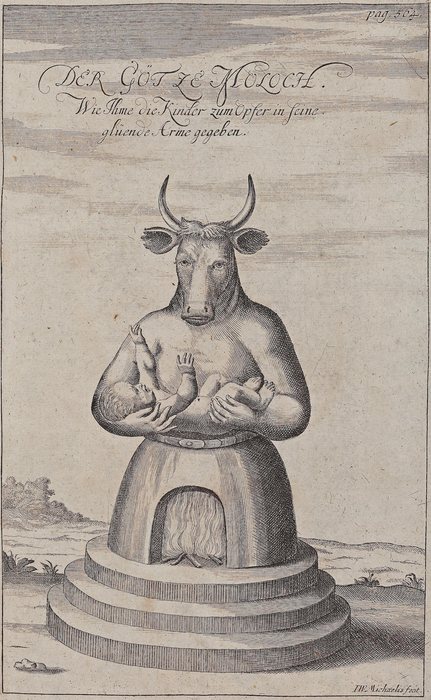
A bull-headed figure on a human body, both hands raised open at shoulder height, seven small chambers cut into the chest in a stepped pattern, a belt at the waist, the body below it a domed furnace with faggots burning in its arched mouth, the whole standing on three circular steps in open country. By eye
The reading
The picture read whole, in the archive's words, from the sources quoted on the marks. Read on, and the picture follows: the motif under discussion keeps its colour.
Count the boxes on his chest. Seven of them, cut in a stepped pattern, one at the throat, three across the breast, two below those and one at the belly, and the sky above his horns counts them for the reader in a copperplate hand: “DER GÖTZE MOLOCH mit 7. Räumen oder Capellen.”
Johann Lund printed the arithmetic on the page this leaf faces. Some, he writes, make the image hollow within and divide it into seven chambers, or seven little chapels, and then he walks his reader up them: a bird in the first, a sheep or a lamb in the second, a ram in the third, a calf in the fourth, a young bullock in the fifth, an ox in the sixth, and in the seventh a human being. Other writers order the ladder differently, starting at fine wheat flour and ending, in Lund's German, at “Menschen-Kinder”. Either way the chambers are a tariff, and the tariff climbs.
Look at what heats them. Lund lights the fire under the image and inside it, and nothing goes into a chamber until the whole idol glows, so the engraver has opened an arch in the belly, laid faggots across it and let the flame stand up behind them. The furnace is the body. The three steps below are a plinth for a stove.
The hands are the part Lund is most exact about, and they are the part the engraver followed most closely. Brass or copper, he says, with an ox's or a calf's head, and hands held out “wie man die Hände ausstrecket, wenn man etwas empfangen wil”, the way a man puts his hands out when he wants to receive something. Both palms are open, empty, level with the shoulders. Waiting.
That head is not scripture's. Moloch is named in Leviticus, in the Third and Fourth Books of Kings and in Jeremias, and every passage commands, forbids or condemns without once saying what he looked like. Leviticus forbids giving seed to be consecrated to him. Solomon builds him a temple on the hill facing Jerusalem. Josias breaks up Topheth so that nobody can pass a son or a daughter through fire there. No head, no hands, no chambers. Nothing an engraver could work from.
Kircher's name reached this plate through two other men. Search it and the sheet comes back as Athanasius Kircher's; Lund is where that starts, and he is more careful than the caption that now travels with the picture. Two lines under the seventh chamber he writes: “Den Abriß dieses Götzens wollen wir hiebey setzen, wie selbigen aus dem Kirchero, Gregorius Michaëlis und Hofm. vorstellen.” We will set the drawing of this idol here, as Gregorius Michaelis and Hofmann present it out of Kircher. Everything turns on that preposition.
Kircher gives Moloch a chapter and prints no picture in it. Oedipus Aegyptiacus, tome I, Rome, Vitale Mascardi, 1652: Caput XV, Moloch Idolum Ammonitarum, four pages of Latin and Hebrew running from 328 to 331 with no engraving on any of them. His own index, at page 450, promises a statue and gives a page for it, Statua Moloch. 330. Page 330 repeats the words in the margin, and beside them stands a sentence.
It is worth reading against the plate. A hollow statue in the valley of Tophet, and into its hands and its lap, “iam igne plenum & incandescentem”, already full of fire and glowing hot, they laid the boys to be burned, while the priests made a din with drums and other instruments. Hands and lap. No chambers, no tariff, no bird in the first room. The sheet that carries Kircher's name is the one that does not follow the sentence his index points to, and the sheet on the next leaf, which nobody credits to anybody, is the one that does.
Decoded: every motif is marked, and each mark carries the reading its author gave it, quoted from the text, or says that it is observed on the picture and not read. The reading above is the archive's own, made from those sources and no others.
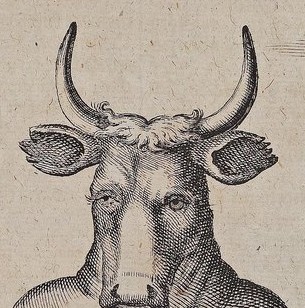
Almost always a composite and almost always subordinate. Note what it is made of and whether it is bound.
In plain words Lund gives the head its metal and its animal in one clause and hedges neither. Scripture, which names Moloch five times, gives it nothing at all.
Johann Lund, 1738 “Sie geben vor, es sey ein eherner oder kupfferner Götze gewesen, mit einem Ochsen- oder Kalbes-Kopffe und ausgestreckten Händen, wie man die Hände ausstrecket, wenn man etwas empfangen wil.”
3 Kings 11:7 “Then Solomon built a temple for Chamos, the idol of Moab, on the hill that is over against Jerusalem, and for Moloch, the idol of the children of Ammon.”
Symbolica Leviticus 18:21 and 20:2 to 5, 3 Kings 11:7, 4 Kings 23:10 and Jeremias 32:35 are the passages that name him. Every one of them commands, forbids or condemns, and not one describes him. The head, the hands and the chambers all come from somewhere else.
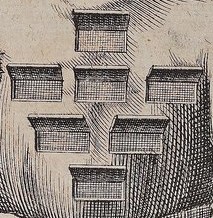
Never the subject. What is inside it is.
In plain words Count them on the plate and the caption's number comes out right. Lund gives the seven a running order, and a second order that other writers give, and both of them climb.
Johann Lund, 1738 “Denn etliche machen dieses Bild inwendig hohl, und theilens in sieben Räume, oder sieben kleine Capelchen ab.”
Johann Lund, 1738 “Wer einen Vogel habe opffern wollen, habe, nachdem unter diesem Bilde inwendig Feuer angemacht, und es gantz glüend geworden, denselben in den ersten Raum gelegt: in dem andern Raum sey ein Schaaf oder Lamm geopffert worden, im dritten ein Widder, im vierdten ein Kalb, im fünften ein junger Farr, im sechsten ein Ochs, im siebenden ein Mensch.”
Johann Lund, 1738 “Andere erzehlen es etwas anders, daß im ersten Raum Semmelmehl geopffert worden, im andern Vögel, im dritten Schaafe oder Lämmer, im vierdten Widder, im fünften Kälber, im sechsten Ochsen, und im siebenden Menschen-Kinder.”
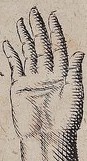
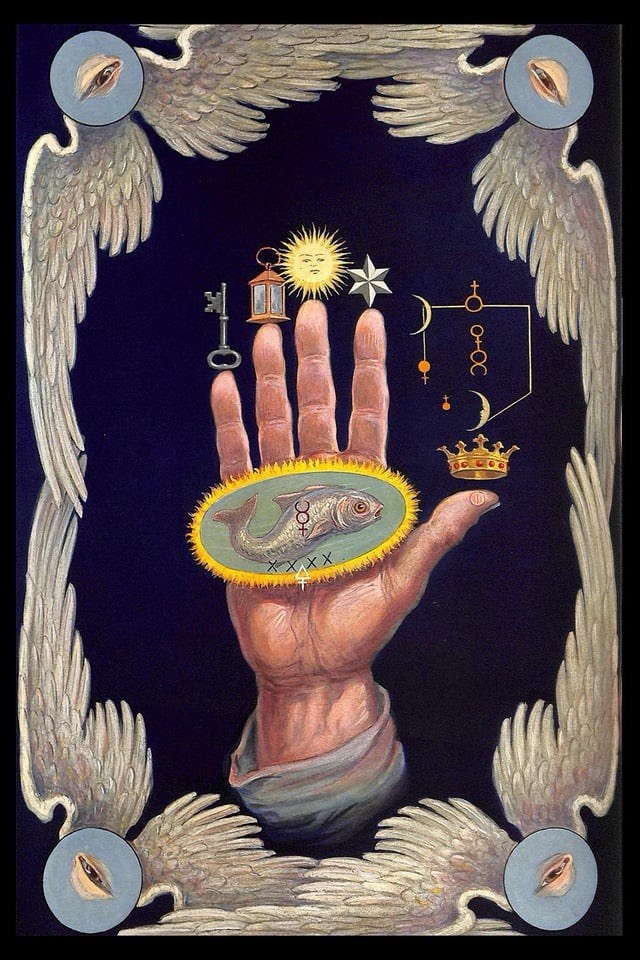
The hand as a sign in itself: what it holds, where it points, which fingers are raised. On the Hand of the Mysteries every finger carries a sign of its own.
In plain words The engraver did not invent the gesture. Lund tells him what the hands are doing, and the comparison he reaches for is a man expecting to be handed something.
Johann Lund, 1738 “wie man die Hände ausstrecket, wenn man etwas empfangen wil”
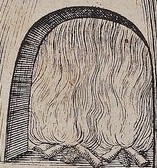
A count, a catastrophe, or the visible part of something that has no body. Note whether the flames are arranged in a number, breaking something, or standing where a figure would be.
In plain words The fire is not lit under the idol on a hearth. Lund puts it inside the hollow image and waits for the whole thing to glow, which is why the engraver opened the belly and left the flame showing.
Johann Lund, 1738 “nachdem unter diesem Bilde inwendig Feuer angemacht, und es gantz glüend geworden”
4 Kings 23:10 “And he defiled Topheth, which is in the valley of the son of Ennom: that no man should consecrate there his son, or his daughter, through fire, to Moloch.”
Athanasius Kircher, 1652 “in cuius manus & sinum iam igne plenum & incandescentem pueros concremandos imponebant”
Also carrying the Demon and the Monster
23 works carry it. The 6 where it is the central motif are here. The symbol.
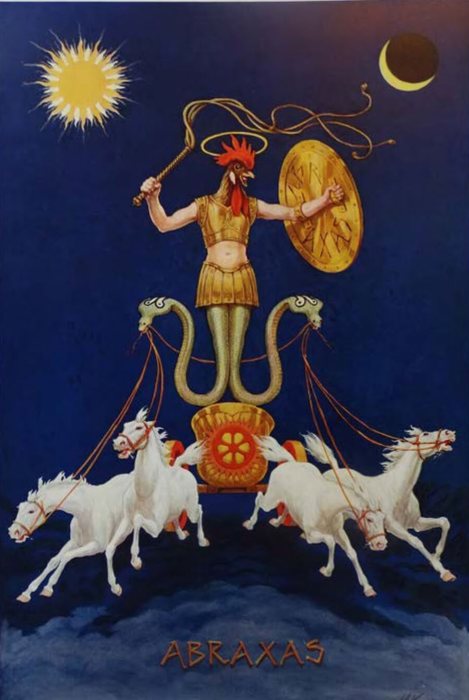 Abraxas, a Gnostic Pantheos
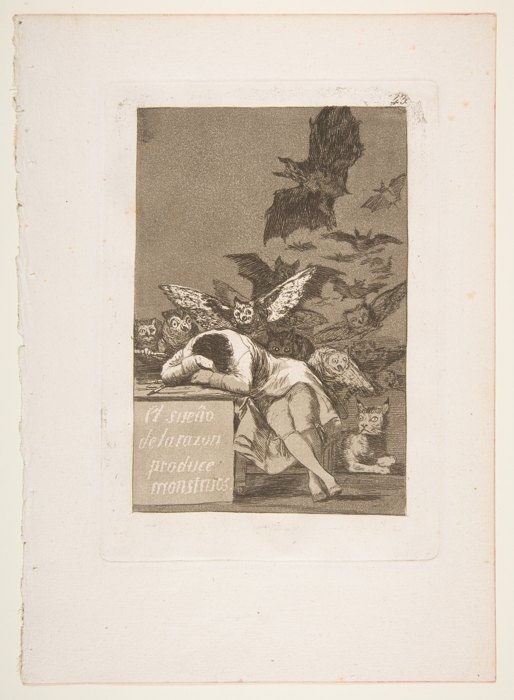 The Sleep of Reason Produces Monsters
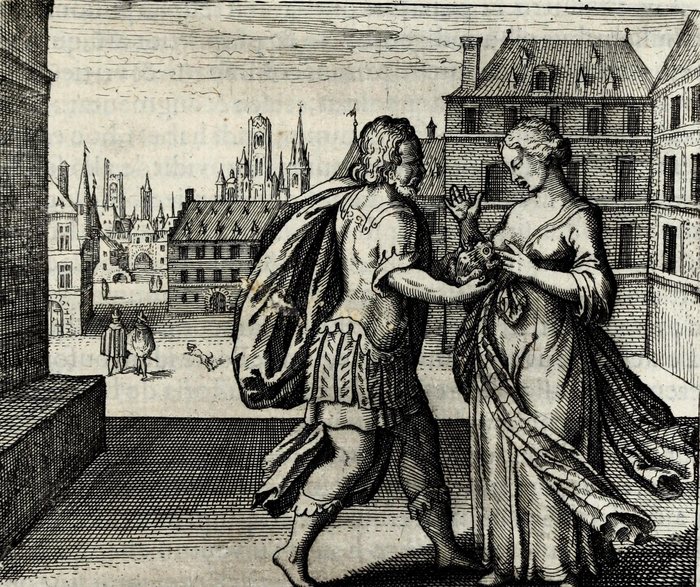 Appone mulieri super mammas bufonem, ut ablactet eum, & moriatur mulier, sitque bufo grossus de lacte
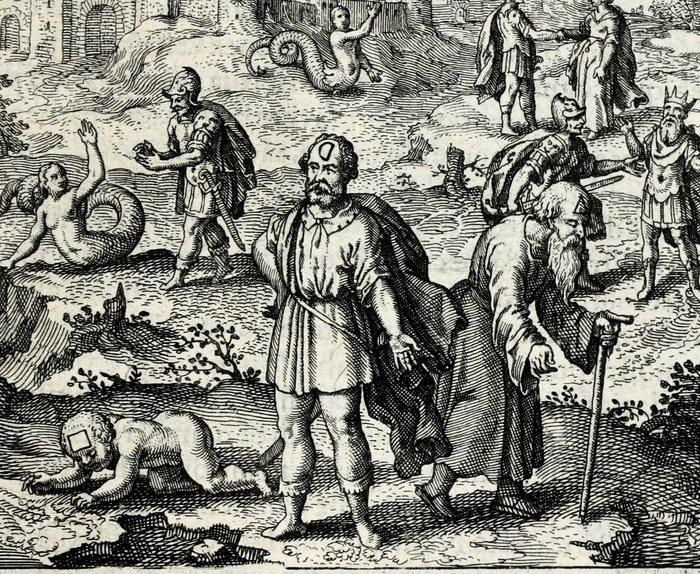 Oedypus Sphynge superata & trucidato Lajo patre matrem ducit in uxorem
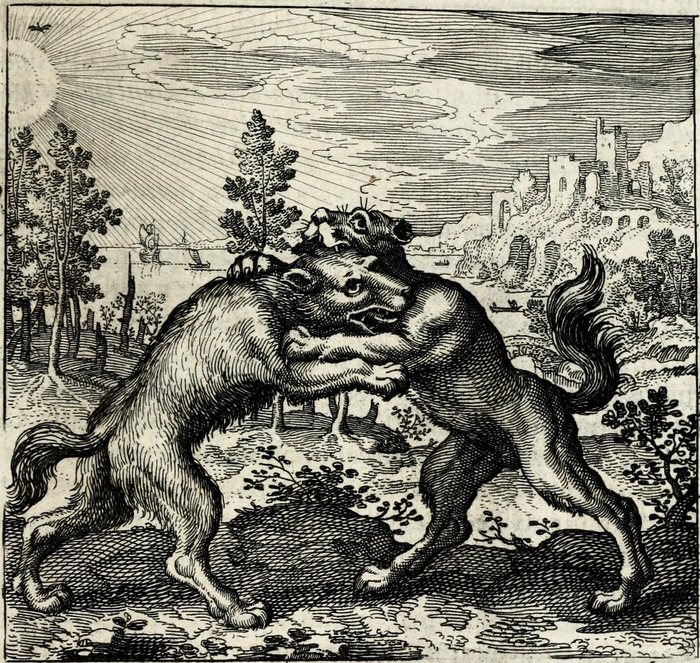 Lupus ab Oriente & Canis ab Occidente venientes se invicem momorderunt
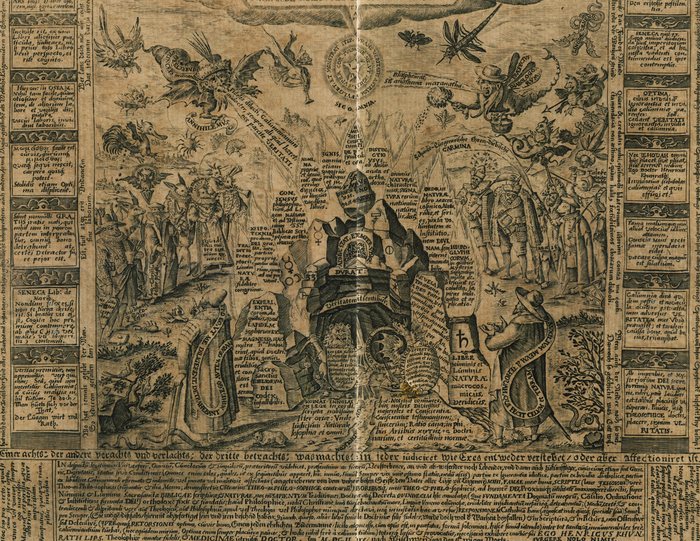 Against the slanderers, by right of retort
Where the detail is the subject
the Vessel · Fire · the Hand
Each of these is in the picture without being what it is about. Below, one work that is about each.
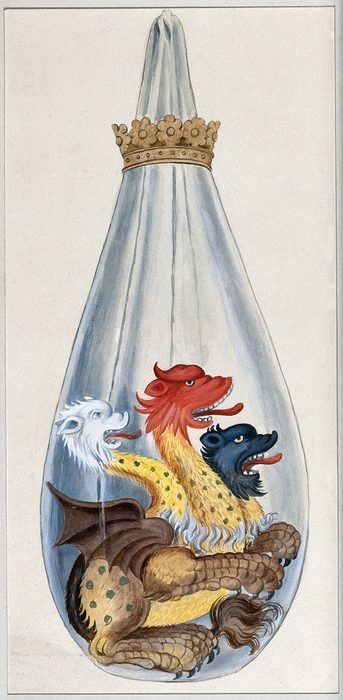
In the same series
Record
One symbol a week, decoded.
This picture is free at full size from its source, linked above. What an address gets is the Sunday letter: one picture, one symbol marked on it, what it meant and who said so, and the master files of the decoded plates as they are verified. Leave any time.
Free, one letter a week, unsubscribe in one click. How the address is used.
Scroll or pinch to zoom · drag to move · double-tap for 1:1 · 872 by 1400 pixel web copy; the source file is linked under Record