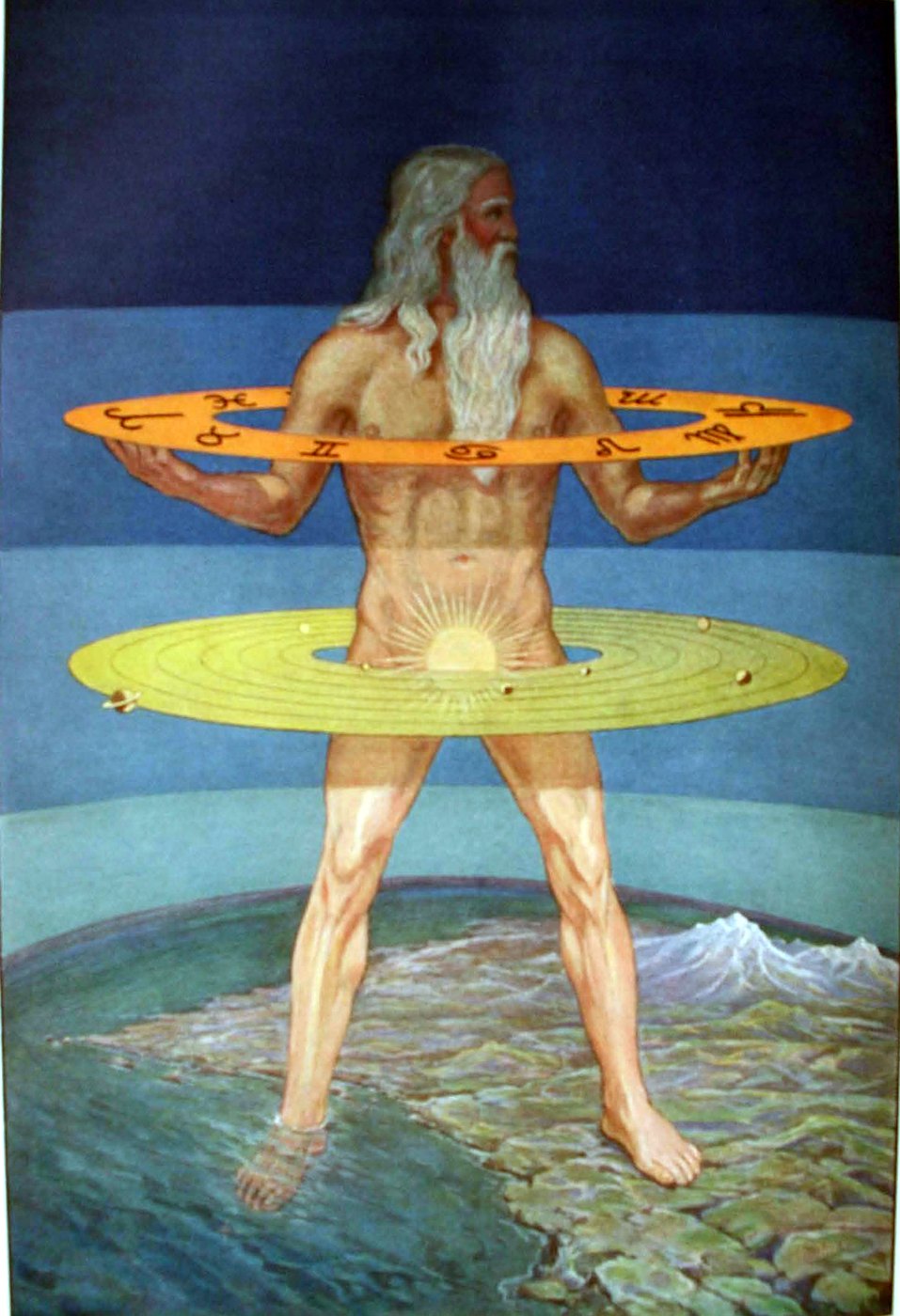
The Grand Man of the Zohar
The Grand Man of the Zohar as the central motif, filed under the Heavens, with the Sun and the Moon, the Divine, and the Water in a secondary part. From The Secret Teachings.
What is happening
Lévi, in Waite's translation, 1913 “When the eyes appeared, light was made; when the mouth was manifested, there was the creation of spirits and the word passed into expression. The entire head was revealed, and this completed the first day of creation. The shoulders, the arms, the breast arose, and thereupon work began. With one hand the Divine Image put back the sea, while with the other it raised up continents and mountains.”
Key · 4 motifs
Tap a motif on the picture, or a line below. Its note opens under the line, with the reading its author gave it.
- Primary motif
- Secondary motifs · 3
The picture
A naked white-bearded giant standing astride the earth, his right foot on the mountains and his left in the sea, holding an orange ring marked with the twelve signs of the zodiac at his chest, a yellow ring of the planets' orbits about his hips with the sun at its centre, a dark blue sky behind; the Grand Man of the Zohar as the central motif. By eye
The reading
The picture read whole, in the archive's words, from the sources quoted on the marks. Read on, and the picture follows: the motif under discussion keeps its colour.
The caption under the plate says The Grand Man of the Zohar and hands the reading to Éliphas Lévi, whose History of Magic Hall quotes at length in the chapter this plate illustrates. Lévi is retelling the opening of the Zohar as he understands it: ‘That synthesis of the word, formulated by the human figure, ascended slowly and emerged from the water, like the sun in its rising.’ Eyes appear and there is light; a mouth, and there are spirits; head, shoulders, arms, ‘and thereupon work began’.
‘The form stood at length erect, having one foot upon the earth and one upon the waters.’ Knapp paints that sentence exactly: the right foot on a mountain range, the left in the sea. Then Lévi's figure, ‘beholding itself at full length in the ocean of creation’, ‘breathed on its own reflection and called its likeness into life. It said: Let us make man - and thus man was made.’ We are the reflection.
The two rings are Hall's reading laid over Lévi's picture. ‘The pagans believed that the zodiac formed the body of the Grand Man of the Universe’, the Macrocosm, ‘divided into twelve major parts’, with the human body, the Microcosm, divided the same way. So the giant holds the zodiac at his chest and wears the planets at his hips: the sky is his body and his body is a map of the sky. Hall finds the same figure in Nebuchadnezzar's dream, ‘with its head in the World of Atziluth’ and ‘its legs and feet in the World of Assiah’, the four worlds of the Kabbalah stacked down one body.
‘Such is Adam Kadmon, the primordial Adam of the Kabalists. Such is the sense in which he is depicted as a giant.’ Lévi ends with Swedenborg, who ‘says that entire creation is only a titanic man and that we are made in the image of the universe’. Knapp's old man is that sentence made visible: not a god above the world but the world itself standing up, looking down at the small earth it is made of.
Readings quoted
Lévi, in Waite's translation, 1913 “There is nothing so beautiful in the masterpiece of any poet as this vision of creation accomplished by the prototype of humanity. Hereby is man but the shadow of a shadow, and yet he is the image of divine power. He also can stretch forth his hands from East to West; to him is the earth given as a dominion.”
Hall, 1928 “The pagan priests always considered the solar system as a Grand Man, and drew their analogy of these three centers of activity from the three main centers of life in the human body: the brain, the heart, and the generative system.”
Decoded: every motif is marked, and each mark carries the reading its author gave it, quoted from the text, or says that it is observed on the picture and not read. The reading above is the archive's own, made from those sources and no others.

A diagram of everything, drawn so that a person can be found inside it. Note where the human figure stands in the scheme.
In plain words Two rings. The upper one, orange, carries the twelve signs of the zodiac and he holds it at his chest like a wheel; the lower one, yellow, is the solar system seen flat, the sun in the middle and the planets on their circles, worn at his hips like a belt. He is the universe standing up: the whole sky is a body, Hall says, and this is the body.
Hall, 1928 “The pagans believed that the zodiac formed the body of the Grand Man of the Universe. This body, which they called the Macrocosm (the Great World), was divided into twelve major parts, one of which was under the control of the celestial powers reposing in each of the zodiacal constellations.”
Hall, 1928 “This is probably the secret significance of the great figure of Nebuchadnezzar's dream, with its head in the World of Atziluth, its arms and hands in the World of Briah, its generative system in the World of Yetzirah, and its legs and feet in the World of Assiah. This is the Grand Man of the Zohar”
Gold, the perfected metal, and the illuminated intellect. The most overloaded symbol in the tradition.
In plain words The sun sits at the centre of the lower ring, with the planets circling it, and the ring sits at the middle of the man. Lévi's text, which Hall's caption quotes, has the great figure rising from the water ‘like the sun in its rising’; Knapp puts the sun at the middle of the planets and at the middle of the giant at once.
Lévi, in Waite's translation, 1913 “That synthesis of the word, formulated by the human figure, ascended slowly and emerged from the water, like the sun in its rising.”
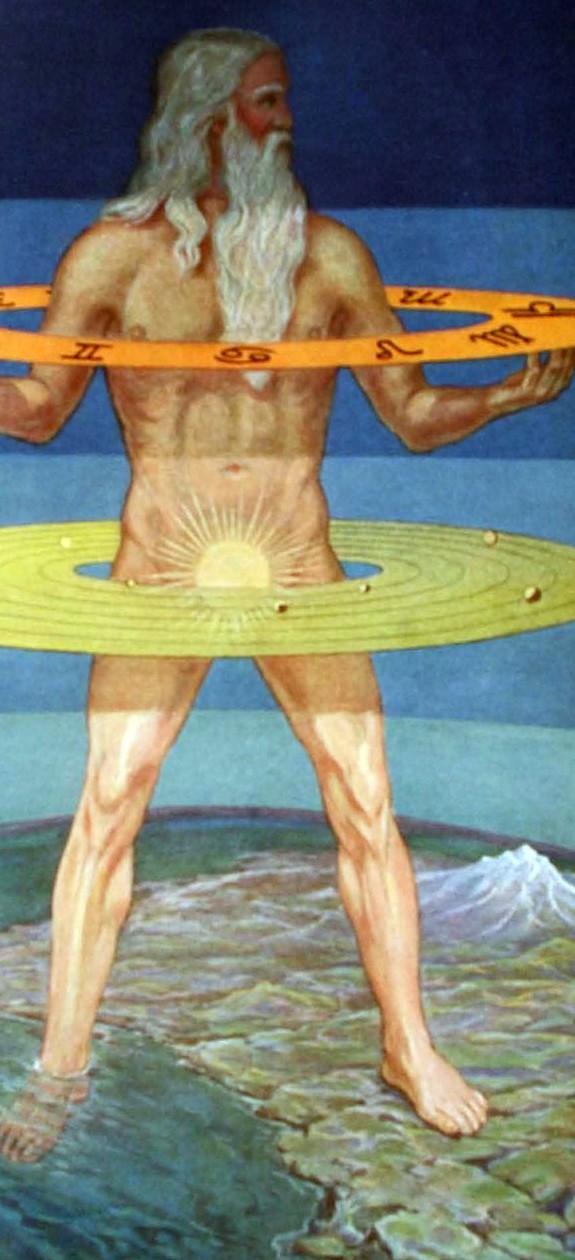
A man the size of the universe, the zodiac across his chest and one foot in the sea. Two writers here call him a giant and neither means a race of them.
In plain words An old man the size of the world, white-haired and bearded, naked, looking down at the earth he stands on. He is Adam Kadmon, the first Adam of the Kabbalists, the shape the divine took to make the world in the Zohar's account as Lévi retells it: ‘a titanic man’ of whom every human being is the image.
Lévi, in Waite's translation, 1913 “That synthesis of the word, formulated by the human figure, ascended slowly and emerged from the water, like the sun in its rising.”
Lévi, in Waite's translation, 1913 “Such is Adam Kadmon, the primordial Adam of the Kabalists. Such is the sense in which he is depicted as a giant; and this is why Swedenborg, haunted in his dreams by reminiscences of the Kabalah, says that entire creation is only a titanic man and that we are made in the image of the universe.”
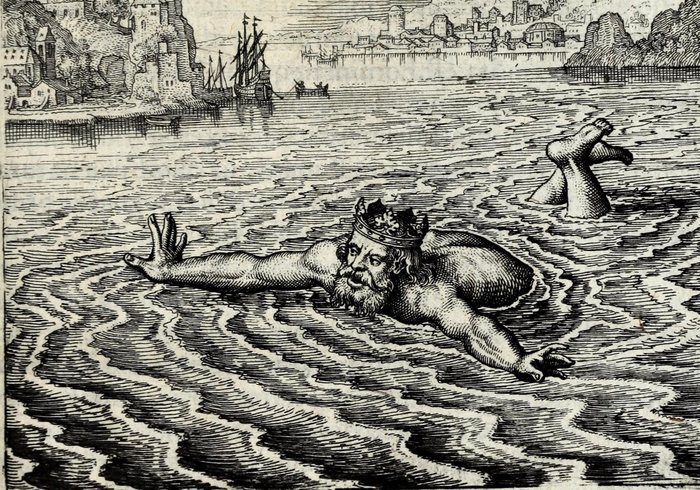
Where a thing is taken apart rather than destroyed. Note whether the figure is in the water, on it, or pouring it.
In plain words His left foot is in the sea and his right on the land, and Lévi's sentence is the reason: the figure ‘stood at length erect, having one foot upon the earth and one upon the waters’. In the story he then sees himself reflected in the ocean and breathes on the reflection, and that reflection is us.
Lévi, in Waite's translation, 1913 “The form stood at length erect, having one foot upon the earth and one upon the waters. Beholding itself at full length in the ocean of creation, it breathed on its own reflection and called its likeness into life. It said: Let us make man - and thus man was made.”
Also carrying the Heavens
61 works carry it. The 6 where it is the central motif are here. The symbol.
Where the detail is the subject
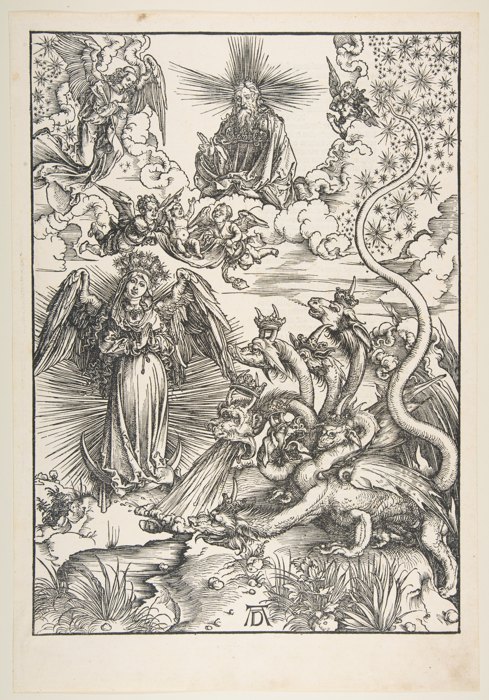
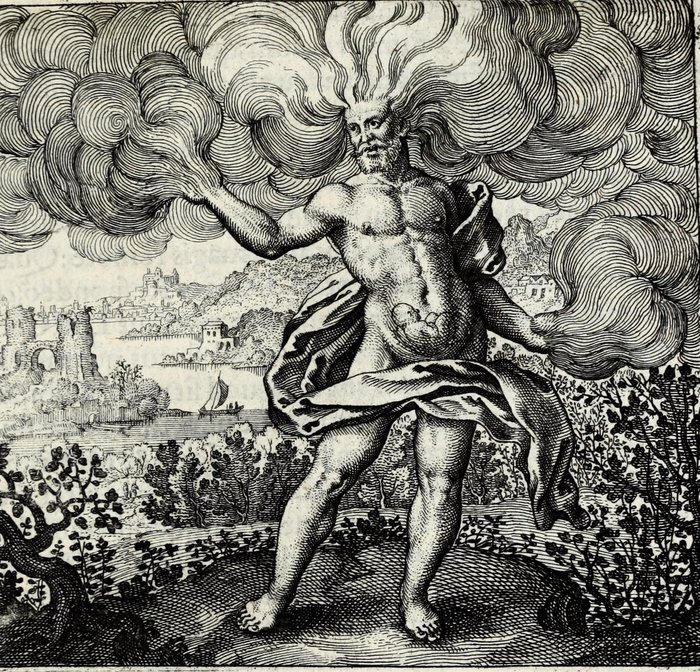
the Sun and the Moon · the Divine · the Water
Each of these is in the picture without being what it is about. Below, one work that is about each.
By the same hand
In the same series
Record
One symbol a week, decoded.
This picture is free at full size from its source, linked above. What an address gets is the Sunday letter: one picture, one symbol marked on it, what it meant and who said so, and the master files of the decoded plates as they are verified. Leave any time.
Free, one letter a week, unsubscribe in one click. How the address is used.
Scroll or pinch to zoom · drag to move · double-tap for 1:1 · 957 by 1400 pixel web copy; the source file is linked under Record