Adam Kadmon
the Grand Man, the Grand Man of the Zohar, the primordial Adam, the Macrocosm
A man the size of the universe, the zodiac across his chest and one foot in the sea. Two writers here call him a giant and neither means a race of them.
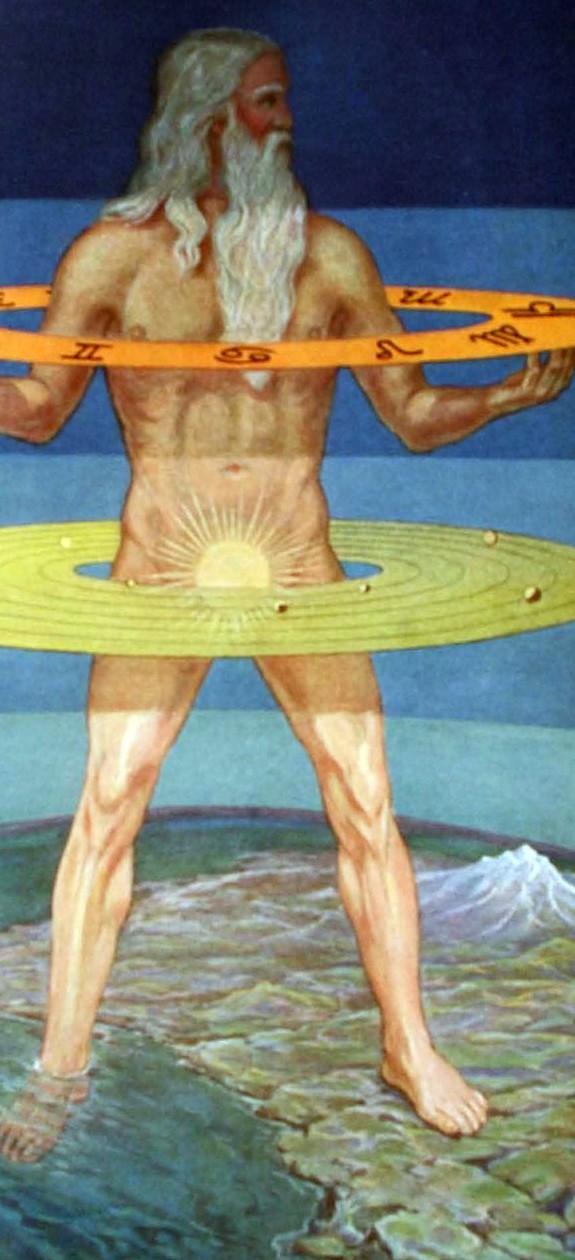
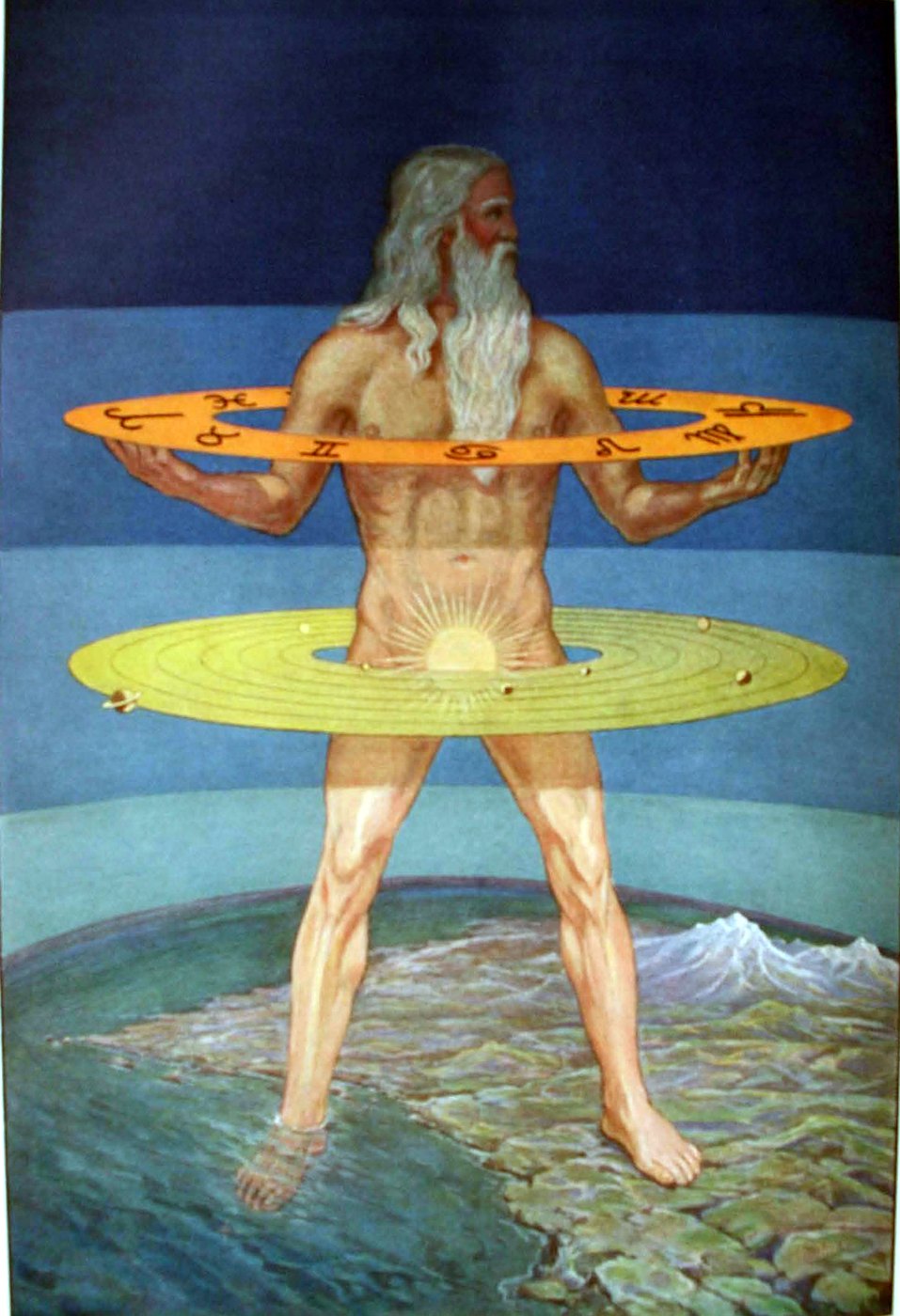
Knapp drew him astride the world: white-bearded, naked, one foot on the mountains and one in the sea, the ring of the zodiac held against his chest and the planets turning about his hips. Éliphas Lévi, in Waite's translation, gives him his name and in the same breath the word that causes all the trouble. “Such is Adam Kadmon, the primordial Adam of the Kabalists. Such is the sense in which he is depicted as a giant; and this is why Swedenborg, haunted in his dreams by reminiscences of the Kabalah, says that entire creation is only a titanic man and that we are made in the image of the universe.”
Depicted as a giant. Not a giant: depicted as one, because what is being drawn has no size of its own and a picture is obliged to give it one. Lévi has the figure rise out of water like a sunrise and then stand, “having one foot upon the earth and one upon the waters”, which is the pose Knapp painted.
Hall arrives at the same body from the sky. “The pagans believed that the zodiac formed the body of the Grand Man of the Universe. This body, which they called the Macrocosm (the Great World), was divided into twelve major parts”, so the ring at the chest is not jewellery, it is anatomy, and the twelve are limbs. Then he ties the figure to a dream: “This is probably the secret significance of the great figure of Nebuchadnezzar's dream, with its head in the World of Atziluth, its arms and hands in the World of Briah, its generative system in the World of Yetzirah, and its legs and feet in the World of Assiah. This is the Grand Man of the Zohar”. Notice his own word, probably. He is offering a reading and saying so.
Between them the two writers describe one thing: a human shape used as a diagram of everything, cut into twelve parts the way a year is, with four worlds stacked down it from head to feet. The giant is a scale rather than a species. Lévi says it in his own sentence, and it is the sentence that gets dropped whenever the picture travels: creation is a titanic man, and we are made in the image of the universe.
Contested
Sources
- Éliphas Lévi, Dogme et Rituel de la Haute Magie, 1856: Book I, The Derivations of Magic, chapter I, Fabulous Sources, in Waite's translation, the Rider edition of 1922.
- Manly P. Hall, The Secret Teachings of All Ages, 1928: The chapter on the fundamentals of Qabbalistic cosmogony, and the caption to the figure from the Margarita Philosophica in the chapter on the zodiac and its signs.
On the same plate
Where it appears · 1
1 work in the archive carries Adam Kadmon. First the one where it has been read, with Adam Kadmon itself picked out.