The Chakras
the seven chakras, the whirling wheels, the lotus centres
Seven wheels up the spine, and one painting of 1928 is why a reader can picture them.
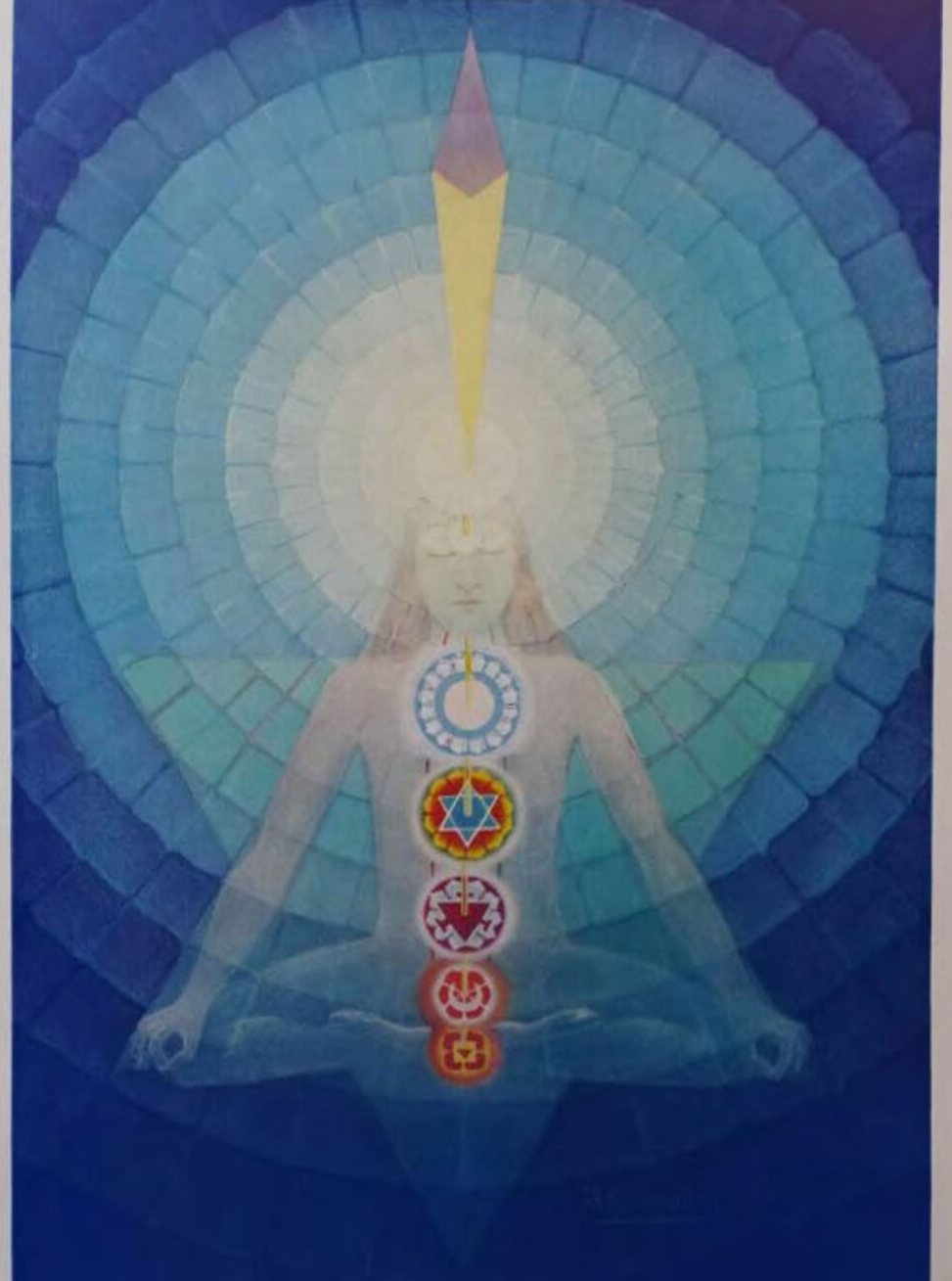
The archive holds one picture of the chakras, and where it came from is worth knowing, because it is close to the reason a reader can picture them at all. Hall printed it in 1928 under a caption that claims no antiquity whatever: “This painting of the CHAKRAS is based upon a number of native drawings brought from India by Mr. Hall in 1924.” Four years between the drawings and the plate, one named traveller, and no suggestion that the painting itself is old.
What Hall wrote about them sits in his chapter on plants, and it opens on a flower rather than a wheel. “The Brahmin and Egyptian initiates, who undoubtedly understood the secret systems of spiritual culture whereby the latent centers of cosmic energy in man may be stimulated, employed the lotus blossoms to represent the spinning vortices of spiritual energy located at various points along the spinal column and called chakras, or whirling wheels, by the Hindus.” Then the count: “Seven of these chakras are of prime importance and have their individual correspondences in the nerve ganglia and plexuses.” Seven, on the spine, tied to nerves.
Serailian painted them to that specification and then went further than it. The lower wheels are reds and orange, the one at the chest carries a six-pointed star, the one at the throat is white and blue, and the last two stop being wheels altogether: a white glow at the brow, and a flame standing up off the crown of the head into a point that leaves the picture.
The part nobody quotes is what he set them inside. The meditating figure is drawn almost transparently against rings of deepening blue, and those rings are the scheme the older plates in this collection use for the cosmos, with the body's axis running up the middle of them like the axis of the world. Hall supplies the count, the place and the source. The rings are the painter's, and they turn a diagram of a spine into a diagram of the universe with a person sitting in it.
Contested
Sources
- Manly P. Hall, The Secret Teachings of All Ages, 1928: The printed plate caption, read by eye from the photographed page, and the passage on the chakras in the chapter on flowers, plants, fruits and trees.
On the same plate
Where it appears · 1
1 work in the archive carries the Chakras. First the one where it has been read, with the Chakras itself picked out.