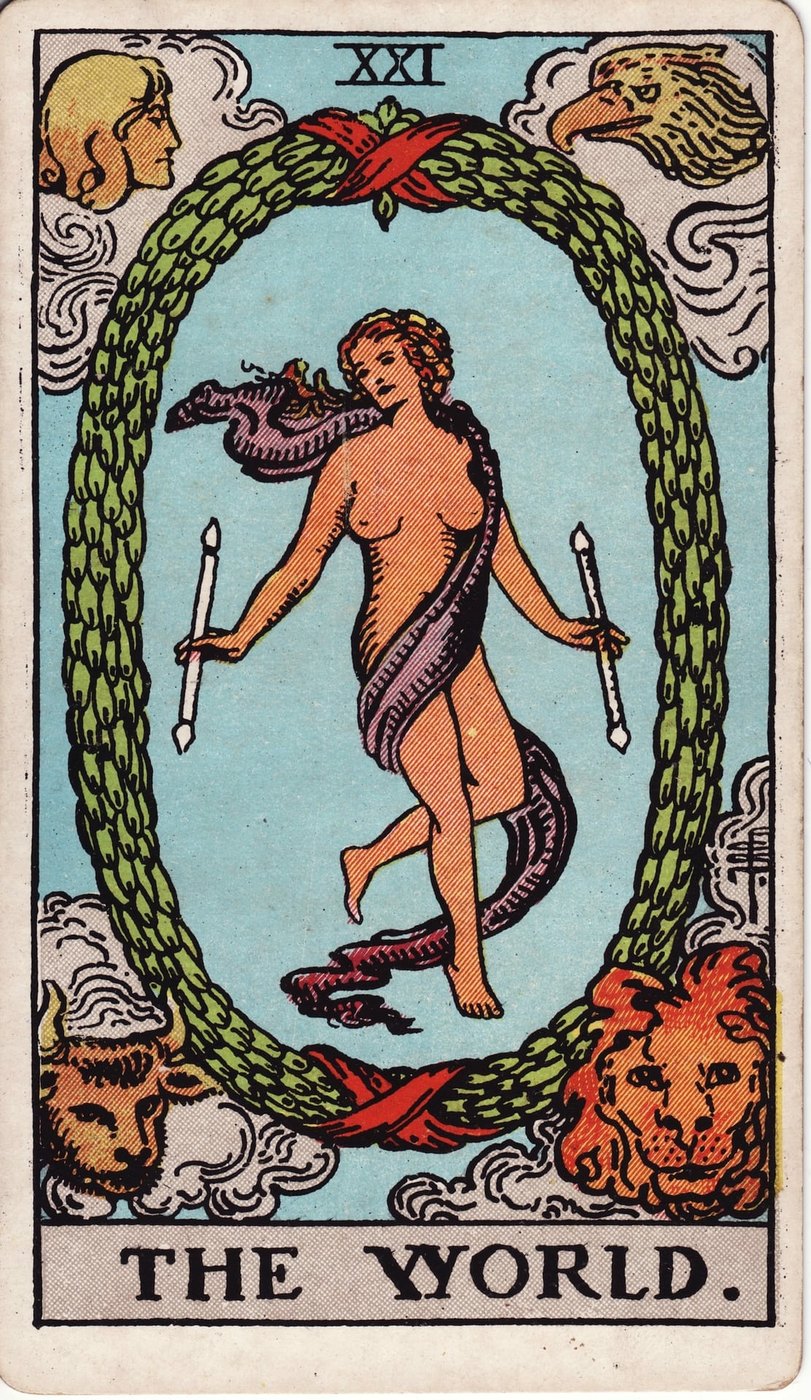
The World (XXI)
The Heavens as the central motif, with the Angel and the Wing, the Lion, and the Bird in a secondary part. From The 1909 tarot.
What is happening
Waite, 1911 “She is in the act of dancing, and has a wand in either hand.”
Waite, 1911 “It is further the state of the soul in the consciousness of Divine Vision, reflected from the self-knowing spirit.”
Waite, 1911 “But it is perhaps more especially a story of the past, referring to that day when all was declared to be good, when the morning stars sang together and all the Sons of God shouted for joy.”
Key · 4 motifs
Tap a motif on the picture, or a line below. Its note opens under the line, with the reading its author gave it.
- Primary motif
- Secondary motifs · 2
The picture
A dancing figure wrapped in a purple sash, a wand in each hand, inside a green wreath bound with red ribbons; the four living creatures, a man, an eagle, a lion and a bull, in the corners; the Heavens as the central motif, the Angel and the Lion by eye. By eye
The reading
The picture read whole, in the archive's words, from the sources quoted on the marks. Read on, and the picture follows: the motif under discussion keeps its colour.
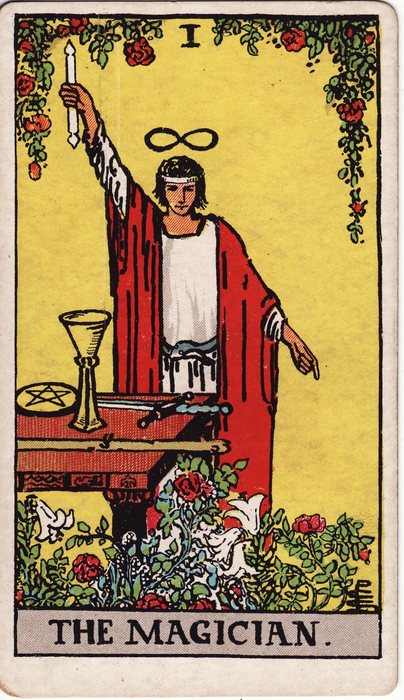
The deck opens with a man at a table pulling light down through himself and closes with a figure in the air with the light all round. Waite calls the design of the last card unchanged and indeed unchangeable, then reads it twice, once from outside the wreath and once from inside.
From outside, in Part I, the wreath is ‘an elliptic garland, as if it were a chain of flowers intended to symbolize all sensible things’, and the picture is eloquent, he says, ‘of the swirl of the sensitive life, of joy attained in the body, of the soul's intoxication in the earthly paradise’. Lévi calls the same garland a crown and says the figure is Truth. From inside, in Part II, the card becomes ‘the perfection and end of the Cosmos, the secret which is within it, the rapture of the universe when it understands itself in God’. Both readings make the wreath the whole created world, seen as a garden or seen as a cosmos, with a dancer at the middle of it, which is why it is filed under the Heavens.
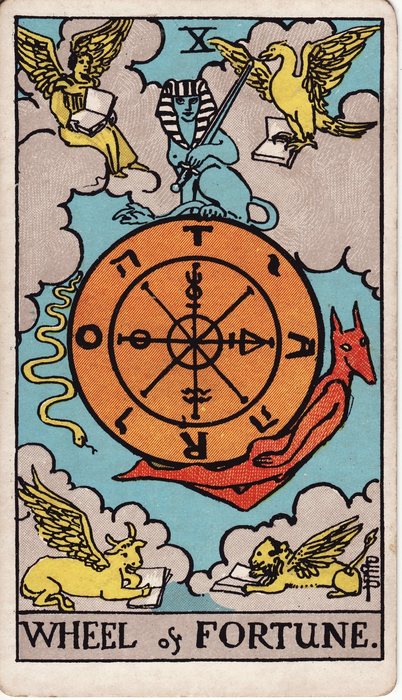
The four in the corners are Ezekiel's and the Apocalypse's, the man, the eagle, the lion and the bull, handed over in Christian use to the four Evangelists. On the Wheel of Fortune they sit reading. Here they only watch. Waite calls them the Divine Watchers and ties them to the four ineffable letters of the Holy Name, which he says the mystical beasts are sometimes given. Four letters, four creatures, four corners of the card and of the sky: the frame that held the tenth card holds the twenty first.
The lion sits at the lower right on its cloud, looking in. It is Mark's lion and it is Leo, and it has an entry of its own here because it turns up everywhere from Fludd's mirror of nature to the Strength card. On this card its whole job is to be one of four.
The dancer Waite describes as ‘a woman whom the wind has girt about the loins with a light scarf, and this is all her vesture; she is in the act of dancing, and has a wand in either hand’. Later readers have argued about the figure's sex and Pamela Colman Smith left it open. Waite did not. What she means he stacks in layers: ‘the state of the soul in the consciousness of Divine Vision, reflected from the self knowing spirit’; the restored world once manifestation has been carried to its highest natural degree; and most especially, he thinks, a story of the past, ‘that day when all was declared to be good, when the morning stars sang together and all the Sons of God shouted for joy’. The readings he dislikes he names and drops: the Magus at the highest degree of initiation, one of the worst; the absolute, ridiculous; Truth, which he says belongs to the Star. What is left is a dance at the end of everything, watched from the four corners of heaven by the same beasts who watched the wheel turn.
Decoded: every motif is marked, and each mark carries the reading its author gave it, quoted from the text, or says that it is observed on the picture and not read. The reading above is the archive's own, made from those sources and no others.
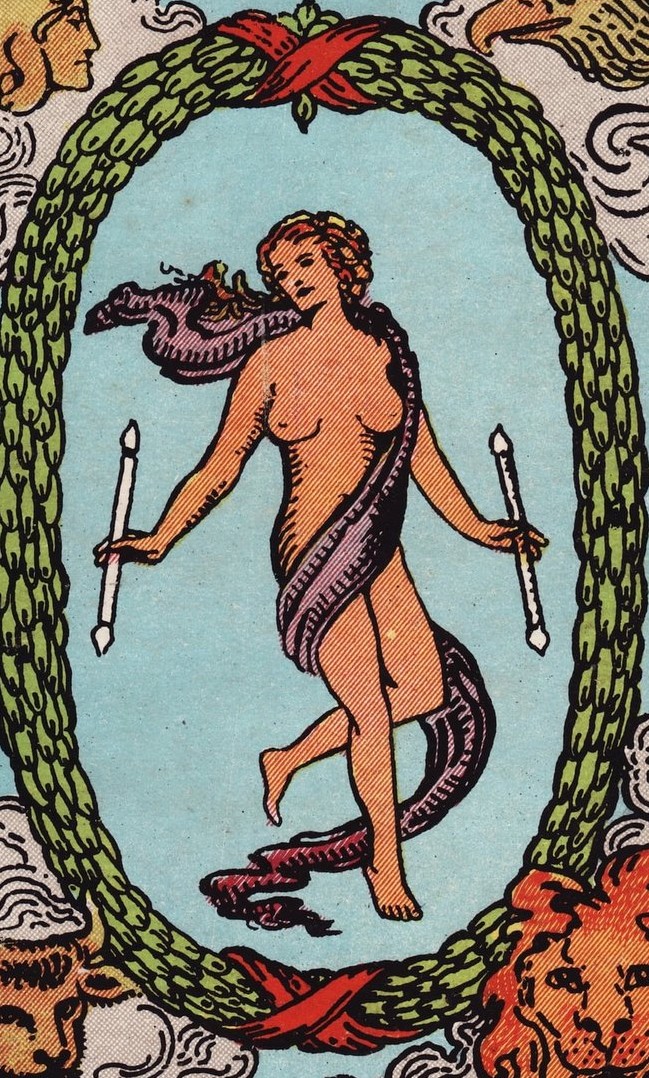
A diagram of everything, drawn so that a person can be found inside it. Note where the human figure stands in the scheme.
In plain words The green wreath round the dancer is the world of the card's name, an oval of leaves tied with red ribbons at top and bottom. Waite quotes Lévi calling it a crown, and reads the whole card as the perfection and end of the cosmos, the universe understanding itself in God.
Waite, 1911 “It represents also the perfection and end of the Cosmos, the secret which is within it, the rapture of the universe when it understands itself in God.”
Waite, 1911 “Eliphas Lévi calls the garland a crown, and reports that the figure represents Truth.”
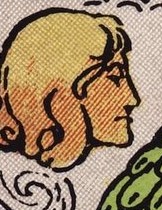
The mark of an errand rather than a nature. Note whether the wings are open, folded, or given to the figure by someone else.
In plain words In the upper corners are a man's head and an eagle, in the lower a bull and a lion, on clouds: the four living creatures of Ezekiel and the Apocalypse, the same four that sit round the Wheel of Fortune. Waite calls them the Divine Watchers guarding the dancer, and ties them to the four letters of God's name.
Waite, 1911 “It is eloquent as an image of the swirl of the sensitive life, of joy attained in the body, of the soul's intoxication in the earthly paradise, but still guarded by the Divine Watchers, as if by the powers and the graces of the Holy Name, Tetragammaton, JVHV--those four ineffable letters which are sometimes attributed to the mystical beasts.”
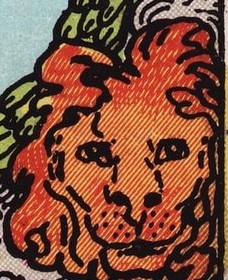
Usually not an animal but one face of a set of four. Count the other three before reading it alone.
In plain words The lion at the lower right is one of the four watchers, the Evangelist Mark's lion and the zodiac's Leo. Waite says the four creatures are grouped about the garland as if it were a chain of flowers standing for all sensible things.
Waite, 1911 “The four living creatures of the Apocalypse and Ezekiel's vision, attributed to the evangelists in Christian symbolism, are grouped about an elliptic garland, as if it were a chain of flowers intended to symbolize all sensible things; within this garland there is the figure of a woman, whom the wind has girt about the loins with a light scarf, and this is all her vesture.”
Also carrying the Heavens
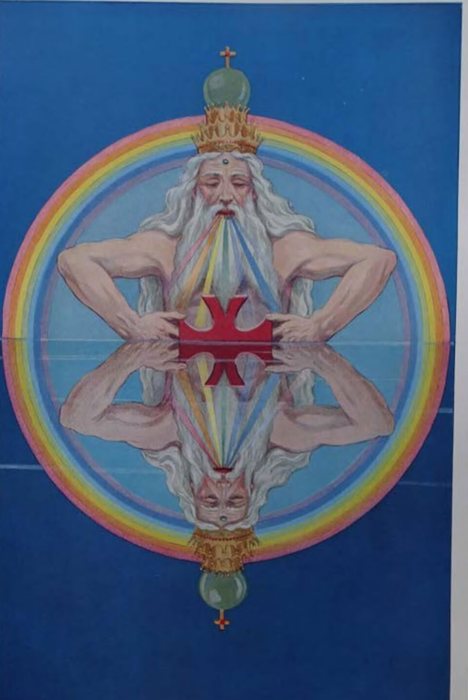
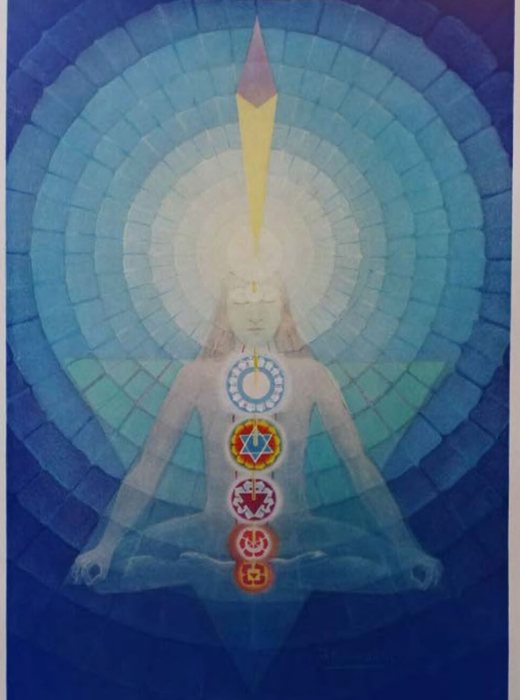
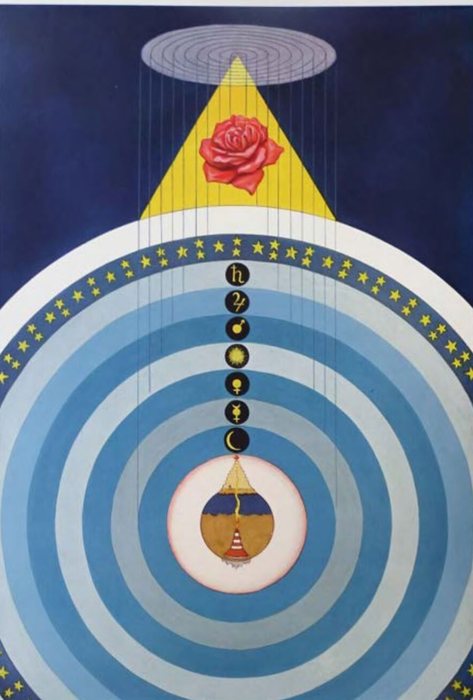
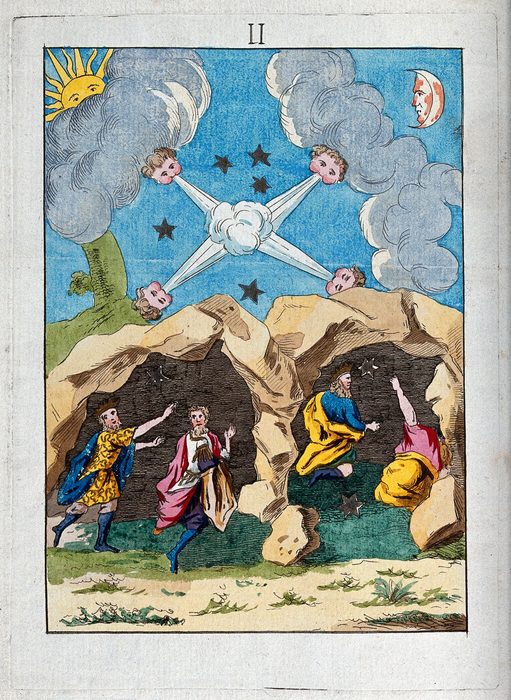
61 works carry it. The 6 where it is the central motif are here. The symbol.
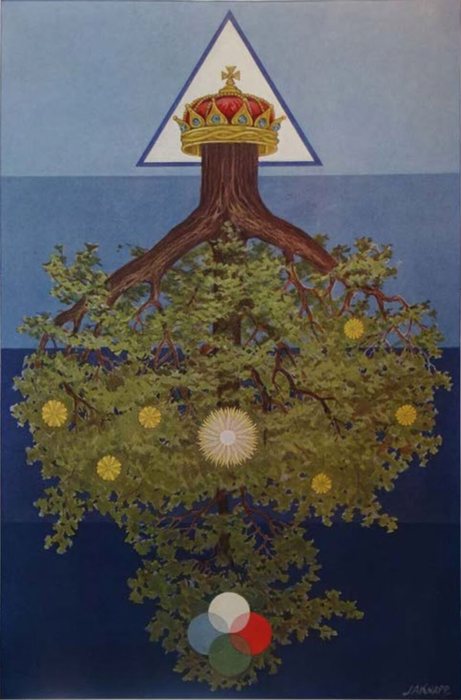
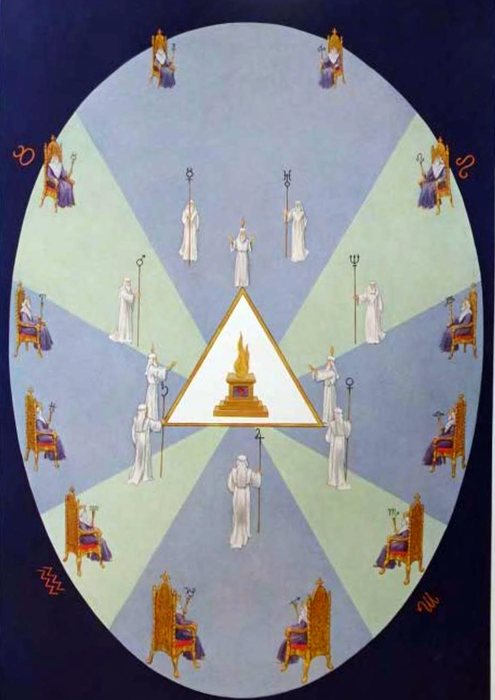
Where the detail is the subject
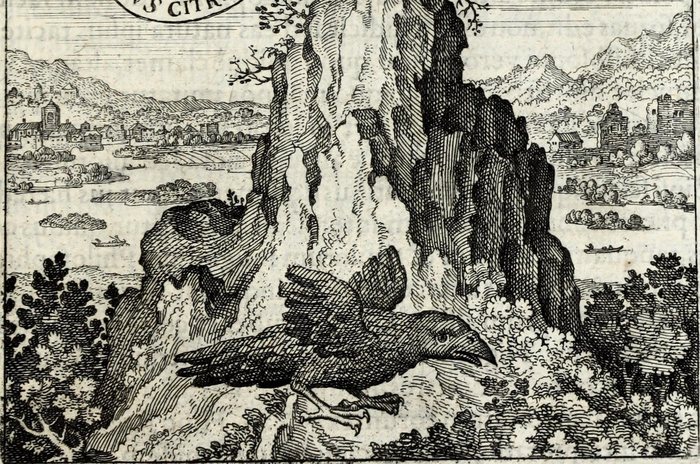
the Angel and the Wing · the Lion · the Bird
Each of these is in the picture without being what it is about. Below, one work that is about each.
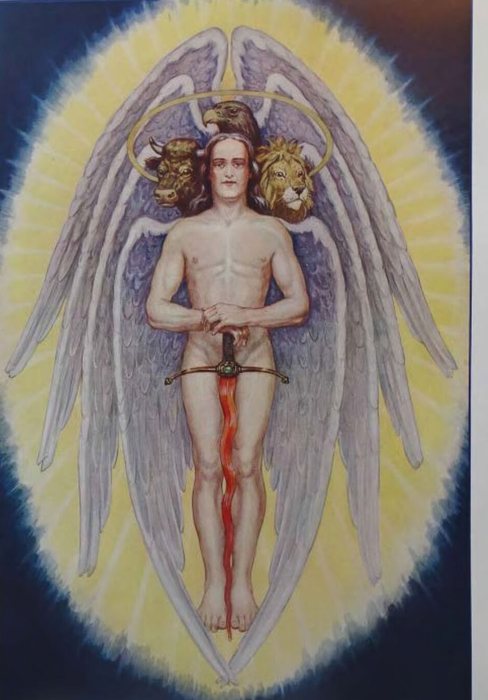
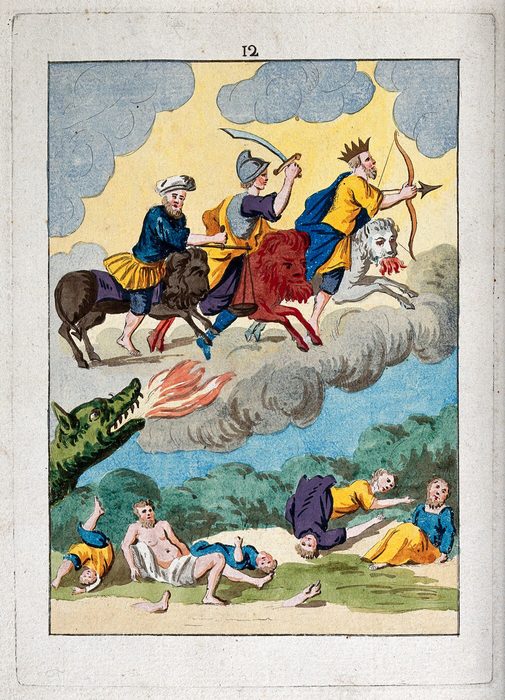
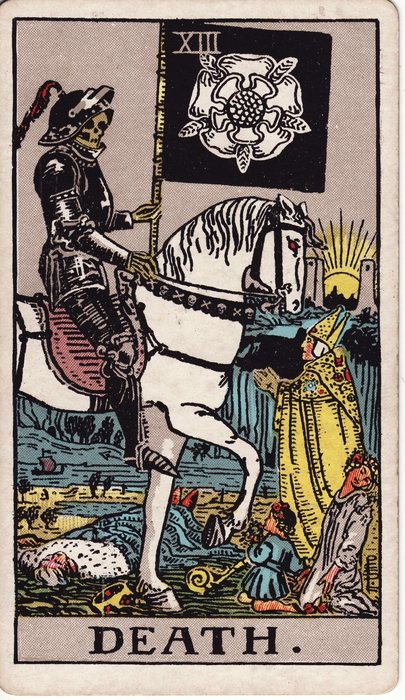
In the same series
Record
One symbol a week, decoded.
This picture is free at full size from its source, linked above. What an address gets is the Sunday letter: one picture, one symbol marked on it, what it meant and who said so, and the master files of the decoded plates as they are verified. Leave any time.
Free, one letter a week, unsubscribe in one click. How the address is used.
Scroll or pinch to zoom · drag to move · double-tap for 1:1 · 811 by 1400 pixel web copy; the source file is linked under Record