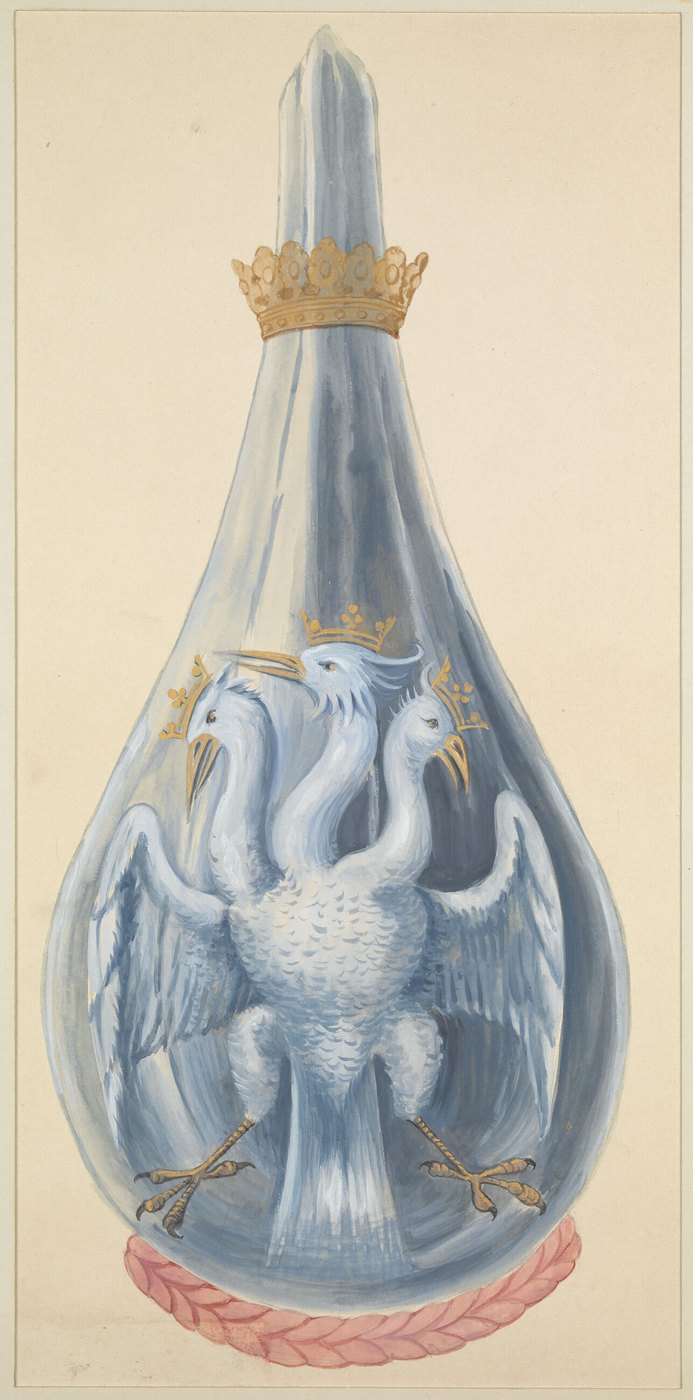
The three-headed bird in the crowned flask
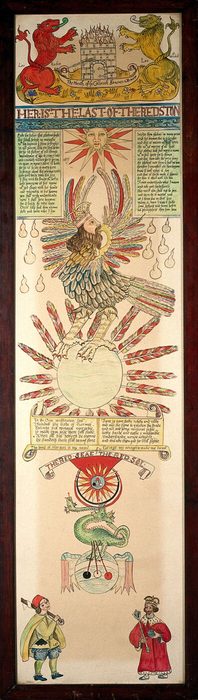
The Bird as the central motif, with the Vessel and the Crown in a secondary part. From Splendor Solis.
What is happening
J. K., who wrote the 1920 elucidation, 1920 “A similar glass cucurbit in a golden niche. Inside the glass, standing upright is a white bird shaded blue, with three heads, each of which is decorated with a golden crown.”
Salomon Trismosin, attributed, 1920 “Though the stone is obtained through one operation, nevertheless has the operation of the Fire to be changed thrice. In the first operation of the work shall the heat be mild moderate and warm, till the matter turns black continually, and further till it becomes white again.”
Symbolica J. K. writes bird and the Wellcome writes eagle. The plate shows a long-necked white bird with a heavy hooked beak and feet like a raptor, so both are defensible and neither is printed on the sheet. The archive keeps the museum’s title and quotes J. K.’s word where the reading is made.
Key · 3 motifs
Tap a motif on the picture, or a line below. Its note opens under the line, with the reading its author gave it.
- Primary motif
- Secondary motifs · 2
The picture
A clear flask crowned in gold, standing on a wreath of red leaves, and inside it a white bird shaded blue with its wings half open and three necks, each head wearing a small gold crown. By eye
The reading
The picture read whole, in the archive's words, from the sources quoted on the marks. Read on, and the picture follows: the motif under discussion keeps its colour.
Fourteenth of the twenty-two, and the second flask the archive now holds from the run of seven. A white bird stands upright in the glass with three necks coming off one body, and every head wears a crown.
“Inside the glass, standing upright is a white bird shaded blue, with three heads, each of which is decorated with a golden crown”. J. K. calls it a bird and the Wellcome calls it an eagle. Nothing on the sheet settles it, so the archive keeps the museum’s title and quotes the man who was looking at the manuscript.
“A similar glass cucurbit in a golden niche”. Similar is the point of the whole third sequence: one shape of vessel, repeated seven times, with the contents changed. [sym:crown] Four crowns on this one sheet, one on the glass and three inside it.
What the three are counting sits fifty pages on, in the chapter on the government of the fires. “Though the stone is obtained through one operation, nevertheless has the operation of the Fire to be changed thrice. In the first operation of the work shall the heat be mild moderate and warm, till the matter turns black continually, and further till it becomes white again.” Three changes of the fire, and a white thing in the glass at the second of them.
Decoded: every motif is marked, and each mark carries the reading its author gave it, quoted from the text, or says that it is observed on the picture and not read. The reading above is the archive's own, made from those sources and no others.
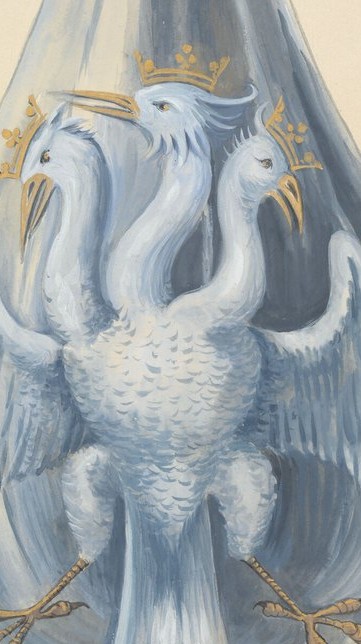
What rises and what comes back down. Note whether the bird is flying, caught, or paired with a second one.
In plain words One body, wings lifted a little from the sides, and three long necks rising from the shoulders, each ending in a hooked white head under a small gold crown.
J. K., who wrote the 1920 elucidation, 1920 “Inside the glass, standing upright is a white bird shaded blue, with three heads, each of which is decorated with a golden crown.”
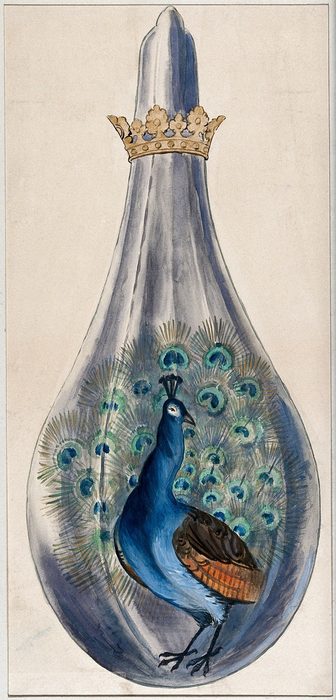
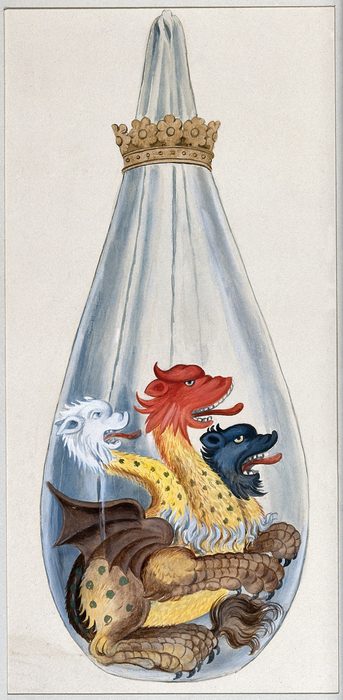
Symbolica Three heads on one body, and the neighbouring flask in this book holds a dragon built the same way. The count is doing the work in both.
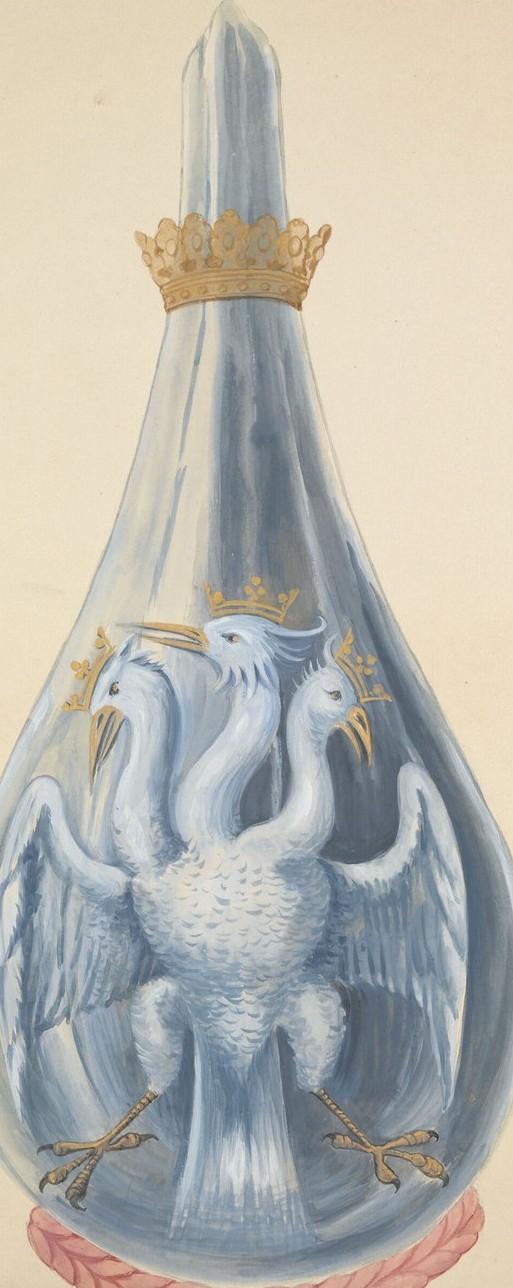
Never the subject. What is inside it is.
In plain words A clear glass vessel of the same shape as the others in the sequence, sealed at the point and resting on a ring of red foliage.
J. K., who wrote the 1920 elucidation, 1920 “A similar glass cucurbit in a golden niche.”
Symbolica Similar is the whole argument of the third sequence. Seven flasks of one shape with different things happening in them.
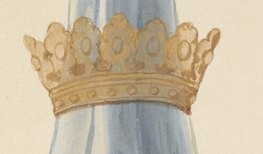
Completion, and in the Kabbalistic reading the first sephirah, the point at which the work is no longer yours.
In plain words The gold band round the neck of the glass, and inside it three much smaller crowns, one to each head.
J. K., who wrote the 1920 elucidation, 1920 “with three heads, each of which is decorated with a golden crown”
Symbolica Four crowns on one sheet: one on the vessel and three on the thing inside it. No other flask in the sequence doubles them up like this.
Also carrying the Bird
24 works carry it. The 6 where it is the central motif are here. The symbol.
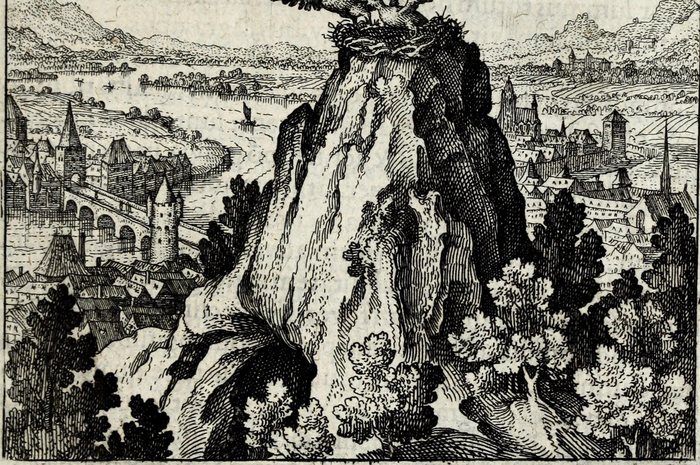
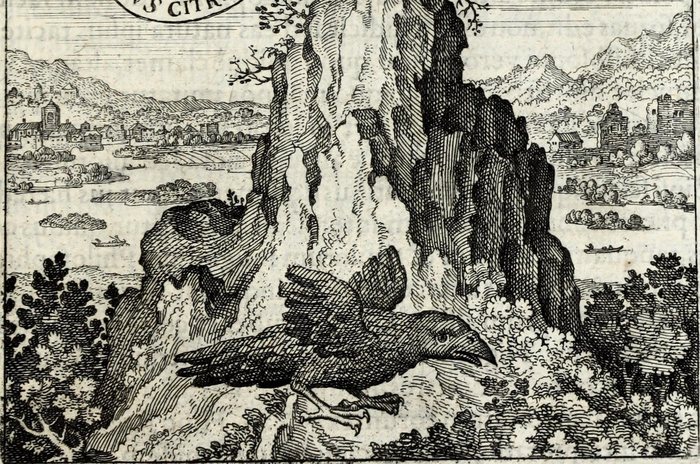
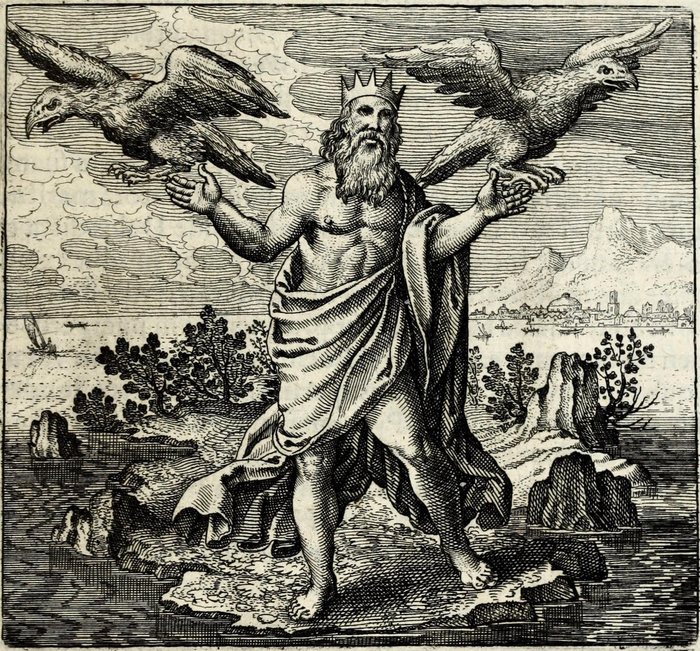
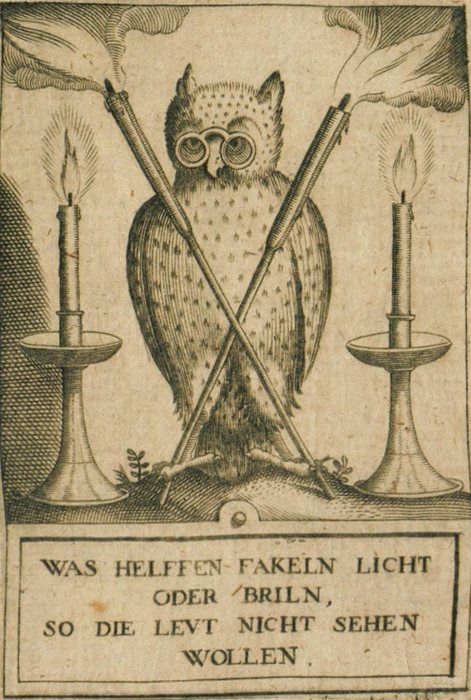

Where the detail is the subject
Each of these is in the picture without being what it is about. Below, one work that is about each.
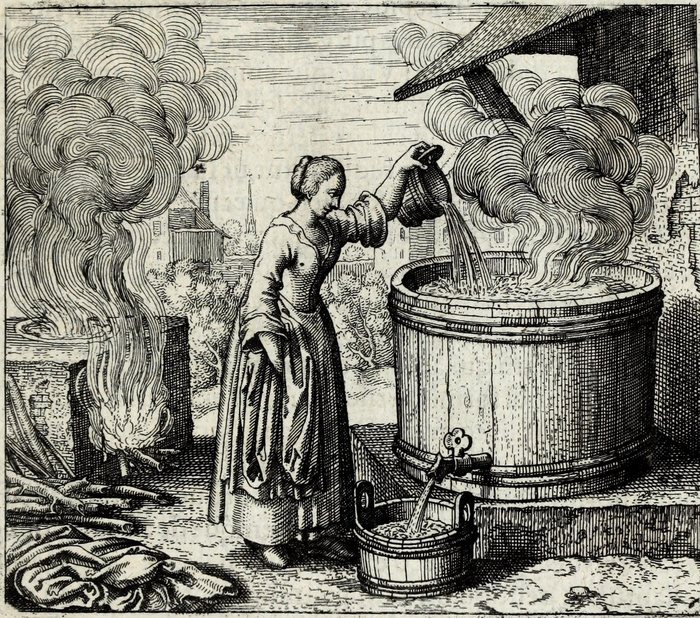
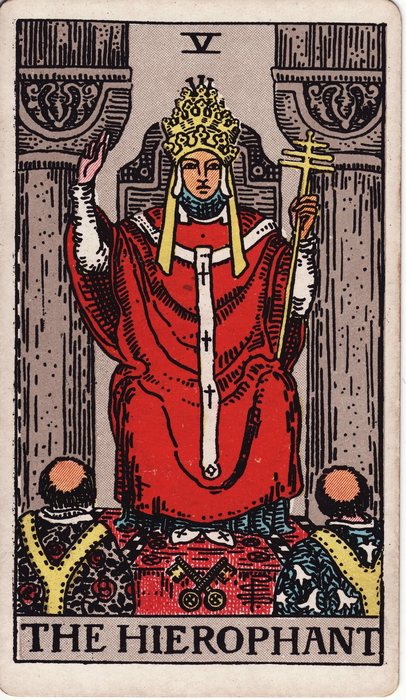
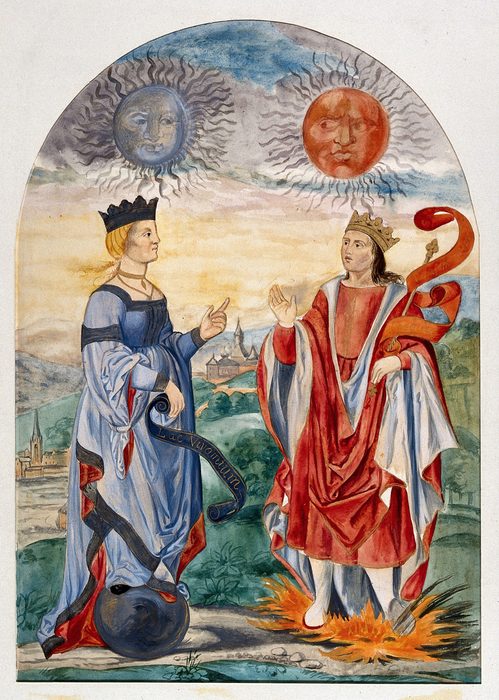
In the same series
After Splendor Solis, watercolours by Edith A. Ibbs, 1900 to 1909
Record
One symbol a week, decoded.
This picture is free at full size from its source, linked above. What an address gets is the Sunday letter: one picture, one symbol marked on it, what it meant and who said so, and the master files of the decoded plates as they are verified. Leave any time.
Free, one letter a week, unsubscribe in one click. How the address is used.
Scroll or pinch to zoom · drag to move · double-tap for 1:1 · 693 by 1400 pixel web copy; the source file is linked under Record