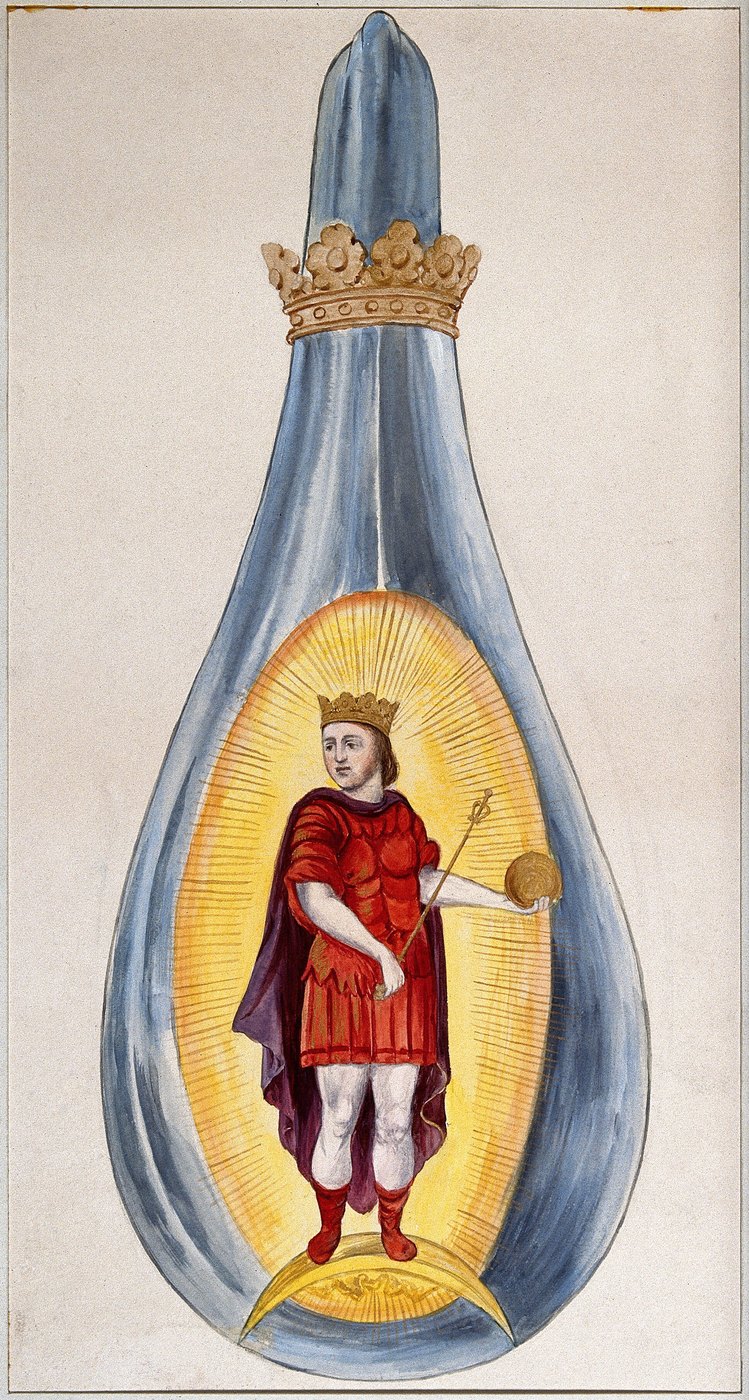
The red king in the crowned flask
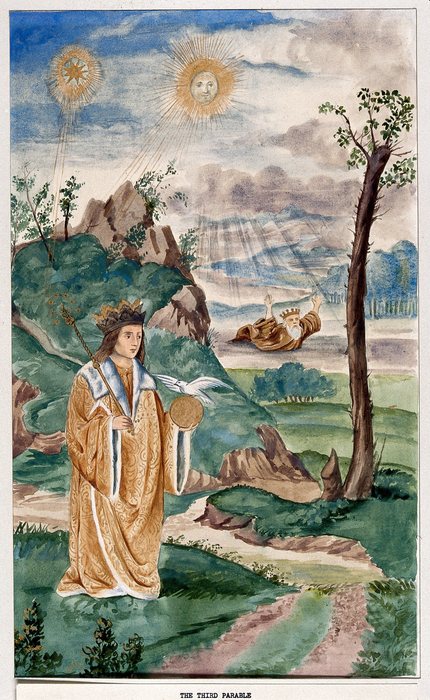
The King and the Queen as the central motif, with the Vessel, the Crown, and the Sun and the Moon in a secondary part. From Splendor Solis.
What is happening
J. K., who wrote the 1920 elucidation, 1920 “In another golden niche surrounded with birds and flowers upon a golden ground stands a similar glass flask or cucurbit. Inside of the same is a youthful boy King, dressed in red and gold. His legs are bare from above knees to lower part of calves. Boots red and gold.”
J. K., who wrote the 1920 elucidation, 1920 “He holds a golden ball in his left, a sceptre in his right hand. He stands upon a crescent moon, convex side up, and with an oval halo of light, throws a great radiance all around, of deep yellow and golden emanations.”
Symbolica The end of the colour sequence, and the treatise names the garment. The stone comes out perfectly red and clad with a royal coat from the fire, and here a boy stands in a flask wearing one.
Key · 4 motifs
Tap a motif on the picture, or a line below. Its note opens under the line, with the reading its author gave it.
- Primary motif
- Secondary motifs · 3
The picture
A crowned flask holding a young king in red and gold with bare legs and red boots, a sceptre in one hand and a golden ball in the other, standing on a crescent moon inside a great oval of yellow light. By eye
The reading
The picture read whole, in the archive's words, from the sources quoted on the marks. Read on, and the picture follows: the motif under discussion keeps its colour.
The eighteenth picture, the last flask of the run the archive holds, and the one the whole colour argument has been walking towards. A boy in red stands in the glass on a crescent moon, throwing yellow light to the walls of the vessel.
“Inside of the same is a youthful boy King, dressed in red and gold”. Then the treatise, fifty pages on, hands over the costume. “And when the stone is perfectly dried up, and calcined, the fire has again to be made more fierce still, until the stone becomes perfectly red, and clad with a royal coat from the fire”. Clad with a royal coat from the fire. The painter read that and dressed a child in it.
“stands a similar glass flask or cucurbit”. [sym:crown] Two crowns here, one clasped on the glass and a small one on the boy, and J. K. describes neither because by the sixth flask he has stopped bothering.
“He stands upon a crescent moon, convex side up”. One plate earlier the white queen stands on a gold face of the sun. Here the red king stands on the moon. The two sheets swap the luminaries under their feet and neither the describer nor the treatise says a word about it. Ibbs cut the figure clear of its page. In the manuscript this niche carries a planet driving over it in a chariot and a scene of ordinary life underneath, and neither survives on the sheet.
Decoded: every motif is marked, and each mark carries the reading its author gave it, quoted from the text, or says that it is observed on the picture and not read. The reading above is the archive's own, made from those sources and no others.
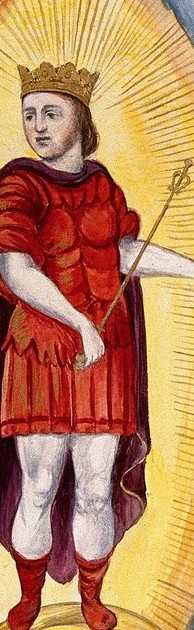
A rank rather than a person. Read the robe, the throne and what comes out of the mouth before you read the face.
In plain words A boy in a short red and gold coat with a red cloak off one shoulder, bare-legged, in red and gold boots, holding a sceptre and a golden ball.
J. K., who wrote the 1920 elucidation, 1920 “Inside of the same is a youthful boy King, dressed in red and gold.”
J. K., who wrote the 1920 elucidation, 1920 “He holds a golden ball in his left, a sceptre in his right hand.”
Salomon Trismosin, attributed, 1920 “And when the stone is perfectly dried up, and calcined, the fire has again to be made more fierce still, until the stone becomes perfectly red, and clad with a royal coat from the fire”
Symbolica Perfectly red, and clad with a royal coat from the fire. The treatise hands the painter the costume and the painter puts it on a child.
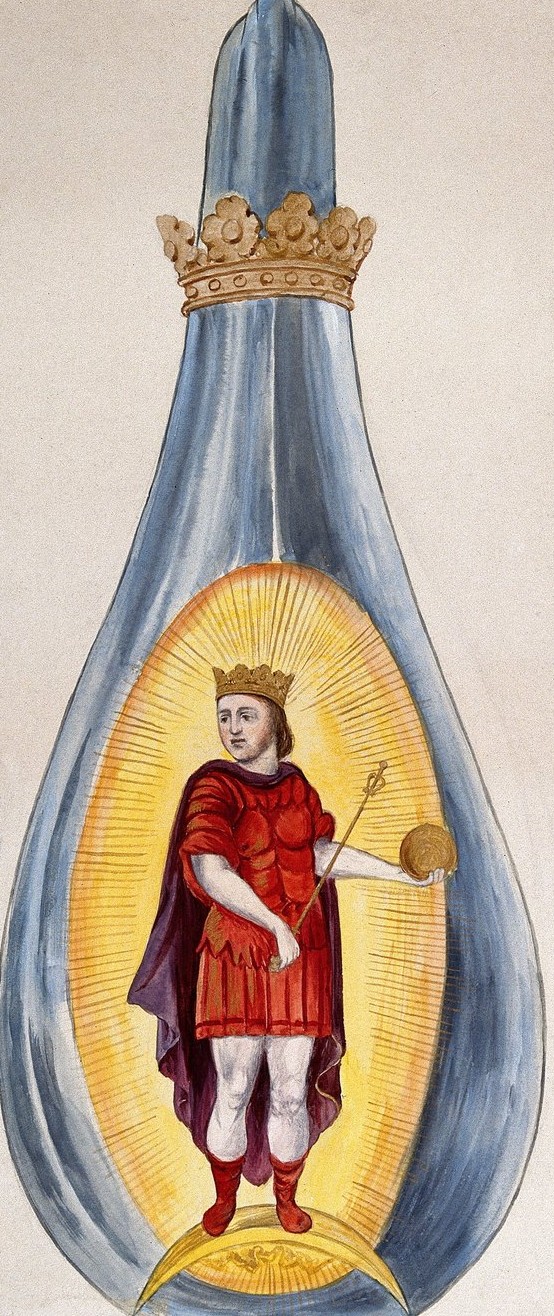
Never the subject. What is inside it is.
In plain words The same glass shape once more, sealed at the point, the figure standing free inside.
J. K., who wrote the 1920 elucidation, 1920 “stands a similar glass flask or cucurbit”
Symbolica Similar again. Six sheets into the sequence the vessel has stopped being worth describing and only the contents change.
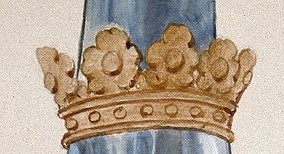
Completion, and in the Kabbalistic reading the first sephirah, the point at which the work is no longer yours.
In plain words The gold band round the glass, and a second small crown on the boy’s head.
Symbolica Two crowns, one on the vessel and one on the figure. J. K. describes neither; he has already used the word King. Recorded as observed.
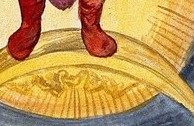
The borrowed light, the mother of the work, and the crescent a woman stands on. The one body here that every source explains against another.
In plain words A gold crescent lying with its convex side up, carrying the boy’s weight.
J. K., who wrote the 1920 elucidation, 1920 “He stands upon a crescent moon, convex side up, and with an oval halo of light, throws a great radiance all around, of deep yellow and golden emanations.”
Symbolica The red figure stands on the moon and the white figure one plate back stands on the sun. Neither J. K. nor the treatise remarks on the exchange.
Also carrying the King and the Queen
35 works carry it. The 6 where it is the central motif are here. The symbol.
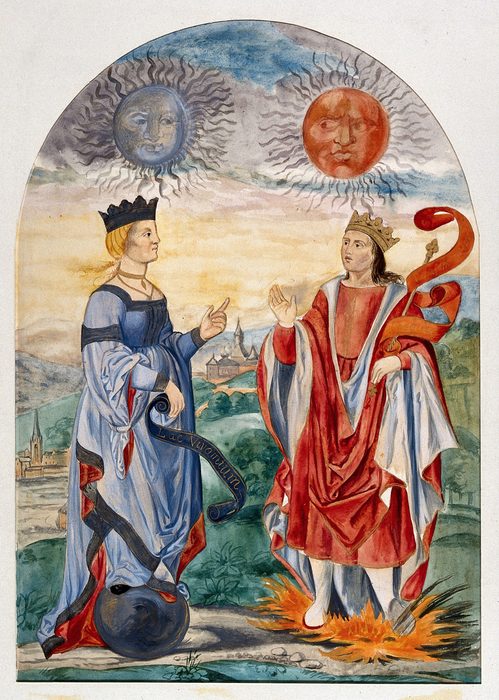
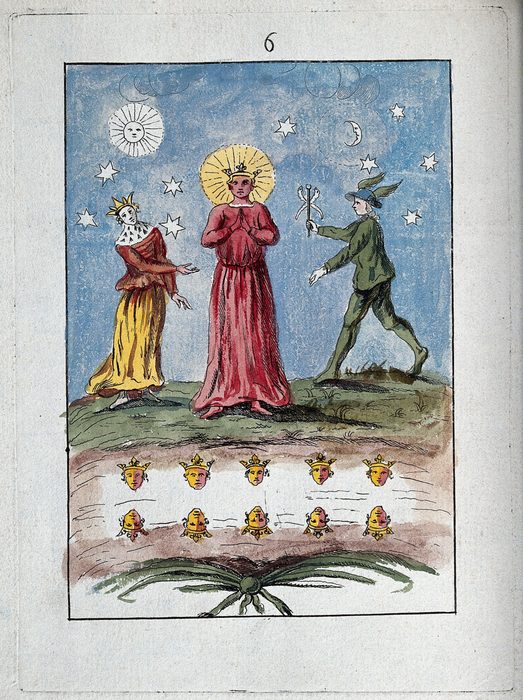
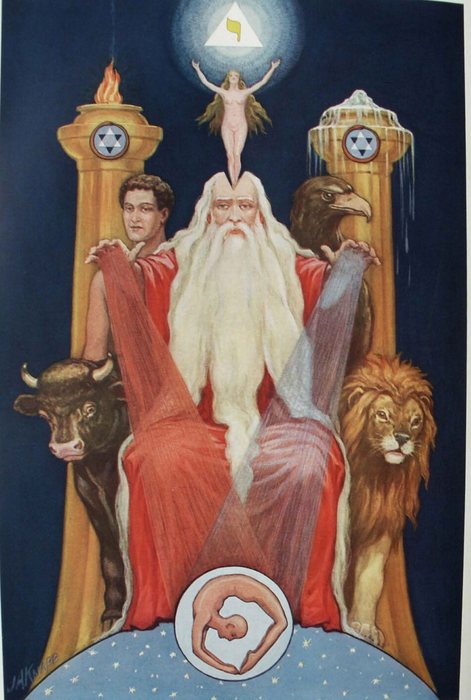
Where the detail is the subject
the Vessel · the Crown · the Sun and the Moon
Each of these is in the picture without being what it is about. Below, one work that is about each.
In the same series
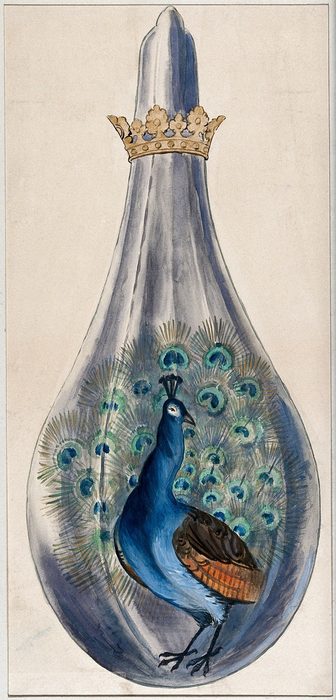
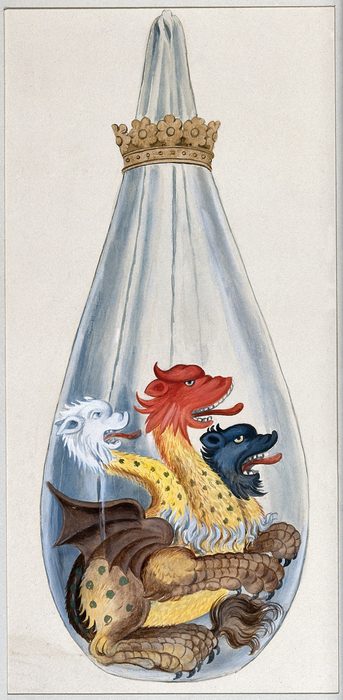
After Splendor Solis, watercolours by Edith A. Ibbs, 1900 to 1909
Record
One symbol a week, decoded.
This picture is free at full size from its source, linked above. What an address gets is the Sunday letter: one picture, one symbol marked on it, what it meant and who said so, and the master files of the decoded plates as they are verified. Leave any time.
Free, one letter a week, unsubscribe in one click. How the address is used.
Scroll or pinch to zoom · drag to move · double-tap for 1:1 · 749 by 1400 pixel web copy; the source file is linked under Record