A. E. Waite
Brooklyn 1857 to London 1942; devised the tarot of 1909, which Pamela Colman Smith drew, and wrote The Pictorial Key to the Tarot of 1911, in which he explains his own cards symbol by symbol and is the only maker in the archive who published a reading of every picture he commissioned.
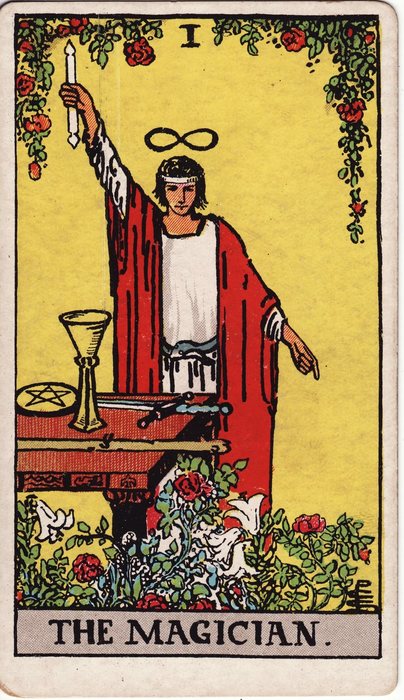 The Magician (I)
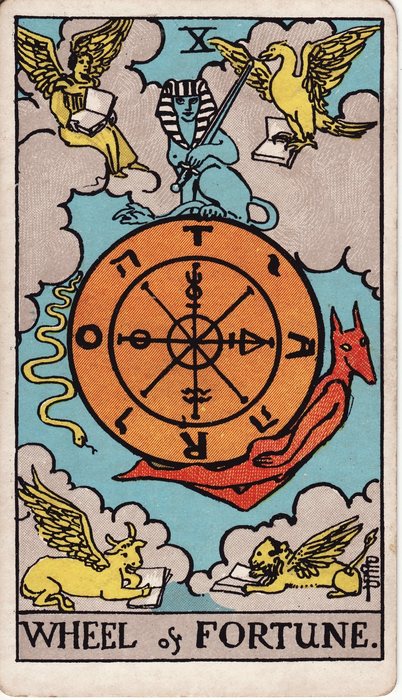 Wheel of Fortune (X)
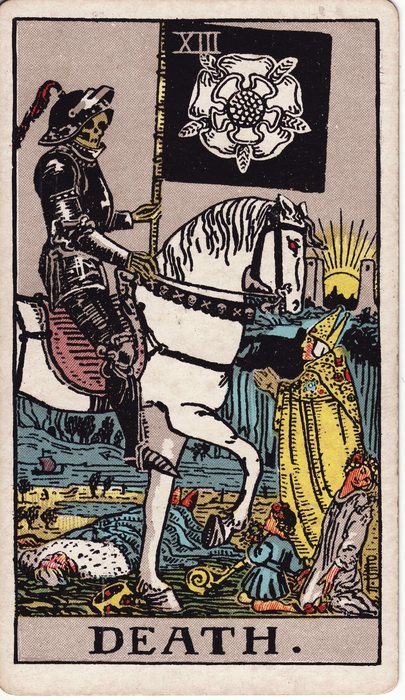 Death (XIII)
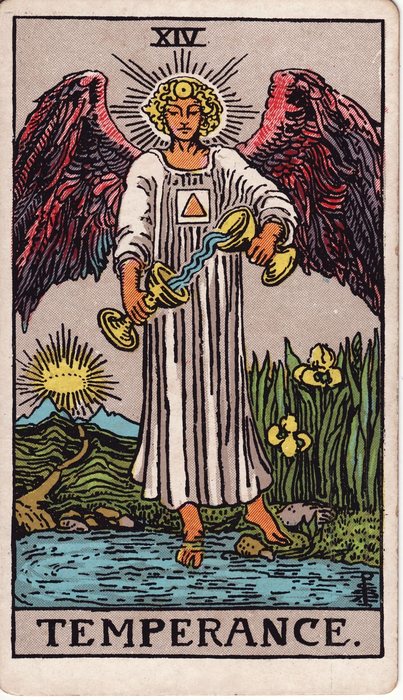 Temperance (XIV)
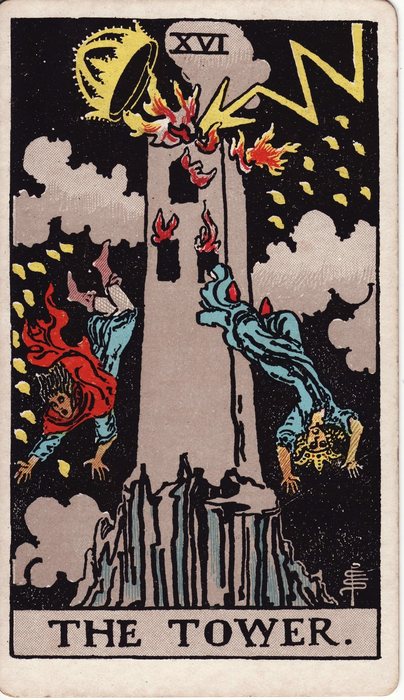 The Tower (XVI)
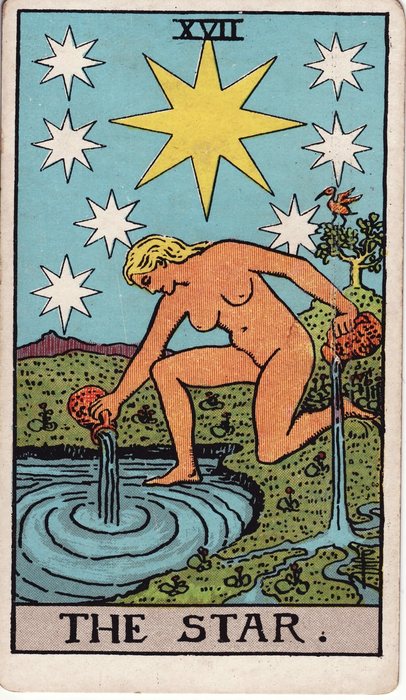 The Star (XVII)
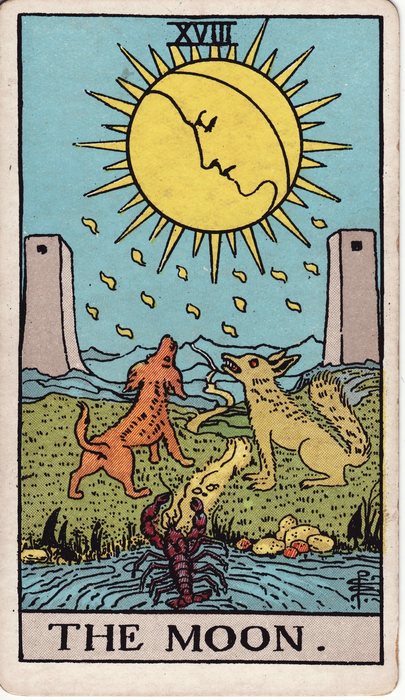 The Moon (XVIII)
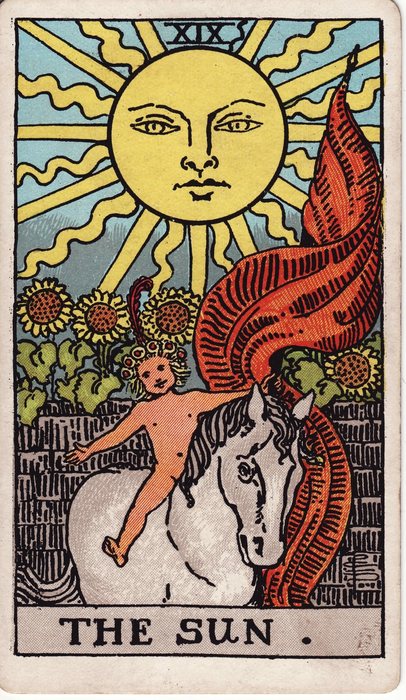 The Sun (XIX)
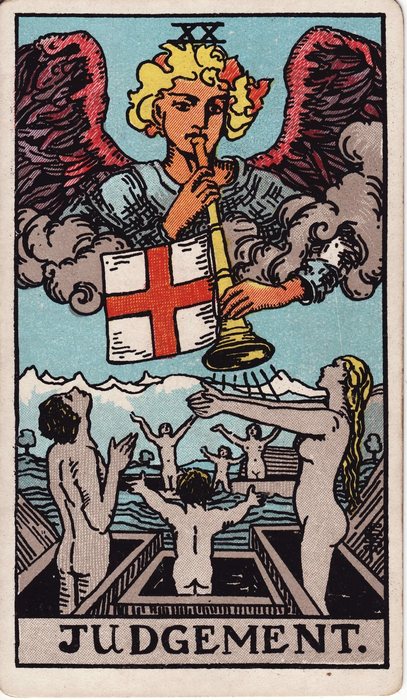 Judgement (XX)
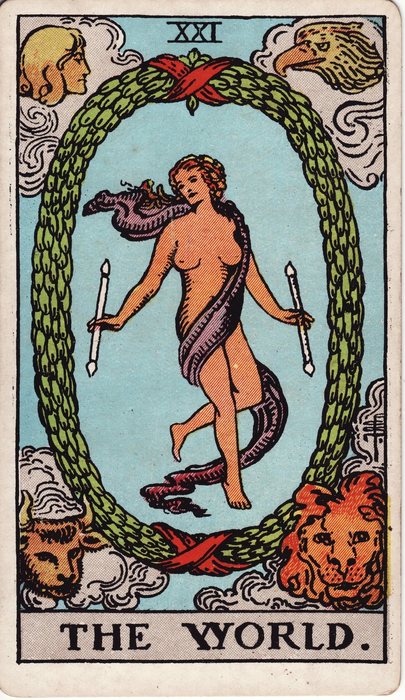 The World (XXI)
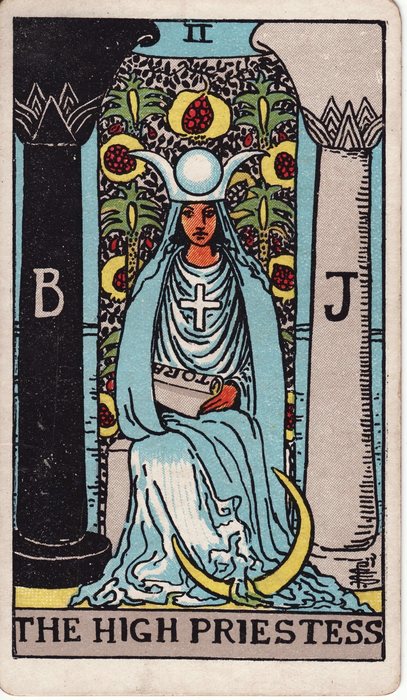 The High Priestess (II)
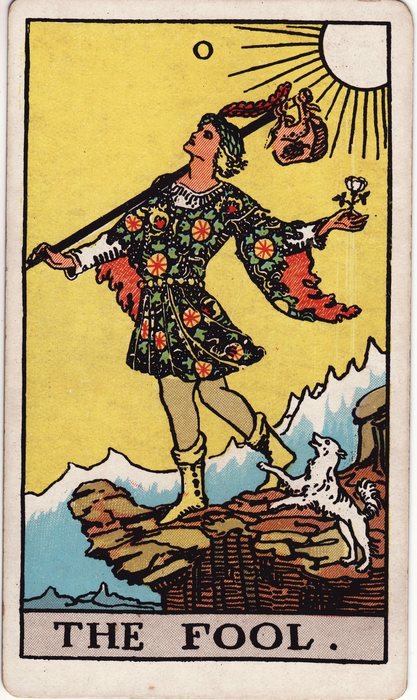 The Fool (0)
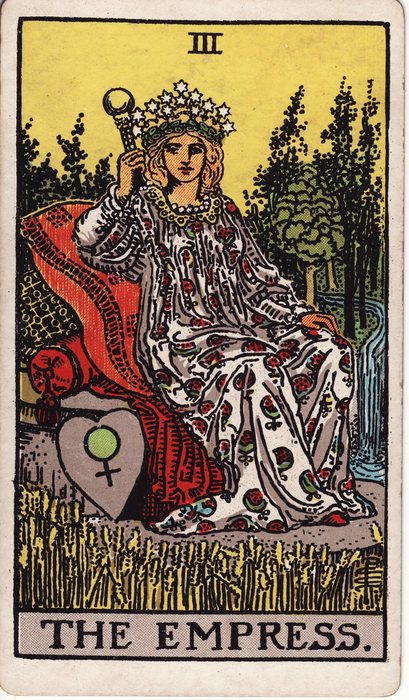 The Empress (III)
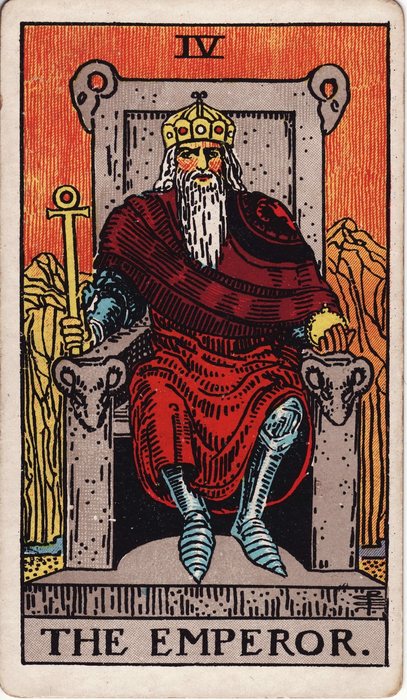 The Emperor (IV)
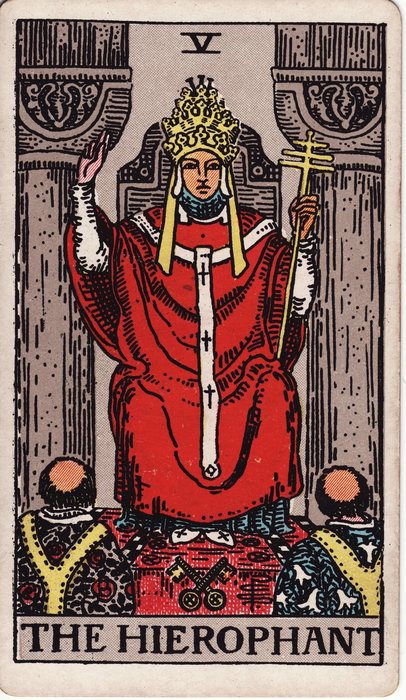 The Hierophant (V)
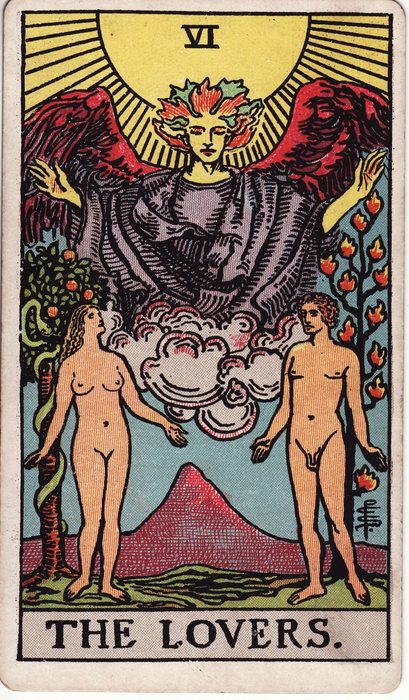 The Lovers (VI)
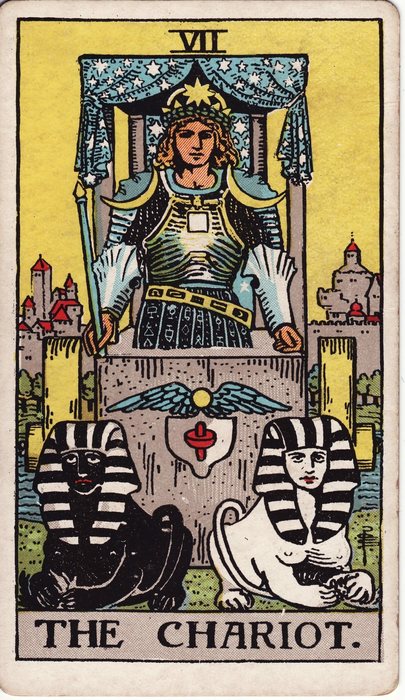 The Chariot (VII)
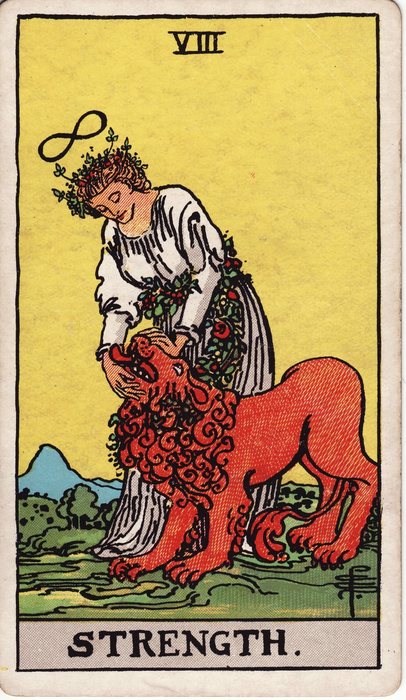 Strength (VIII)
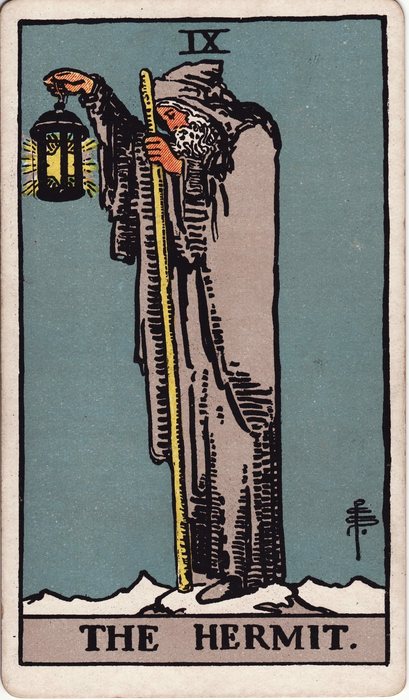 The Hermit (IX)
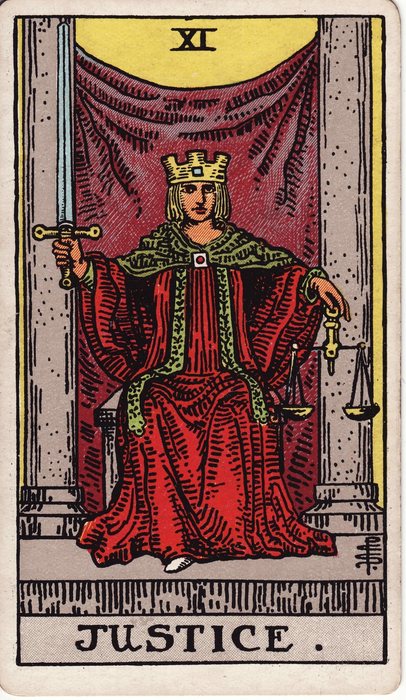 Justice (XI)
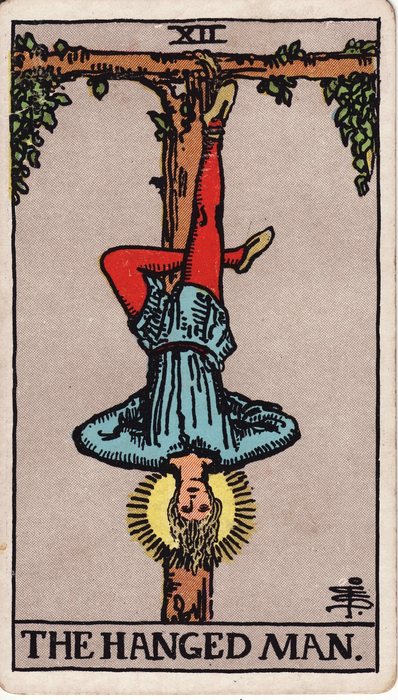 The Hanged Man (XII)
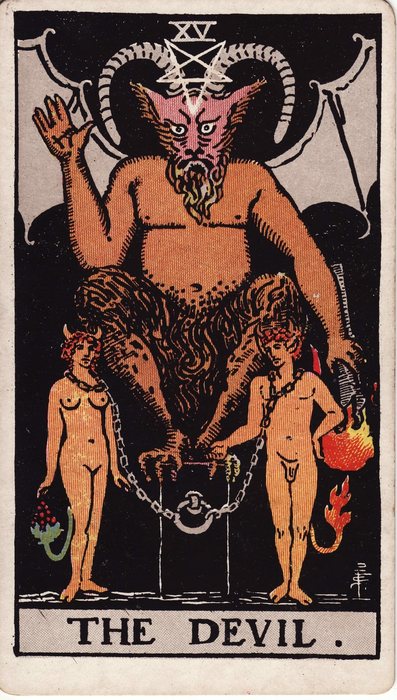 The Devil (XV)
Readings given
158 passages on 22 pictures in the archive, from The Pictorial Key to the Tarot.
-
Part II, The Doctrine Behind the Veil
“In the Magician's right hand is a wand raised towards heaven, while the left hand is pointing to the earth. This dual sign is known in very high grades of the Instituted Mysteries; it shews the descent of grace, virtue and light, drawn from things above and derived to things below.”
“The suggestion throughout is therefore the possession and communication of the Powers and Gifts of the Spirit.”
“About his waist is a serpent-cincture, the serpent appearing to devour its own tail. This is familiar to most as a conventional symbol of eternity, but here it indicates more especially the eternity of attainment in the spirit.”
“On the table in front of the Magician are the symbols of the four Tarot suits, signifying the elements of natural life, which lie like counters before the adept, and he adapts them as he wills.”
“A youthful figure in the robe of a magician, having the countenance of divine Apollo, with smile of confidence and shining eyes. Above his head is the mysterious sign of the Holy Spirit, the sign of life, like an endless cord, forming the figure 8 in a horizontal position.”
“This card signifies the divine motive in man, reflecting God, the will in the liberation of its union with that which is above. It is also the unity of individual being on all planes, and in a very high sense it is thought, in the fixation thereof.”
-
Part II, The Doctrine Behind the Veil
“With the French occultist, and in the design itself, the symbolic picture stands for the perpetual motion of a fluidic universe and for the flux of human life. The Sphinx is the equilibrium therein.”
“The transliteration of Taro as Rota is inscribed on the wheel, counterchanged with the letters of the Divine Name--to shew that Providence is implied through all.”
“The symbolism is, of course, not exclusively Egyptian, as the four Living Creatures of Ezekiel occupy the angles of the card, and the wheel itself follows other indications of Lévi in respect of Ezekiel's vision, as illustrative of the particular Tarot Key.”
“In this symbol I have again followed the reconstruction of Eliphas Lévi, who has furnished several variants. It is legitimate--as I have intimated--to use Egyptian symbolism when this serves our purpose, provided that no theory of origin is implied therein. I have, however, presented Typhon in his serpent form.”
“But this is the Divine intention within, and the similar intention without is exemplified by the four Living Creatures.”
“Sometimes the sphinx is represented couchant on a pedestal above, which defrauds the symbolism by stultifying the essential idea of stability amidst movement.”
“Behind the general notion expressed in the symbol there lies the denial of chance and the fatality which is implied therein.”
-
Part II, The Doctrine Behind the Veil
“The veil or mask of life is perpetuated in change, transformation and passage from lower to higher, and this is more fitly represented in the rectified Tarot by one of the apocalyptic visions than by the crude notion of the reaping skeleton.”
“The horseman carries no visible weapon, but king and child and maiden fall before him, while a prelate with clasped hands awaits his end.”
“The mysterious horseman moves slowly, bearing a black banner emblazoned with the Mystic Rose, which signifies life.”
“Between two pillars on the verge of the horizon there shines the sun of immortality.”
“The natural transit of man to the next stage of his being either is or may be one form of his progress, but the exotic and almost unknown entrance, while still in this life, into the state of mystical death is a change in the form of consciousness and the passage into a state to which ordinary death is neither the path nor gate.”
“The existing occult explanations of the 13th card are, on the whole, better than usual, rebirth, creation, destination, renewal, and the rest.”
Part I, The Veil and its Symbols, Class I, The Trumps Major, on the traditional design
“Other heads have been swept from their place previously, but it is, in its current and patent meaning, more especially a card of the death of Kings.”
-
Part II, The Doctrine Behind the Veil
“I speak of him in the masculine sense, but the figure is neither male nor female.”
“It is, moreover, untrue to say that the figure symbolizes the genius of the sun, though it is the analogy of solar light, realized in the third part of our human triplicity.”
“It is called Temperance fantastically, because, when the rule of it obtains in our consciousness, it tempers, combines and harmonises the psychic and material natures.”
“It is held to be pouring the essences of life from chalice to chalice.”
“It has one foot upon the earth and one upon waters, thus illustrating the nature of the essences.”
“A winged angel, with the sign of the sun upon his forehead and on his breast the square and triangle of the septenary.”
“A direct path goes up to certain heights on the verge of the horizon, and above there is a great light, through which a crown is seen vaguely. Hereof is some part of the Secret of Eternal Life, as it is possible to man in his incarnation.”
“All the conventional emblems are renounced herein. So also are the conventional meanings, which refer to changes in the seasons, perpetual movement of life and even the combination of ideas.”
“Under that rule we know in our rational part something of whence we came and whither we are going.”
-
Part I, The Veil and its Symbols, Class I, The Trumps Major
“It is a little surprising that the device has not so far been allocated to the destruction of Solomon's Temple, when the lightning would symbolize the fire and sword with which that edifice was visited by the King of the Chaldees.”
“Its alternative titles are: Castle of Plutus, God's House and the Tower of Babel. In the last case, the figures falling therefrom are held to be Nimrod and his minister.”
Part II, The Doctrine Behind the Veil
“It is idle to indicate that it depicts ruin in all its aspects, because it bears this evidence on the surface.”
“I agree rather with Grand Orient that it is the ruin of the House of Life, when evil has prevailed therein, and above all that it is the rending of a House of Doctrine. I understand that the reference is, however, to a House of Falsehood.”
-
Part II, The Doctrine Behind the Veil
“A great, radiant star of eight rays, surrounded by seven lesser stars--also of eight rays.”
“The star is l'étoile flamboyante, which appears in Masonic symbolism, but has been confused therein.”
“She pours Water of Life from two great ewers, irrigating sea and land.”
“It has been said truly that the mottoes of this card are "Waters of Life freely" and "Gifts of the Spirit."”
“The female figure in the foreground is entirely naked. Her left knee is on the land and her right foot upon the water.”
“For the majority of prepared minds, the figure will appear as the type of Truth unveiled, glorious in undying beauty, pouring on the waters of the soul some part and measure of her priceless possession. But she is in reality the Great Mother in the Kabalistic Sephira Binah, which is supernal Understanding, who communicates to the Sephiroth that are below in the measure that they can receive her influx.”
-
Part II, The Doctrine Behind the Veil
“The distinction between this card and some of the conventional types is that the moon is increasing on what is called the side of mercy, to the right of the observer. It has sixteen chief and sixteen secondary rays.”
“The intellectual light is a reflection and beyond it is the unknown mystery which it cannot shew forth.”
“The face of the mind directs a calm gaze upon the unrest below; the dew of thought falls; the message is: Peace, be still; and it may be that there shall come a calm upon the animal nature, while the abyss beneath shall cease from giving up a form.”
“It illuminates our animal nature, types of which are represented below--the dog, the wolf and that which comes up out of the deeps, the nameless and hideous tendency which is lower than the savage beast.”
“It strives to attain manifestation, symbolized by crawling from the abyss of water to the land, but as a rule it sinks back whence it came.”
“The card represents life of the imagination apart from life of the spirit. The path between the towers is the issue into the unknown.”
“The dog and wolf are the fears of the natural mind in the presence of that place of exit, when there is only reflected light to guide it.”
-
Part II, The Doctrine Behind the Veil
“The sun is that of consciousness in the spirit - the direct as the antithesis of the reflected light.”
“The card signifies, therefore, the transit from the manifest light of this world, represented by the glorious sun of earth, to the light of the world to come, which goes before aspiration and is typified by the heart of a child.”
“The naked child mounted on a white horse and displaying a red standard has been mentioned already as the better symbolism connected with this card. It is the destiny of the Supernatural East and the great and holy light which goes before the endless procession of humanity, coming out from the walled garden of the sensitive life and passing on the journey home.”
“The characteristic type of humanity has become a little child therein--a child in the sense of simplicity and innocence in the sense of wisdom. In that simplicity, he bears the seal of Nature and of Art; in that innocence, he signifies the restored world.”
“When the self-knowing spirit has dawned in the consciousness above the natural mind, that mind in its renewal leads forth the animal nature in a state of perfect conformity.”
Part I, The Veil and its Symbols, Class I, The Trumps Major
“The luminary is distinguished in older cards by chief rays that are waved and salient alternately and by secondary salient rays.”
“Eliphas Lévi says that these are sometimes replaced by a spinner unwinding destinies, and otherwise by a much better symbol-a naked child mounted on a white horse and displaying a scarlet standard.”
-
Part II, The Doctrine Behind the Veil
“The great angel is here encompassed by clouds, but he blows his bannered trumpet, and the cross as usual is displayed on the banner.”
“What is that within us which does sound a trumpet and all that is lower in our nature rises in response--almost in a moment, almost in the twinkling of an eye?”
“The dead are rising from their tombs--a woman on the right, a man on the left hand, and between them their child, whose back is turned. But in this card there are more than three who are restored, and it has been thought worth while to make this variation as illustrating the insufficiency of current explanations.”
“It is the card which registers the accomplishment of the great work of transformation in answer to the summons of the Supernal--which summons is heard and answered from within.”
-
Part II, The Doctrine Behind the Veil
“It represents also the perfection and end of the Cosmos, the secret which is within it, the rapture of the universe when it understands itself in God.”
“It is further the state of the soul in the consciousness of Divine Vision, reflected from the self-knowing spirit.”
“But it is perhaps more especially a story of the past, referring to that day when all was declared to be good, when the morning stars sang together and all the Sons of God shouted for joy.”
Part I, The Veil and its Symbols, Class I, The Trumps Major
“Eliphas Lévi calls the garland a crown, and reports that the figure represents Truth.”
“It is eloquent as an image of the swirl of the sensitive life, of joy attained in the body, of the soul's intoxication in the earthly paradise, but still guarded by the Divine Watchers, as if by the powers and the graces of the Holy Name, Tetragammaton, JVHV--those four ineffable letters which are sometimes attributed to the mystical beasts.”
“The four living creatures of the Apocalypse and Ezekiel's vision, attributed to the evangelists in Christian symbolism, are grouped about an elliptic garland, as if it were a chain of flowers intended to symbolize all sensible things; within this garland there is the figure of a woman, whom the wind has girt about the loins with a light scarf, and this is all her vesture.”
“She is in the act of dancing, and has a wand in either hand.”
-
Part II, The Doctrine Behind the Veil
“She is seated between the white and black pillars--J. and B.--of the mystic Temple, and the veil of the Temple is behind her: it is embroidered with palms and pomegranates.”
“She has the lunar crescent at her feet, a horned diadem on her head, with a globe in the middle place, and a large solar cross on her breast.”
“She is, in fine, the Queen of the borrowed light, but this is the light of all. She is the Moon nourished by the milk of the Supernal Mother.”
“She has the lunar crescent at her feet, a horned diadem on her head, with a globe in the middle place.”
-
Part II, The Doctrine Behind the Veil
“The sun, which shines behind him, knows whence he came, whither he is going, and how he will return by another path after many days. He is the spirit in search of experience.”
“He has a rose in one hand and in the other a costly wand, from which depends over his right shoulder a wallet curiously embroidered. He is a prince of the other world on his travels through this one-all amidst the morning glory, in the keen air.”
“Many symbols of the Instituted Mysteries are summarized in this card, which reverses, under high warrants, all the confusions that have preceded it.”
“The conventional explanations say that the Fool signifies the flesh, the sensitive life, and by a peculiar satire its subsidiary name was at one time the alchemist, as depicting folly at the most insensate stage.”
“With light step, as if earth and its trammels had little power to restrain him, a young man in gorgeous vestments pauses at the brink of a precipice among the great heights of the world; he surveys the blue distance before him-its expanse of sky rather than the prospect below.”
“His act of eager walking is still indicated, though he is stationary at the given moment; his dog is still bounding. The edge which opens on the depth has no terror; it is as if angels were waiting to uphold him, if it came about that he leaped from the height.”
Part I, The Veil and its Symbols, Class I, The Trumps Major
“Court de Gebelin places it at the head of the whole series as the zero or negative which is presupposed by numeration, and as this is a simpler so also it is a better arrangement.”
“The Fool carries a wallet; he is looking over his shoulder and does not know that he is on the brink of a precipice; but a dog or other animal--some call it a tiger--is attacking him from behind, and he is hurried to his destruction unawares.”
-
Part II, The Doctrine Behind the Veil
“A stately figure, seated, having rich vestments and royal aspect, as of a daughter of heaven and earth.”
“She is the inferior Garden of Eden, the Earthly Paradise, all that is symbolized by the visible house of man. She is not Regina coeli, but she is still refugium peccatorum, the fruitful mother of thousands.”
“She is above all things universal fecundity and the outer sense of the Word.”
“Her diadem is of twelve stars, gathered in a cluster.”
“There are also certain aspects in which she has been correctly described as desire and the wings thereof, as the woman clothed with the sun, as Gloria Mundi and the veil of the Sanctum Sanctorum; but she is not, I may add, the soul that has attained wings, unless all the symbolism is counted up another and unusual way.”
“A field of corn is ripening in front of her, and beyond there is a fall of water.”
“In another order of ideas, the card of the Empress signifies the door or gate by which an entrance is obtained into this life, as into the Garden of Venus; and then the way which leads out therefrom, into that which is beyond, is the secret known to the High Priestess: it is communicated by her to the elect.”
“Most old attributions of this card are completely wrong on the symbolism--as, for example, its identification with the Word, Divine Nature, the Triad, and so forth.”
“The symbol of Venus is on the shield which rests near her.”
“The sceptre which she bears is surmounted by the globe of this world.”
-
Part II, The Doctrine Behind the Veil
“He is a crowned monarch--commanding, stately, seated on a throne, the arms of which are fronted by rams' heads.”
“He is executive and realization, the power of this world, here clothed with the highest of its natural attributes.”
“He is the virile power, to which the Empress responds, and in this sense is he who seeks to remove the Veil of Isis; yet she remains virgo intacta.”
“On the surface, as I have indicated, they stand for mundane royalty, uplifted on the seats of the mighty; but above this there is the suggestion of another presence. They signify also--and the male figure especially--the higher kingship, occupying the intellectual throne.”
“He has a form of the Crux ansata for his sceptre and a globe in his left hand.”
“It should be understood that this card and that of the Empress do not precisely represent the condition of married life, though this state is implied.”
“Hereof is the lordship of thought rather than of the animal world. Both personalities, after their own manner, are "full of strange experience," but theirs is not consciously the wisdom which draws from a higher world.”
“The Emperor has been described as (a) will in its embodied form, but this is only one of its applications, and (b) as an expression of virtualities contained in the Absolute Being--but this is fantasy.”
“He is occasionally represented as seated on a cubic stone, which, however, confuses some of the issues.”
-
Part II, The Doctrine Behind the Veil
“He wears the triple crown and is seated between two pillars, but they are not those of the Temple which is guarded by the High Priestess.”
“He has been usually called the Pope, which is a particular application of the more general office that he symbolizes. He is the ruling power of external religion, as the High Priestess is the prevailing genius of the esoteric, withdrawn power.”
“In his left hand he holds a sceptre terminating in the triple cross, and with his right hand he gives the well-known ecclesiastical sign which is called that of esotericism, distinguishing between the manifest and concealed part of doctrine. It is noticeable in this connexion that the High Priestess makes no sign.”
“Grand Orient says truly that the Hierophant is the power of the keys, exoteric orthodox doctrine, and the outer side of the life which leads to the doctrine; but he is certainly not the prince of occult doctrine, as another commentator has suggested.”
“He is rather the summa totius theologia, when it has passed into the utmost rigidity of expression; but he symbolizes also all things that are righteous and sacred on the manifest side.”
“He is the order and the head of the recognized hierarchy, which is the reflection of another and greater hierarchic order; but it may so happen that the pontiff forgets the significance of this his symbolic state and acts as if he contained within his proper measures all that his sign signifies or his symbol seeks to shew forth.”
“At his feet are the crossed keys, and two priestly ministers in albs kneel before him.”
-
Part II, The Doctrine Behind the Veil
“In the foreground are two human figures, male and female, unveiled before each other, as if Adam and Eve when they first occupied the paradise of the earthly body.”
“The figures suggest youth, virginity, innocence and love before it is contaminated by gross material desire. This is in all simplicity the card of human love, here exhibited as part of the way, the truth and the life.”
“The sun shines in the zenith, and beneath is a great winged figure with arms extended, pouring down influences.”
“Behind the man is the Tree of Life, bearing twelve fruits, and the Tree of the Knowledge of Good and Evil is behind the woman; the serpent is twining round it.”
“The suggestion in respect of the woman is that she signifies that attraction towards the sensitive life which carries within it the idea of the Fall of Man, but she is rather the working of a Secret Law of Providence than a willing and conscious temptress.”
“It replaces, by recourse to first principles, the old card of marriage, which I have described previously, and the later follies which depicted man between vice and virtue. In a very high sense, the card is a mystery of the Covenant and Sabbath.”
“It is through her imputed lapse that man shall arise ultimately, and only by her can he complete himself. The card is therefore in its way another intimation concerning the great mystery of womanhood.”
-
Part II, The Doctrine Behind the Veil
“On the shoulders of the victorious hero are supposed to be the Urim and Thummim.”
“He has thus replied to the sphinx, and it is on this account that I have accepted the variation of Eliphas Lévi; two sphinxes thus draw his chariot. He is above all things triumph in the mind.”
“It is to be understood for this reason (a) that the question of the sphinx is concerned with a Mystery of Nature and not of the world of Grace, to which the charioteer could offer no answer; (b) that the planes of his conquest are manifest or external and not within himself;”
“He has led captivity captive; he is conquest on all planes--in the mind, in science, in progress, in certain trials of initiation.”
“(c) that the liberation which he effects may leave himself in the bondage of the logical understanding; (d) that the tests of initiation through which he has passed in triumph are to be understood physically or rationally; and (e) that if he came to the pillars of that Temple between which the High Priestess is seated, he could not open the scroll called Tora, nor if she questioned him could he answer. He is not hereditary royalty and he is not priesthood.”
“An erect and princely figure carrying a drawn sword and corresponding, broadly speaking, to the traditional description which I have given in the first part.”
-
Part II, The Doctrine Behind the Veil
“A woman, over whose head there broods the same symbol of life which we have seen in the card of the Magician, is closing the jaws of a lion. The only point in which this design differs from the conventional presentations is that her beneficent fortitude has already subdued the lion, which is being led by a chain of flowers.”
“There is one aspect in which the lion signifies the passions, and she who is called Strength is the higher nature in its liberation. It has walked upon the asp and the basilisk and has trodden down the lion and the dragon.”
“A woman, over whose head there broods the same symbol of life which we have seen in the card of the Magician, is closing the jaws of a lion.”
“The card has nothing to do with self-confidence in the ordinary sense, though this has been suggested--but it concerns the confidence of those whose strength is God, who have found their refuge in Him.”
“For reasons which satisfy myself, this card has been interchanged with that of justice, which is usually numbered eight. As the variation carries nothing with it which will signify to the reader, there is no cause for explanation.”
“Fortitude, in one of its most exalted aspects, is connected with the Divine Mystery of Union; the virtue, of course, operates in all planes, and hence draws on all in its symbolism. It connects also with innocentia inviolata, and with the strength which resides in contemplation.”
“These higher meanings are, however, matters of inference, and I do not suggest that they are transparent on the surface of the card. They are intimated in a concealed manner by the chain of flowers, which signifies, among many other things, the sweet yoke and the light burden of Divine Law, when it has been taken into the heart of hearts.”
Part II, The Doctrine Behind the Veil, on the Magician
“Above his head is the mysterious sign of the Holy Spirit, the sign of life, like an endless cord, forming the figure 8 in a horizontal position.”
-
Part II, The Doctrine Behind the Veil
“The variation from the conventional models in this card is only that the lamp is not enveloped partially in the mantle of its bearer, who blends the idea of the Ancient of Days with the Light of the World. It is a star which shines in the lantern.”
“I have said that this is a card of attainment, and to extend this conception the figure is seen holding up his beacon on an eminence.”
“His beacon intimates that "where I am, you also may be."”
“It is a star which shines in the lantern.”
“Therefore the Hermit is not, as Court de Gebelin explained, a wise man in search of truth and justice; nor is he, as a later explanation proposes, an especial example of experience.”
“It is further a card which is understood quite incorrectly when it is connected with the idea of occult isolation, as the protection of personal magnetism against admixture. This is one of the frivolous renderings which we owe to Eliphas Lévi.”
“It did not refer to the intended concealment of the Instituted Mysteries, much less of their substitutes, but--like the card itself--to the truth that the Divine Mysteries secure their own protection from those who are unprepared.”
Part I, The Veil and its Symbols, Class I, The Trumps Major
“It is said also that his lantern contains the Light of Occult Science and that his staff is a Magic Wand. These interpretations are comparable in every respect to the divinatory and fortune-telling meanings with which I shall have to deal in their turn.”
“He is said to be in search of that Truth which is located far off in the sequence, and of justice which has preceded him on the way. But this is a card of attainment, as we shall see later, rather than a card of quest.”
-
Part II, The Doctrine Behind the Veil
“It will be seen, however, that the figure is seated between pillars, like the High Priestess, and on this account it seems desirable to indicate that the moral principle which deals unto every man according to his works--while, of course, it is in strict analogy with higher things;--differs in its essence from the spiritual justice which is involved in the idea of election.”
“In conclusion, the pillars of Justice open into one world and the pillars of the High Priestess into another.”
“As this card follows the traditional symbolism and carries above all its obvious meanings, there is little to say regarding it outside the few considerations collected in the first part, to which the reader is referred.”
“The latter belongs to a mysterious order of Providence, in virtue of which it is possible for certain men to conceive the idea of dedication to the highest things. The operation of this is like the breathing of the Spirit where it wills, and we have no canon of criticism or ground of explanation concerning it.”
“It is analogous to the possession of the fairy gifts and the high gifts and the gracious gifts of the poet: we have them or have not, and their presence is as much a mystery as their absence. The law of Justice is not however involved by either alternative.”
Part I, The Veil and its Symbols, Class I, The Trumps Major
“The female figure of the eleventh card is said to be Astreea, who personified the same virtue and is represented by the same symbols.”
“The Tarot has, therefore, its justice, its Temperance also and its Fortitude, but--owing to a curious omission--it does not offer us any type of Prudence, though it may be admitted that, in some respects, the isolation of the Hermit, pursuing a solitary path by the light of his own lamp, gives, to those who can receive it, a certain high counsel in respect of the via prudentie.”
-
Part II, The Doctrine Behind the Veil
“The gallows from which he is suspended forms a Tau cross, while the figure--from the position of the legs--forms a fylfot cross. There is a nimbus about the head of the seeming martyr.”
“It should be noted (1) that the tree of sacrifice is living wood, with leaves thereon; (2) that the face expresses deep entrancement, not suffering; (3) that the figure, as a whole, suggests life in suspension, but life and not death.”
“I will say very simply on my own part that it expresses the relation, in one of its aspects, between the Divine and the Universe.”
“It is a card of profound significance, but all the significance is veiled. One of his editors suggests that Eliphas Lévi did not know the meaning, which is unquestionable nor did the editor himself.”
“It has been called falsely a card of martyrdom, a card of prudence, a card of the Great Work, a card of duty; but we may exhaust all published interpretations and find only vanity.”
“He who can understand that the story of his higher nature is imbedded in this symbolism will receive intimations concerning a great awakening that is possible, and will know that after the sacred Mystery of Death there is a glorious Mystery of Resurrection.”
Part I, The Veil and its Symbols, Class I, The Trumps Major
“The figure of a man is suspended head-downwards from a gibbet, to which he is attached by a rope about one of his ankles. The arms are bound behind him, and one leg is crossed over the other. According to another, and indeed the prevailing interpretation, he signifies sacrifice, but all current meanings attributed to this card are cartomancists' intuitions, apart from any real value on the symbolical side.”
-
Part II, The Doctrine Behind the Veil
“The design is an accommodation, mean or harmony, between several motives mentioned in the first part. The Horned Goat of Mendes, with wings like those of a bat, is standing on an altar. At the pit of the stomach there is the sign of Mercury.”
“What it does signify is the Dweller on the Threshold without the Mystical Garden when those are driven forth therefrom who have eaten the forbidden fruit.”
“The Horned Goat of Mendes, with wings like those of a bat, is standing on an altar. At the pit of the stomach there is the sign of Mercury.”
“A reversed pentagram is on the forehead.”
“With more than his usual derision for the arts which he pretended to respect and interpret as a master therein, Eliphas Lévi affirms that the Baphometic figure is occult science and magic.”
“In the left hand there is a great flaming torch, inverted towards the earth.”
“The right hand is upraised and extended, being the reverse of that benediction which is given by the Hierophant in the fifth card.”
“There is a ring in front of the altar, from which two chains are carried to the necks of two figures, male and female. These are analogous with those of the fifth card, as if Adam and Eve after the Fall. Hereof is the chain and fatality of the material life.”
“The figures are tailed, to signify the animal nature, but there is human intelligence in the faces, and he who is exalted above them is not to be their master for ever. Even now, he is also a bondsman, sustained by the evil that is in him and blind to the liberty of service.”
“Another commentator says that in the Divine world it signifies predestination, but there is no correspondence in that world with the things which below are of the brute.”
Part I, The Veil and its Symbols, Class I, The Trumps Major
“Since 1856 the influence of Eliphas Lévi and his doctrine of occultism has changed the face of this card, and it now appears as a pseudo-Baphometic figure with the head of a goat and a great torch between the horns; it is seated instead of erect, and in place of the generative organs there is the Hermetic caduceus.”
“In the eighteenth century this card seems to have been rather a symbol of merely animal impudicity. Except for a fantastic head-dress, the chief figure is entirely naked; it has bat-like wings, and the hands and feet are represented by the claws of a bird.”