The Fool (0)
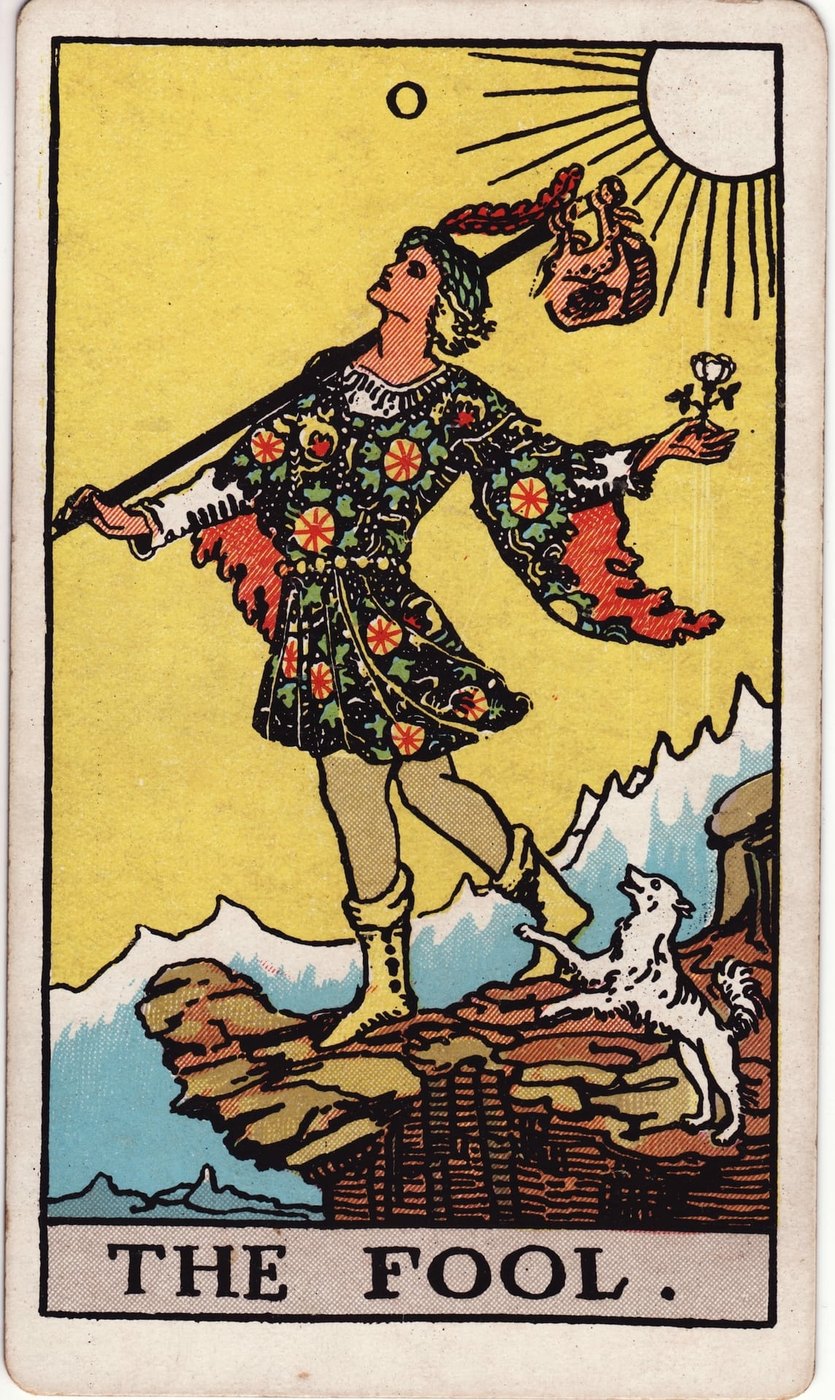
The Fool as the central motif, filed under the Sun and the Moon, with the Hand in a secondary part. From The 1909 tarot.
What is happening
Waite, 1911 “With light step, as if earth and its trammels had little power to restrain him, a young man in gorgeous vestments pauses at the brink of a precipice among the great heights of the world; he surveys the blue distance before him-its expanse of sky rather than the prospect below.”
Waite, 1911 “His act of eager walking is still indicated, though he is stationary at the given moment; his dog is still bounding. The edge which opens on the depth has no terror; it is as if angels were waiting to uphold him, if it came about that he leaped from the height.”
Waite, 1911 “The Fool carries a wallet; he is looking over his shoulder and does not know that he is on the brink of a precipice; but a dog or other animal--some call it a tiger--is attacking him from behind, and he is hurried to his destruction unawares.”
Key · 2 motifs
Tap a motif on the picture, or a line below. Its note opens under the line, with the reading its author gave it.
- Primary motif
- Secondary motifs · 1
The picture
A young man in a flowered tunic at the edge of a precipice, a white rose in his left hand, a wand with a wallet over his right shoulder, a white dog at his heels, the sun shining behind him and mountains beyond; the Fool as the central motif. By eye
The reading
The picture read whole, in the archive's words, from the sources quoted on the marks. Read on, and the picture follows: the motif under discussion keeps its colour.
Waite's Fool is not falling, and his account insists on it. On the older cards a jester is hurried over a cliff by a dog snapping at his legs. Here the young man ‘pauses at the brink of a precipice among the great heights of the world’ and looks at the sky instead of the drop, and Waite says it flatly: ‘the edge which opens on the depth has no terror’. The dog is still bounding at his heels, but it has changed sides. It is company now.
What he carries says who he is. A white rose held loosely in one hand, a wand over the shoulder with an embroidered wallet hanging off it, and a tunic covered in flowers, which Waite calls gorgeous vestments. He is ‘a prince of the other world on his travels through this one’, and the wallet is the whole of his luggage. The older glosses had it stuffed with his follies and his vices; Waite calls that bourgeois and arbitrary and drops it.
The sun is behind him, and Waite gives it a mind. It ‘knows whence he came, whither he is going, and how he will return by another path after many days’. So there is one knowing thing in the picture, and the traveller has his back to it. He is ‘the spirit in search of experience’. He does not know the route. Something does.
The card is numbered zero and Waite keeps it at the head of the sequence, where Court de Gébelin put it, as the zero or negative that numeration presupposes. Everything else in the deck is counted. This is the one who has not started counting. His last word on the card is that ‘many symbols of the Instituted Mysteries are summarized in this card’, and then he declines to list a single one.
Readings quoted
Waite, 1911 “Many symbols of the Instituted Mysteries are summarized in this card, which reverses, under high warrants, all the confusions that have preceded it.”
Waite, 1911 “The conventional explanations say that the Fool signifies the flesh, the sensitive life, and by a peculiar satire its subsidiary name was at one time the alchemist, as depicting folly at the most insensate stage.”
Waite, 1911 “Court de Gebelin places it at the head of the whole series as the zero or negative which is presupposed by numeration, and as this is a simpler so also it is a better arrangement.”
Decoded: every motif is marked, and each mark carries the reading its author gave it, quoted from the text, or says that it is observed on the picture and not read. The reading above is the archive's own, made from those sources and no others.
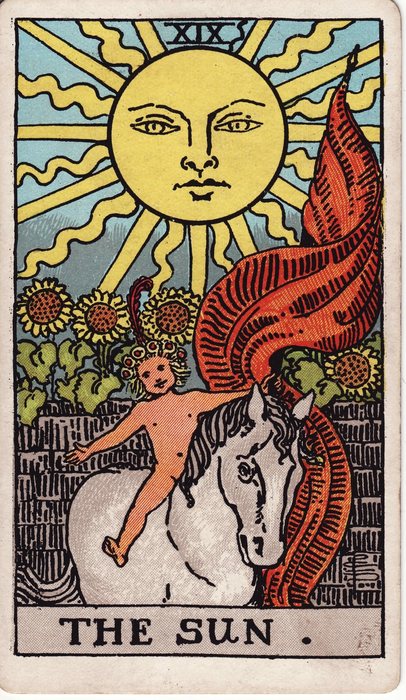
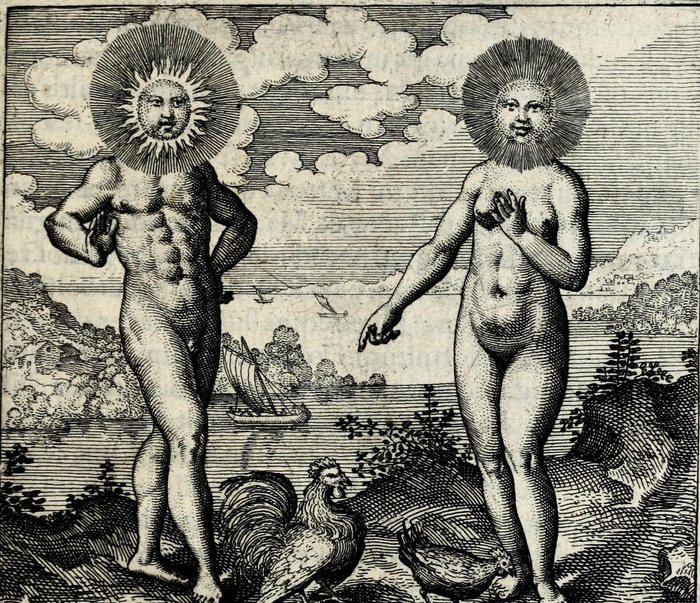
Gold, the perfected metal, and the illuminated intellect. The most overloaded symbol in the tradition.
In plain words The sun stands behind him, not ahead of him. Waite makes it the one thing in the picture that knows the whole journey, where the young man came from and how he will come back, which is why it is at his back: he is walking away from what knows him, into the open.
Waite, 1911 “The sun, which shines behind him, knows whence he came, whither he is going, and how he will return by another path after many days. He is the spirit in search of experience.”
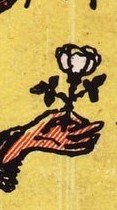
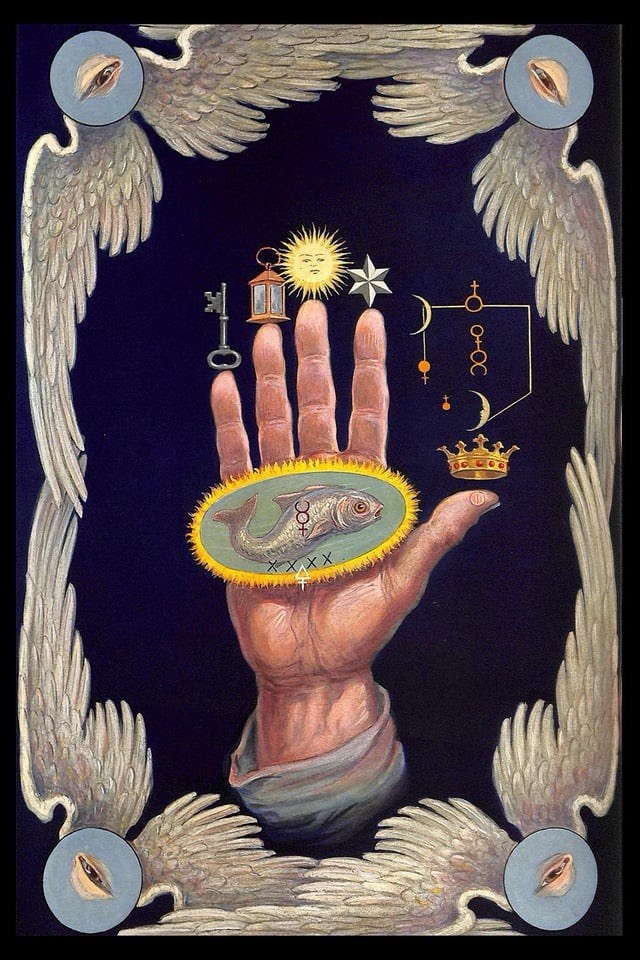
The hand as a sign in itself: what it holds, where it points, which fingers are raised. On the Hand of the Mysteries every finger carries a sign of its own.
In plain words One hand holds a white rose lightly, the other a wand with a small embroidered bag hung from it. Waite reads the whole figure as a prince from another world travelling through this one, and the two hands carry what such a traveller would: a flower, and everything he owns in one bag.
Waite, 1911 “He has a rose in one hand and in the other a costly wand, from which depends over his right shoulder a wallet curiously embroidered. He is a prince of the other world on his travels through this one-all amidst the morning glory, in the keen air.”
Also carrying the Sun and the Moon
59 works carry it. The 6 where it is the central motif are here. The symbol.
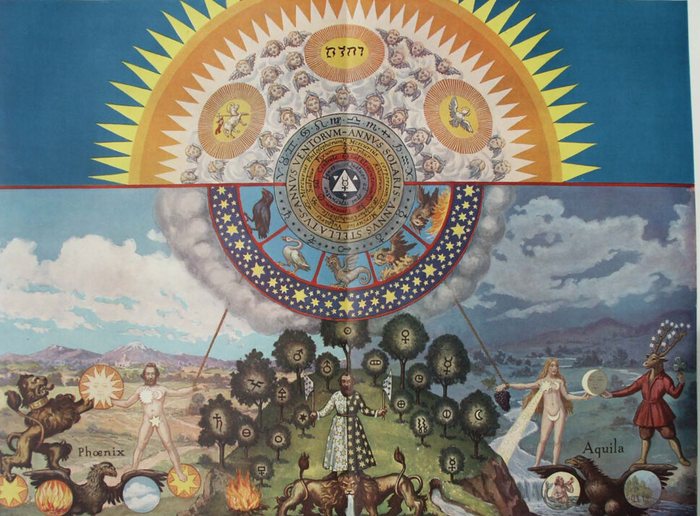
Where the detail is the subject
This is in the picture without being what it is about. Below, one work that is about it.
In the same series
Record
One symbol a week, decoded.
This picture is free at full size from its source, linked above. What an address gets is the Sunday letter: one picture, one symbol marked on it, what it meant and who said so, and the master files of the decoded plates as they are verified. Leave any time.
Free, one letter a week, unsubscribe in one click. How the address is used.
Scroll or pinch to zoom · drag to move · double-tap for 1:1 · 835 by 1400 pixel web copy; the source file is linked under Record