The Angelic Orders
the nine orders, the celestial hierarchy, the angelic hierarchy, the choirs of angels
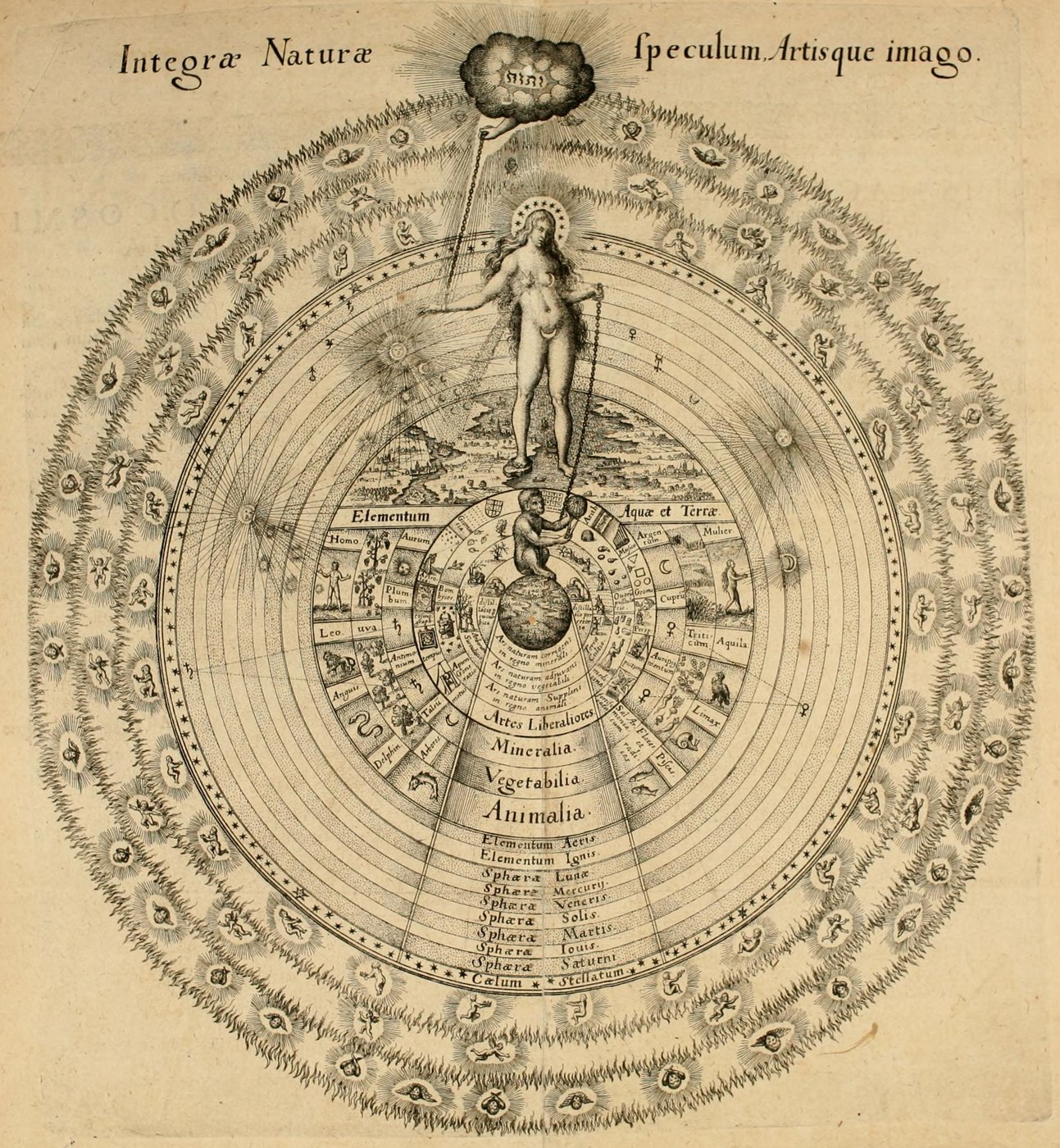
Nine ranks of angels, drawn as rings or as rungs. Note which order the picture puts at the top, and whether the book beside it agrees.
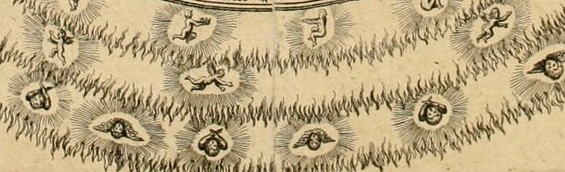
Fludd put the angels outside the stars, in three rings of fire, and accounted for them in the same volume. God divided the first mass into three parts by purity, and out of the purest he made, in Fludd’s own list, “Cherubin, Seraphin, Archangelos & omnes aliorum Angelorum ordines”, the Cherubim, Seraphim, Archangels and all the other orders of angels. Three get named. The rest arrive as an etcetera, and a reader who wants the whole list has to go elsewhere for it.
Craven, writing Fludd’s life in 1902 with the engraving in front of him, counted the rings and then stalled: “three orders of angels; cherubim highest, next seraphim, then what appear to be either ransomed souls or more ordinary angelic beings.” A biographer could not name the outermost rank. He also recorded, without pausing over it, that his subject had set the cherubim above the seraphim.
The whole list came out of one book, written in Greek under a borrowed name, and that book settled the number before anybody drew anything: “The Word of God has designated the whole Heavenly Beings as nine, by appellations, which shew their functions. These our Divine Initiator divides into three threefold Orders.” Nine, in three groups of three. Every ring and every ladder since works off that count.
Kircher bolted the nine onto the Sephiroth, one order to a circle, and wrote out each joint in his chapter on the Cabala. The Crown pours its goodness “supra Seraphinos”; Wisdom carries it “supra Cherubinos”; Understanding sends it “primò in Chorum Thronorum”. Below those, Mercy feeds the “Chorum Dominationum”, Severity the “ordinem Potestatum”, Beauty the “ordinem virtutum”, Victory the “Principatus”, Honour the “Archangelos”, Foundation the “Angelos”. Nine circles, nine orders, and beside each a planet with an intelligence to steer it.
Ten circles, though, and the Greek supplies only nine. Kircher does not stretch them to fit. For Kingdom, the tenth, he reaches into the other tradition and takes a rank from there: the channel runs into the order of the Ishim, “id est, Animarum”, that is, of souls, with Mitatron over it and the whole elemental world beneath the moon below. Two schemes that divide into different numbers of parts, joined at the foot of the plate, and the seam shows.
He flags the borrowing himself, at the head of the section, before naming a single rank: “Aduerte me hìc Angelorum nomina, aliaque omnia, ex Rabbinorum mente enumerare”, note that here I set out the names of the angels, and everything else, from the mind of the Rabbis. A Jesuit reporting, and saying on the page that he reports.
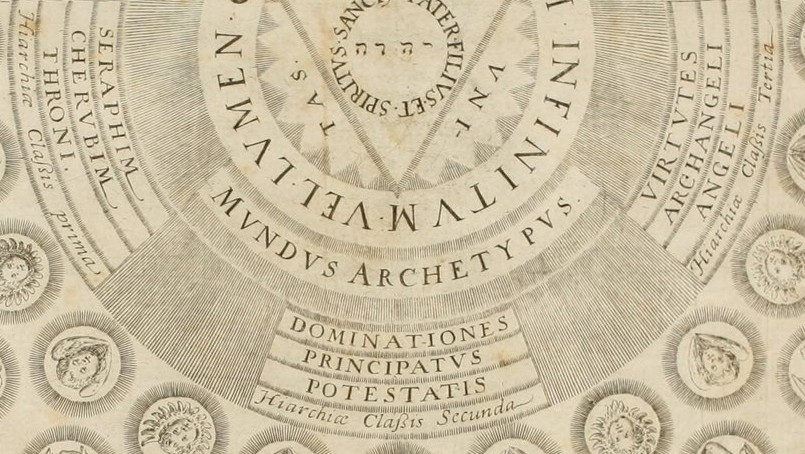
A third plate settles nothing. Twenty-five years after Kircher, an unsigned engraving at the back of the Musaeum Hermeticum letters all nine on the picture itself, in three banners round a Trinity: “SERAPHIM. CHERVBIM. THRONI. Hiarchiae Classis prima.” Then “DOMINATIONES. PRINCIPATVS. POTESTATIS. Hiarchiae Classis Secunda.” Then “VIRTVTES. ARCHANGELI. ANGELI. Hiarchiae Classis Tertia.” Kircher gave the Virtues the sixth place and the Principalities the seventh. This engraver swaps them, and drops the Virtues a whole class. Two sheets from the same century, the same nine names, no agreement about which rank stands where.
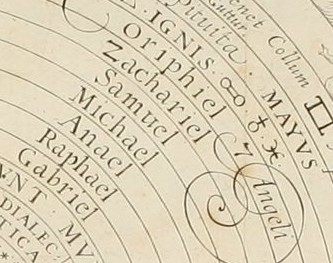
The planetary angels do no better. A second plate in the same 1678 set names seven of them round a wheel of the elemental world, “Oriphiel. Zachariel. Samuel. Michael. Anael. Raphael. Gabriel.” Kircher had already run the same names down his tree and handed Raphael the sun and Michael the heaven of Mercury. This wheel gives Michael the sun and Raphael Mercury. Two plates, one century, seven names, and the two most famous of them swapped.
One check worth making against any of these diagrams. Recite the nine and they come down in a fixed order, Seraphim at the top, Angels at the foot. The sentence that fixed the triads does not run that way. Its first group arrives as “the most Holy Thrones, and the many-eyed and many-winged hosts, named in the Hebrew tongue Cherubim and Seraphim”, with the Thrones in front. Its second reads “the Authorities, and Lordships, and Powers”, and its third names “the Order of the Angels and Archangels and Principalities”, climbing while the ladder descends. Somebody straightened that into a descent, and no page held here shows who.
Contested
The name on the Greek is borrowed, the archive quotes it in John Parker’s English of 1897 rather than in Greek, and that puts two removes between this page and the text which fixed the number. Fludd names three orders and waves at the rest; Craven, with the engraving in front of him, could not tell what the outer ring held, and the archive keeps his uncertainty rather than filling it. Kircher’s ladder carries his own warning that he sets the names out from the mind of the Rabbis, so his chapter reports a scheme rather than asserting one, and his plate letters no order names at all, where the Frankfurt engraving letters every one of them. Every rung of the Sephirotic ladder quoted here comes from the text beside the engraving, caput VIII, pages 292 to 295, read against the page images of the Sevilla copy.
Sources
- Dionysius the Areopagite, The Celestial Hierarchy, 1897: Caput VI, in John Parker’s English, London 1897, pages 23 and 24. The name is attributed and not the man, and the Greek is centuries older than the English quoted here.
- Robert Fludd, Utriusque cosmi historia, Tomus primus, Tractatus primus, 1617: Fludd’s own explanation of the plate, page 7, where the orders are made out of the purest part of the first mass.
- J. B. Craven, Doctor Robert Fludd (Robertus de Fluctibus), the English Rosicrucian: Life and Writings, 1902: Chapter IX, describing the plate ring by ring. A biographer reading the engraving in 1902, not Fludd explaining himself.
- Athanasius Kircher, Oedipus Aegyptiacus, Tomus II pars I, Classis IV, Cabala Hebraeorum, 1653: Caput VIII, pages 292 to 295, where each Sephirah is given its order of angels, its planet and its intelligence in turn, under Kircher’s own warning that he sets them out from the mind of the Rabbis.
On the same plate
Where it appears · 4
4 works in the archive carry the Angelic Orders. First the 4 where it has been read, with the Angelic Orders itself picked out.