Mundus Elementaris, the world under the moon as a wheel
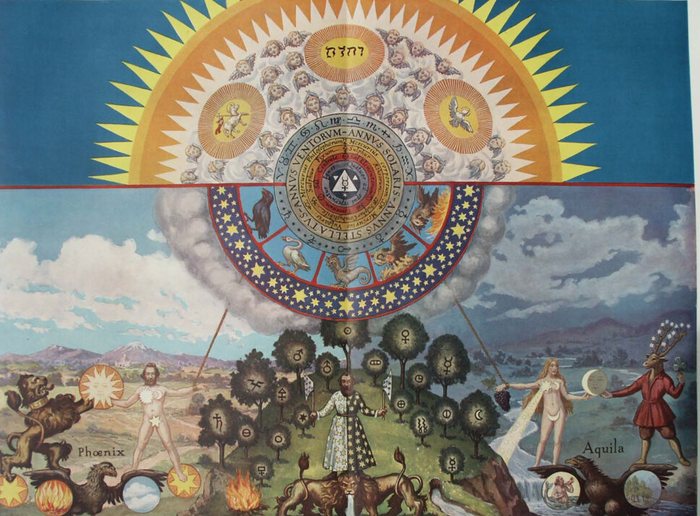
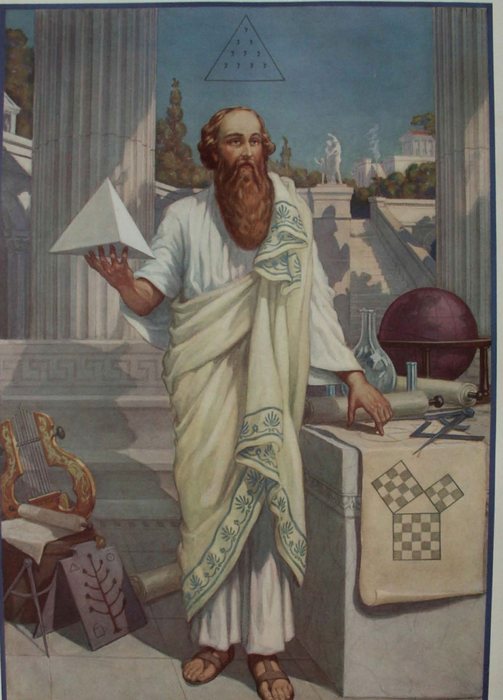
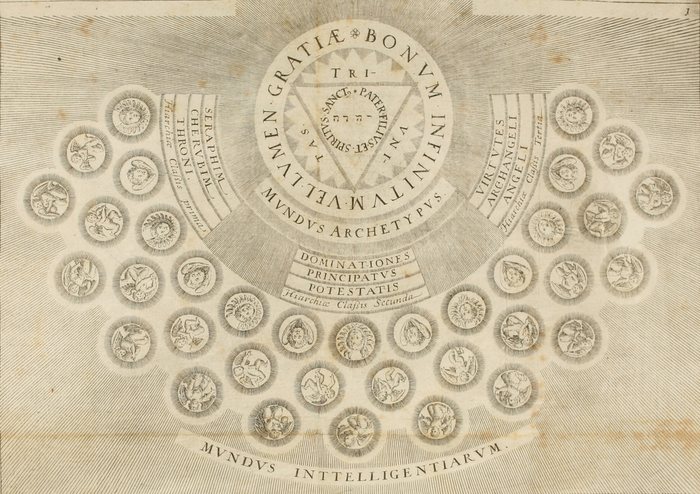
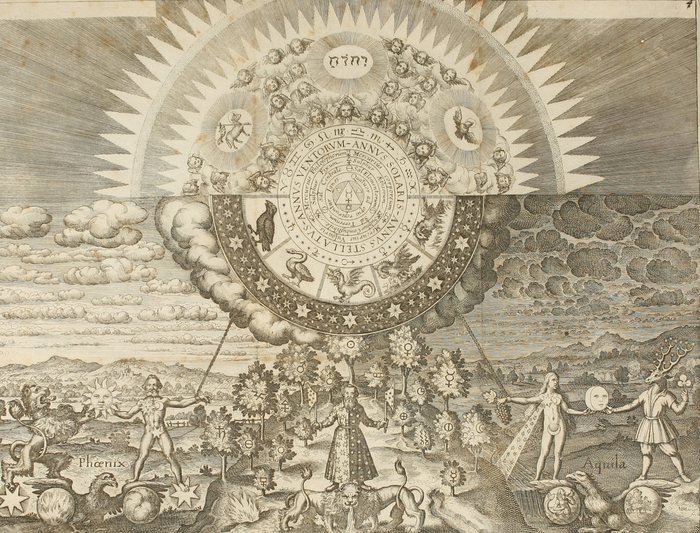
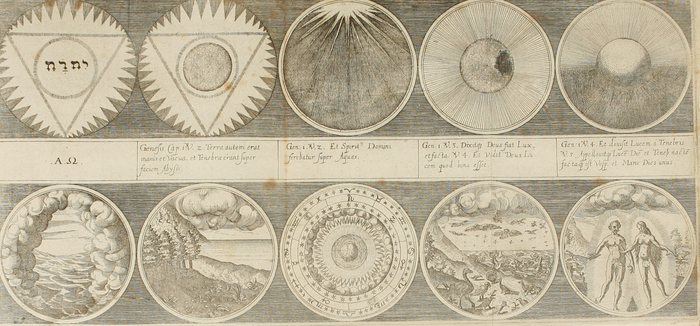
The Heavens as the central motif, with the Angel and the Wing, the Sun and the Moon, and the Triangle and the Pyramid in a secondary part. From Musaeum Hermeticum.
What is happening
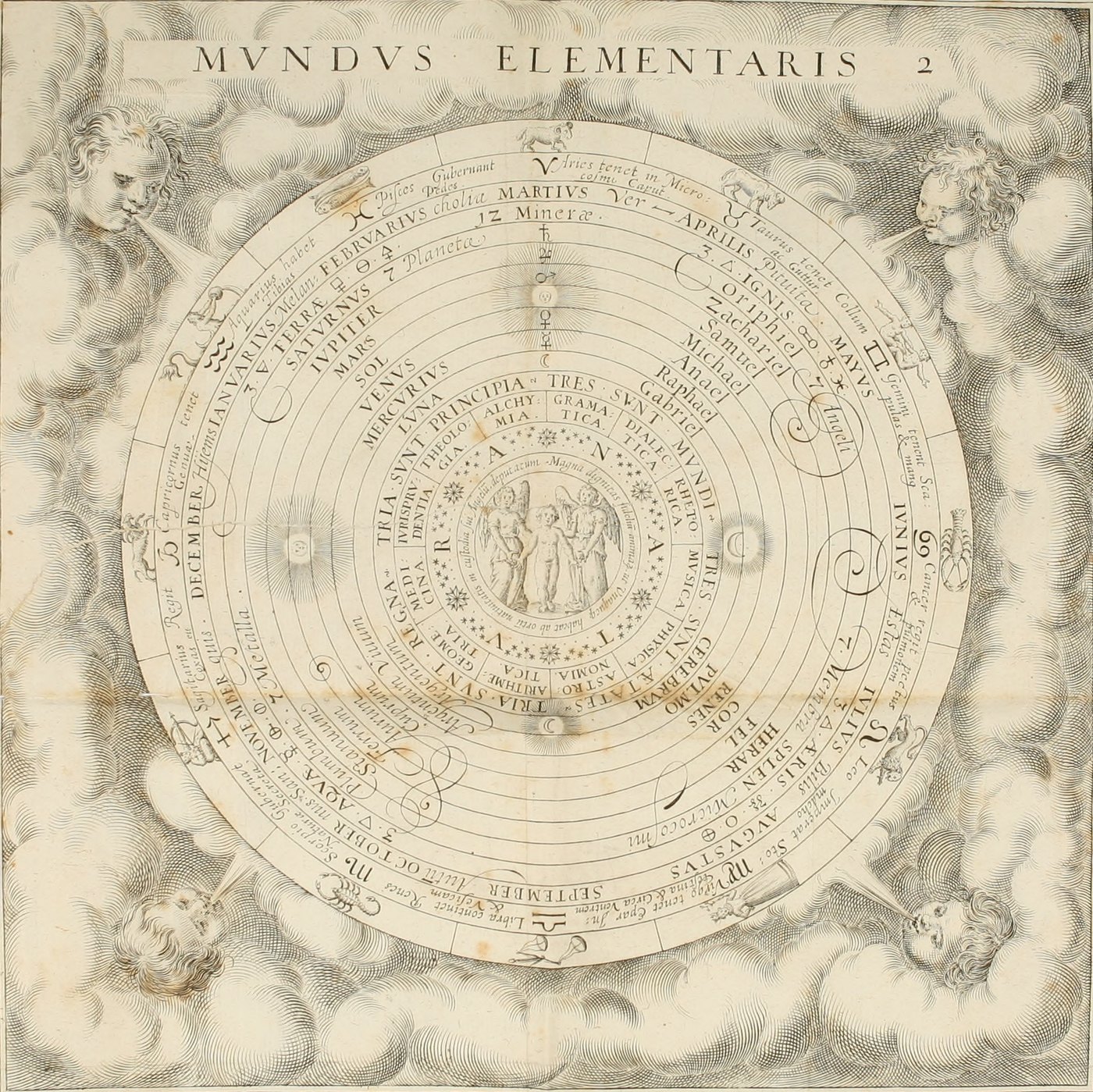
The plate, 1678 “MVNDVS ELEMENTARIS 2.”
Symbolica, 2026 The plate's Latin, put into English here: the elemental world. It is the second of the four, and it draws the world under the moon as one wheel with everything in it lined up ring by ring.
The plate, 1678 “Autor Enchiridii Physicae Restitutae. Can. 1. seq.”
Jean d’Espagnet, 1678 “Deus est Ens Aeternum, Unitas Infinita, Radicale Rerum omnium Principium: Cujus Essentia est Lux Immensa: Potestas Omnipotentia: Voluntas Bonum Perfectum: Nutus Opus absolutum.”
Symbolica, 2026 D'Espagnet's Latin, put into English here: God is the eternal Being, infinite Unity, the radical beginning of all things: whose essence is immense Light, whose power is omnipotence, whose will is perfect Good, whose nod is the finished work.
Symbolica, 2026 The wheel above holds no god and no throne. It starts at a child between two angels and works outward through the arts, the planets, the metals, the parts of the body, the months and the zodiac to the cloud at the rim. The name the explanation begins with is not drawn anywhere on it.
Key · 4 motifs
Tap a motif on the picture, or a line below. Its note opens under the line, with the reading its author gave it.
- Primary motif
- Secondary motifs · 3
The picture
Twelve signs each given a part of the body, the months and seasons and humours, the four element triplicities at the quarters, seven planets and seven named angels, and a child between two winged figures at the centre. By eye
The reading
The picture read whole, in the archive's words, from the sources quoted on the marks. Read on, and the picture follows: the motif under discussion keeps its colour.
A wheel with everything under the moon in it, ring inside ring, and a child at the middle. The sheet letters it “MVNDVS ELEMENTARIS 2.” and gives it four wind-heads blowing in cloud at the corners.
Read from the rim inward and it is a filing system. The outer ring takes the twelve signs and gives each one a piece of a body: “Aries tenet in Microcosmo Caput”, Aries holds the head in the microcosm, down through the neck and the shoulders and the chest to “Pisces Gubernant Pedes”, the fishes govern the feet. That is a Zodiac Man, laid out flat. Inside it run the months, the four seasons and the four humours, then twelve minerals, seven planets, seven metals, seven parts of the body, and at the centre the arts and the faculties under headings that keep counting: three principles, three worlds, three faculties, three kingdoms.
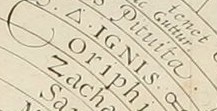
Four cells at the quarters break the rings up: “3. IGNIS. 3. TERRAE. 3. AQVA. 3. AERIS.” Three of fire, three of earth, three of water, three of air, each behind the sign of its element. The triplicities, set as a ring rather than as a table.
One ring names seven angels: “Oriphiel. Zachariel. Samuel. Michael. Anael. Raphael. Gabriel.” They are planetary rather than ranked, and they do not match the archive’s other seventeenth-century sheet. Kircher gives Raphael the sun and Michael Mercury. This wheel swaps them.
At the dead centre, inside every ring, a naked child stands between two winged figures who each hold a hand, and a sentence goes round them: “Magna dignitas fidelium animarum, ut unaquaeque habeat ab ortu nativitatis in custodia sui Angelum deputatum.” Great is the dignity of the souls of the faithful, that every one has an angel appointed to its keeping from the hour of its birth. Everything else on the sheet counts and sorts. That one roundel does not.
The explanation printed underneath comes from somewhere else entirely. It is headed “Autor Enchiridii Physicae Restitutae. Can. 1. seq.” and it opens on God rather than on the world: “Deus est Ens Aeternum, Unitas Infinita, Radicale Rerum omnium Principium: Cujus Essentia est Lux Immensa.” God is the eternal Being, infinite Unity, the radical beginning of all things, whose essence is immense Light. Nothing answering to that is drawn on the wheel. The picture starts at a child and works outward; the text starts at the top and works down, and the sheet leaves the two to meet in the reader.
Decoded: every motif is marked, and each mark carries the reading its author gave it, quoted from the text, or says that it is observed on the picture and not read. The reading above is the archive's own, made from those sources and no others.
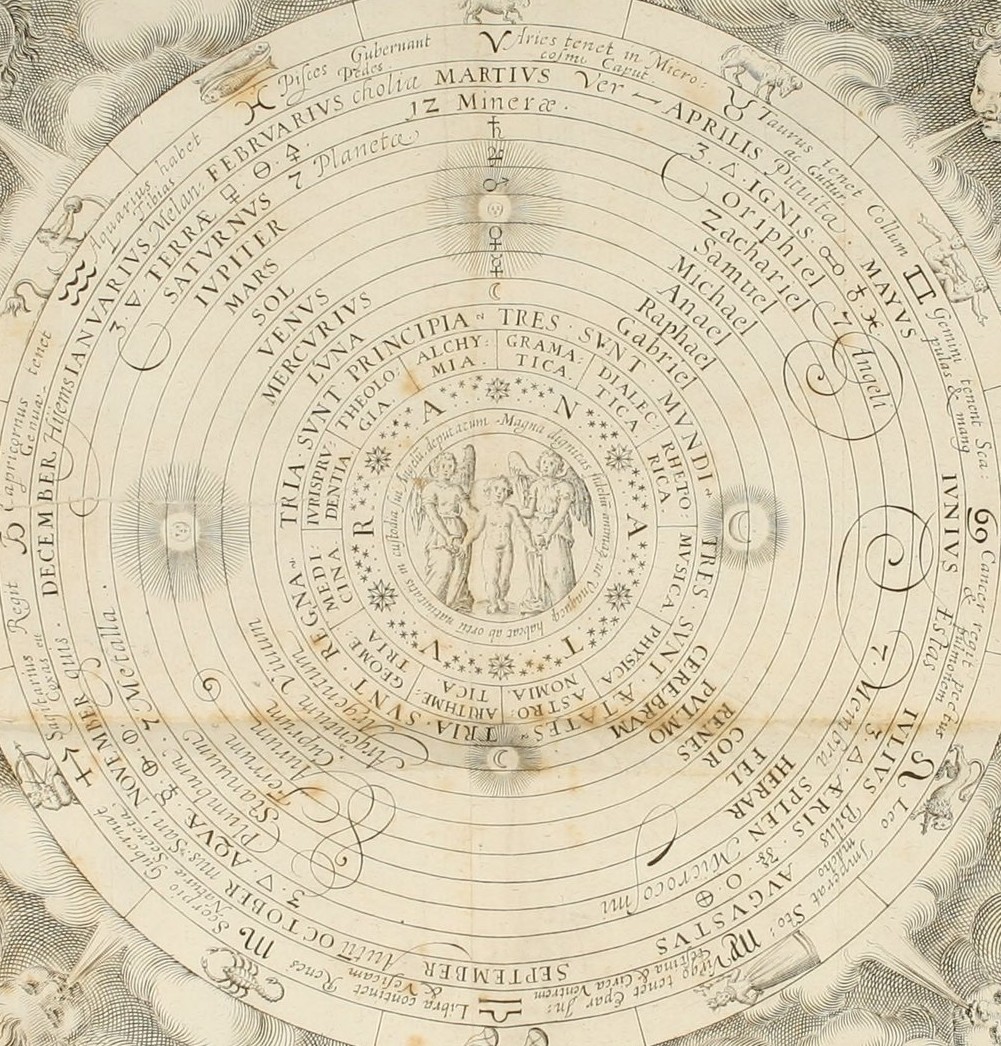
A diagram of everything, drawn so that a person can be found inside it. Note where the human figure stands in the scheme.
In plain words Every ring carries a list and the lists line up across them. The outermost names the twelve signs and gives each one a part of the body, head at the first sign and feet at the last, which is the Zodiac Man written out instead of drawn. Inside it come the twelve months, the four seasons and the four humours, then the triplicities of the elements, then twelve minerals, seven planets, seven angels, the metals, the parts of the body again by planet, and at the middle the arts and the faculties.
The plate, 1678 “Aries tenet in Microcosmo Caput. Taurus tenet Collum ac Guttur. Cancer regit pectus & pulmonem. Leo Imperat Stomacho. Virgo tenet Epar Intestina & Circa Ventrem. Libra continet Renes & Vesicam. Scorpio Gubernat Naturæ Secreta. Capricornus tenet Genua. Aquarius habet Tibias. Pisces Gubernant Pedes.”
Symbolica, 2026 The plate’s Latin, put into English here: Aries holds the head in the microcosm. Taurus holds the neck and the throat. Cancer rules the chest and the lung. Leo commands the stomach. Virgo holds the liver, the intestines and what lies about the belly. Libra contains the kidneys and the bladder. Scorpio governs the secrets of nature. Capricorn holds the knees. Aquarius has the shins. Pisces govern the feet. The ring runs the body from the head at the first sign to the feet at the last, which makes it a Zodiac Man laid out flat instead of drawn on a figure. Scorpio is the one cell that names no part of the body.
The plate, 1678 “IANVARIVS. FEBRVARIVS. MARTIVS. APRILIS. MAYVS. IVNIVS. IVLIVS. AVGVSTVS. SEPTEMBER. OCTOBER. NOVEMBER. DECEMBER. Hiems. Ver. Estas. Autumnus.”
The plate, 1678 “12 Minerae. 7 Planetae. 7 Metalla. 7 Angeli.”
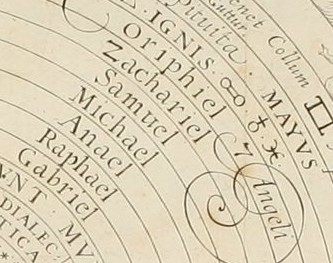
Nine ranks of angels, drawn as rings or as rungs. Note which order the picture puts at the top, and whether the book beside it agrees.
In plain words One ring names seven angels and labels itself as such. At the dead centre of the whole wheel, inside every other ring, stands a naked child with a winged figure on either side holding its hands, and a sentence runs round the roundel saying that every soul has one appointed to it from birth.
The plate, 1678 “Oriphiel. Zachariel. Samuel. Michael. Anael. Raphael. Gabriel. 7 Angeli.”
The plate, 1678 “Magna dignitas fidelium animarum, ut unaquaeque habeat ab ortu nativitatis in custodia sui Angelum deputatum.”
Symbolica, 2026 The plate's Latin, put into English here: great is the dignity of the souls of the faithful, that every one of them has an angel appointed to its keeping from the hour of its birth.
Symbolica, 2026 These seven are planetary, not the nine orders. They also disagree with Kircher, who gives Raphael the sun and Michael Mercury where this wheel gives Michael the sun and Raphael Mercury.
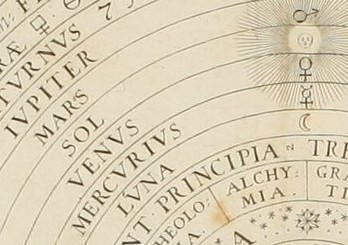
Gold, the perfected metal, and the illuminated intellect. The most overloaded symbol in the tradition.
In plain words The planets are set in one ring in their old order, Saturn furthest out and the Moon closest to the centre, with the sun in the middle of the seven. Each has a metal, an angel and a part of the body on the rings either side of it.
The plate, 1678 “SATVRNVS. IVPITER. MARS. SOL. VENVS. MERCVRIVS. LVNA.”
Symbolica, 2026 The sun sits fourth of seven, with three above it and three below. That is the order the archive already holds on Kircher’s tree, where the engraver ran the same seven down the Sephiroth.
A number made visible. Count the points and then find what else in the picture comes in threes.
In plain words Four cells at the quarters carry an element sign with the number three in front of it: three of fire, three of earth, three of water, three of air. The three counts the signs of the zodiac that belong to each element, which is the triplicity every astrologer of the period worked with.
The plate, 1678 “3. IGNIS. 3. TERRAE. 3. AQVA. 3. AERIS.”
Symbolica, 2026 The plate's Latin, put into English here: three of fire, three of earth, three of water, three of air. Twelve signs divided four ways, which is the triplicity every astrologer of the period used, set here as a ring rather than as a table.
Also carrying the Heavens
61 works carry it. The 6 where it is the central motif are here. The symbol.
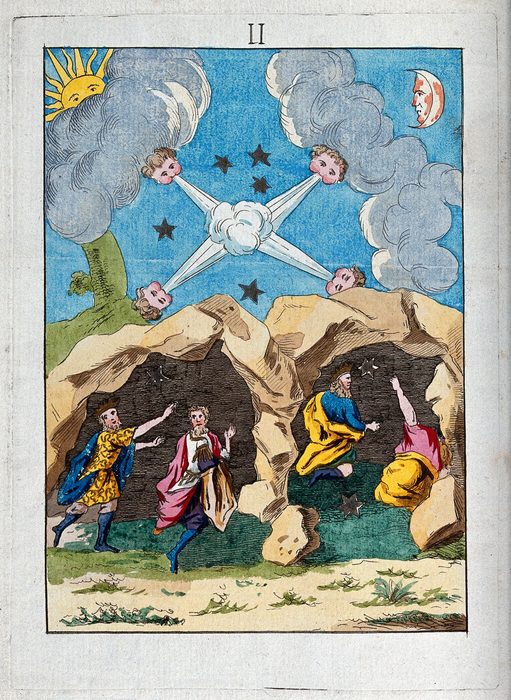
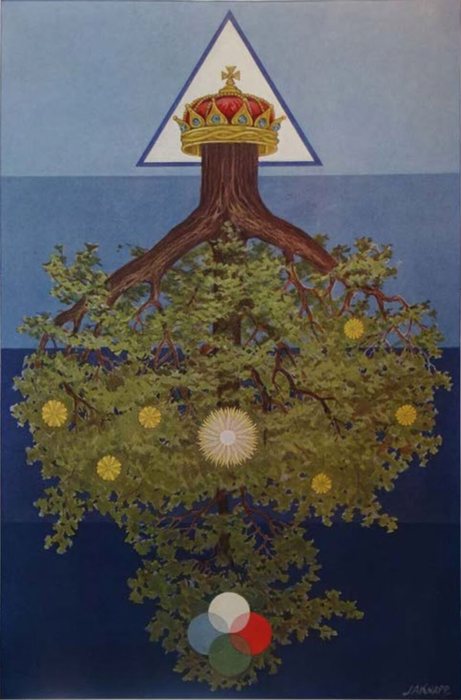
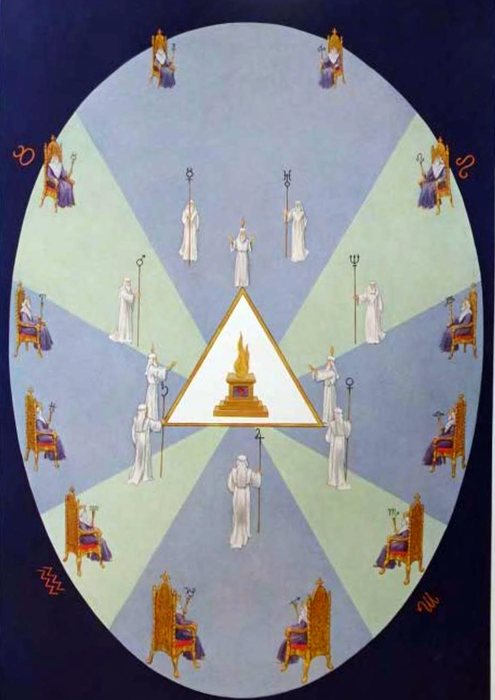
Where the detail is the subject
the Angel and the Wing · the Sun and the Moon · the Triangle and the Pyramid
Each of these is in the picture without being what it is about. Below, one work that is about each.
In the same series
Record
One symbol a week, decoded.
This picture is free at full size from its source, linked above. What an address gets is the Sunday letter: one picture, one symbol marked on it, what it meant and who said so, and the master files of the decoded plates as they are verified. Leave any time.
Free, one letter a week, unsubscribe in one click. How the address is used.
Scroll or pinch to zoom · drag to move · double-tap for 1:1 · 1400 by 1399 pixel web copy; the source file is linked under Record