Which part of the body belongs to your star sign, on a wheel printed in 1678
The lists go round and round: Aries the head, Pisces the feet, ten more in between, and hardly anywhere a source. Here is one. The second of the four folding plates at the back of the Musaeum Hermeticum, Frankfurt 1678, gives its outermost ring to the body, one sign to a cell, in a small engraved italic. Ten of the twelve still read.
Look at the outermost ring of this wheel and read it round.
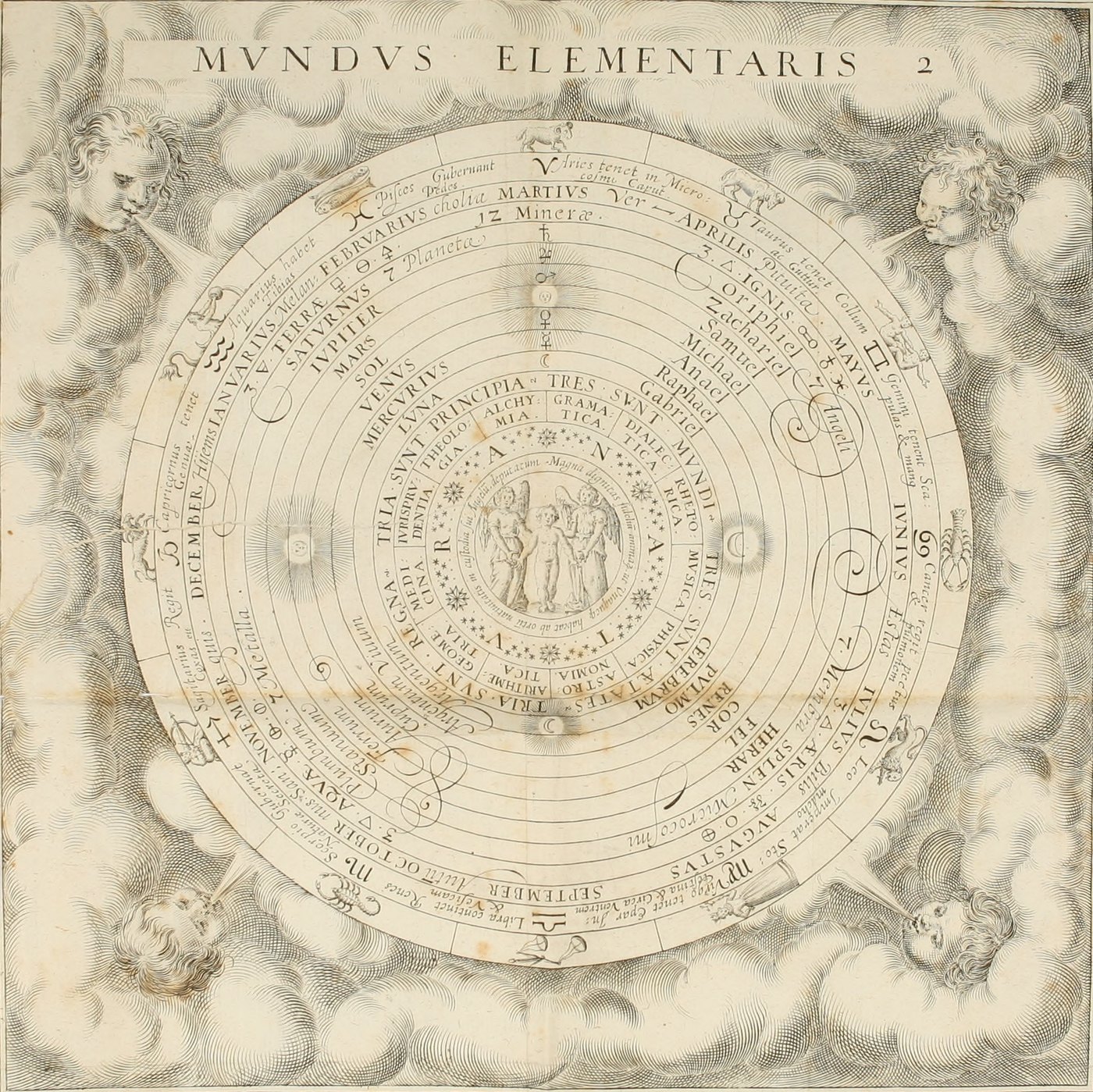
The title runs across the top in capitals, Mundus Elementaris, the world of the elements, meaning everything under the moon. The drawing keeps that promise. It takes the whole of that world and files it in rings, one inside another, so a line drawn from the rim to the middle crosses a complete account of one thing.
Twelve signs on the outside. Then the twelve months, with the four seasons and the four humours set against them. Then the triplicities of the elements, twelve minerals, seven planets, seven angels, seven metals, the parts of the body a second time, and at the very middle a naked child with a winged figure holding either hand.
The outer ring holds no picture of a man, and it carries the Zodiac Man all the same. Each cell names a sign and hands it a part of the body.
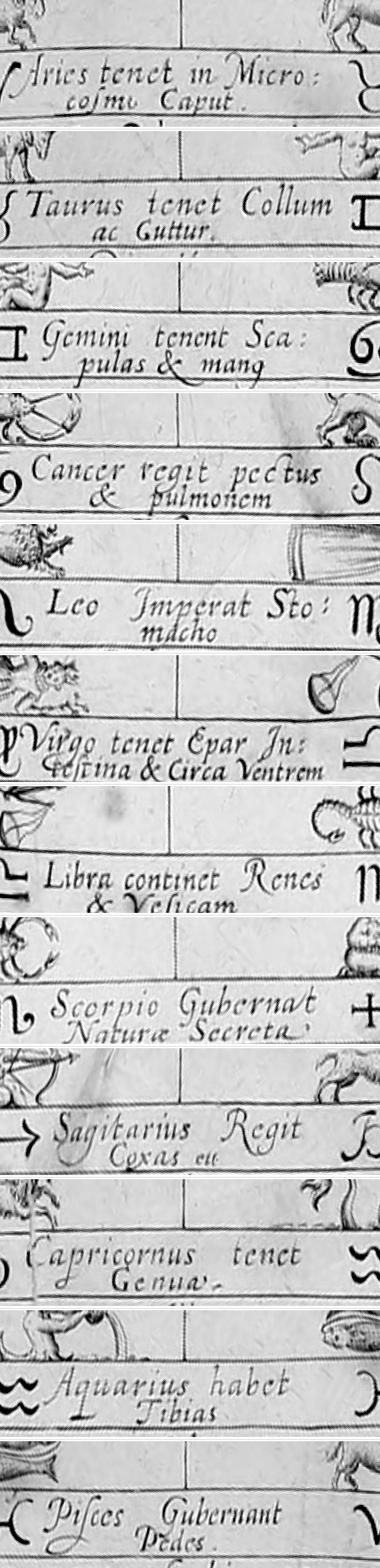
Aries tenet in Microcosmo Caput. Taurus tenet Collum ac Guttur. Cancer regit pectus & pulmonem. Leo Imperat Stomacho. Virgo tenet Epar Intestina & Circa Ventrem. Libra continet Renes & Vesicam. Scorpio Gubernat Naturæ Secreta. Capricornus tenet Genua. Aquarius habet Tibias. Pisces Gubernant Pedes.
FIGURA II, the outermost lettered ring, read round from Aries at the top
In English, and this English belongs to the archive rather than to the plate: Aries holds the head in the microcosm. Taurus holds the neck and the throat. Cancer rules the chest and the lung. Leo commands the stomach. Virgo holds the liver, the intestines and what lies about the belly. Libra contains the kidneys and the bladder. Scorpio governs the secrets of nature. Capricorn holds the knees. Aquarius has the shins. Pisces govern the feet.
Ten cells, and the ring has twelve.
Two of them refuse to come clear. The third opens Gemini tenent Scapulas, the shoulder blades, and ends on a word that stays a smudge at every magnification. The ninth opens Sagitarius Regit Coxas, the hips, and ends on a short mark that does the same. The Getty camera file carries the whole sheet at its native width and the item ships nothing larger, so those two stay unread here rather than borrowed from another book. Anyone can check both in the strip above.
Read the order rather than the list. Head at the first sign, feet at the last, and the body walks downward as the year goes round. A person gets filed exactly as a month gets filed, or a metal, by where they fall on the wheel.
A wheel of this kind works as a lookup table. Every ring carries a list and the lists line up across them, so a reader holding one month can take a season, a humour, an element, a metal, an angel and an organ off the same radius without turning a page. The body earns its ring by serving as one more column in that table. It draws no man, and that refusal buys it something: a body written into a ring sits beside the metals and reads across, where a drawn figure could only stand in the middle and be pointed at.
One cell names no organ at all. Scorpio governs the secrets of nature, and the plate leaves the sentence standing there.
And here a sign never arrives on its own. The ring immediately inside hands it a month, a season and a humour, so anyone taking an organ off this wheel takes a temperament along with it. A list that offers the organ by itself has lifted one ring off a wheel of a dozen and thrown the rest away.
The body turns up a second time further in, set against the seven planets instead of the twelve signs, so a reader could run a finger from a month to a humour to a metal to an organ without leaving the sheet. Two ways of filing the same person, printed on the same page, and the plate raises no objection to either.
At the middle of every ring stands that naked child, a winged figure holding each hand, and a sentence runs round the roundel.
Magna dignitas fidelium animarum, ut unaquaeque habeat ab ortu nativitatis in custodia sui Angelum deputatum.
FIGURA II, the sentence round the centre roundel
A great dignity of faithful souls, that each one has from the hour of its birth an appointed angel in its keeping. So the sheet that files a body by the month it was born into closes, at its own centre, on the other thing that birth was held to appoint.