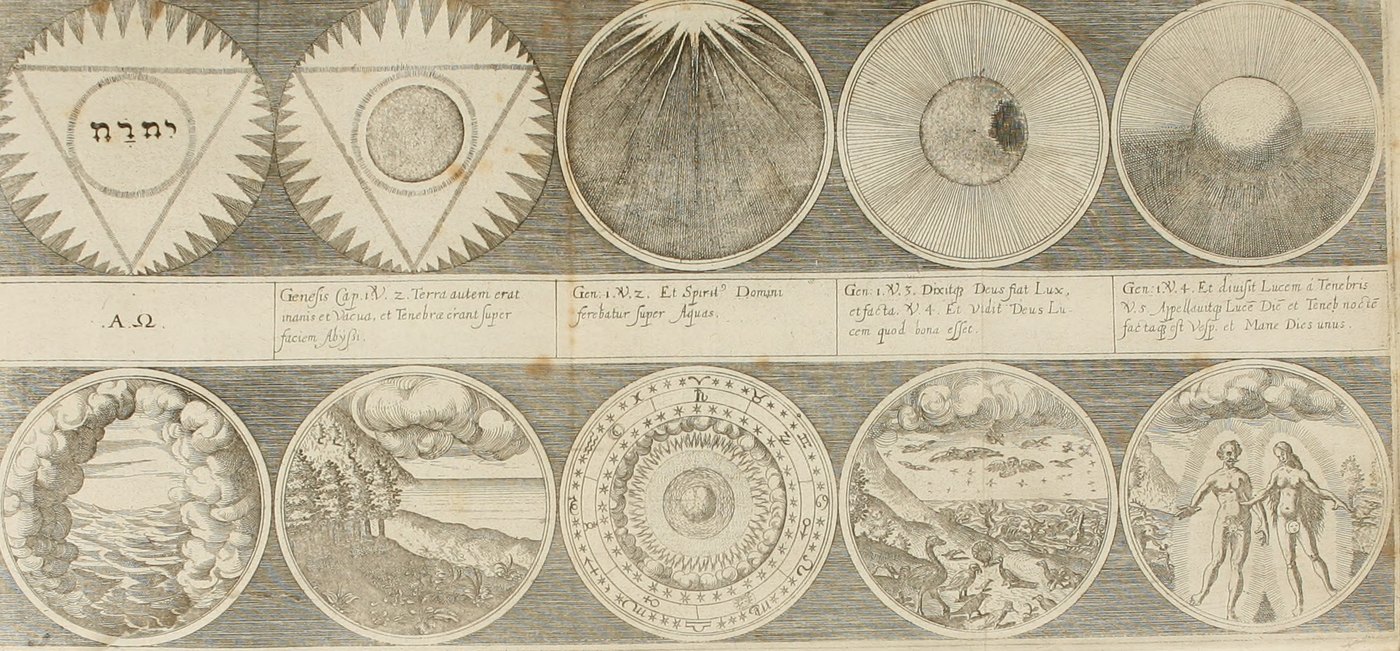
Creation in ten roundels, with Ripley’s prologue beneath
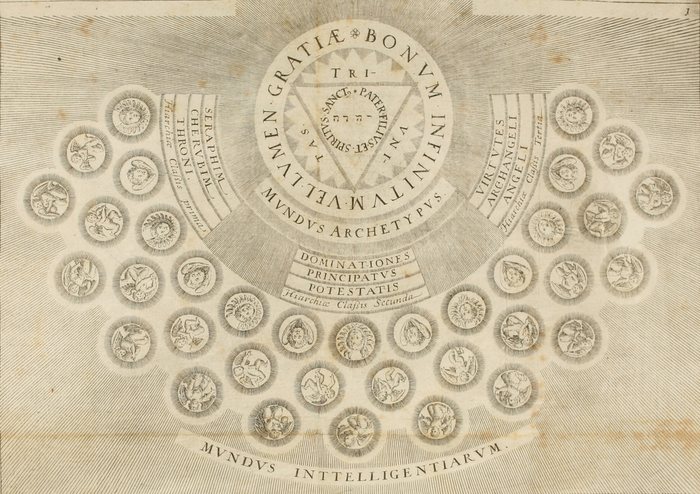
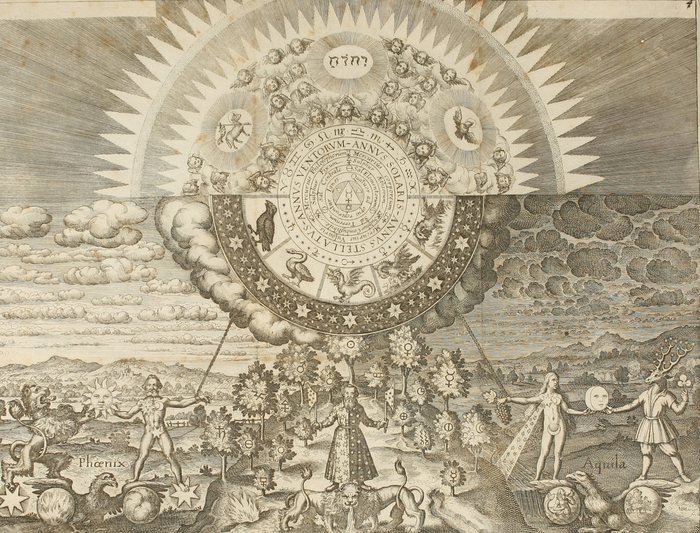
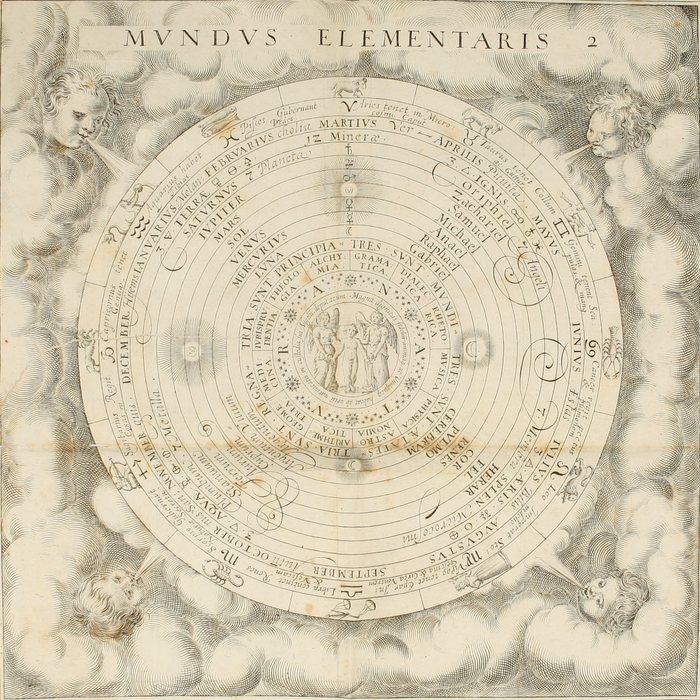
The Divine as the central motif, with the Water, the Tree, the Heavens and the Bird in a secondary part. From Musaeum Hermeticum.
What is happening
The plate, 1678 “Genesis Cap. 1. V. 2. Terra autem erat inanis et Vacua, et Tenebrae erant super faciem Abyssi. Gen. 1. V. 2. Et Spiritus Domini ferebatur super Aquas. Gen. 1. V. 3. Dixitque Deus fiat Lux, et facta. V. 4. Et vidit Deus Lucem quod bona esset. Gen. 1. V. 4. Et divisit Lucem a Tenebris. V. 5. Appellavitque Lucem Diem et Tenebras noctem, factaque est Vespere et Mane Dies unus.”
Symbolica, 2026 The five cells hold the first day only, and they are cut into the plate. The five days that follow are set in letterpress under the second row instead, one column to a roundel, so the sheet changes medium halfway down: what the engraver could fit he engraved, and the printer took the rest.
The plate, 1678 “Gen. 1. v. 6. Dixit quoque Deus, fiat firmamentum. Gen. 1. v. 9. Dixit vero Deus, congregentur aquae. Gen. 1. v. 14. Dixit autem Deus: Fiant Lumina. Gen. 1. v. 20. Dixit etiam Deus, producant. Gen. 1. v. 24. Dixit quoque Deus, producat terra.”
The plate, 1678 “Georgius Riplaeus prolog. XII. portarum.”
George Ripley, 1678 “O Lumen Incomprehensibile! Gloriosum in Majestate, cujus radiorum claritas offuscat nostra Lumina. O Unitas in substantia Et Triplex in Deitate.”
Symbolica, 2026 Ripley's Latin, put into English here: O incomprehensible Light, glorious in majesty, whose brightness of rays darkens our own lights. O Unity in substance and Threefold in Godhead.
George Ripley, 1678 “Ex una massa confusa creata sunt omnia quae nunc sunt. HOC Principium unum esse potest ad Declarationem nostri Benedicti Lapidis. Nam quemadmodum ex una massa creata sunt omnia, sic in nostra practica hoc ipsum esse debet: Nam omnia nostra secreta ex Una oriuntur Imagine.”
Symbolica, 2026 Ripley's Latin, put into English here: out of one confused mass were created all the things that now are. This one beginning can serve to declare our Blessed Stone. For just as all things were created out of one mass, so it must be in our own practice: for all our secrets rise out of One Image.
Symbolica, 2026 That sentence is why the creation is on this sheet at all. The roundels are not an illustration of Genesis for its own sake. They are the argument, and Ripley states it directly under them: all things came out of one mass, so the work must go the same way.
Key · 5 motifs
Tap a motif on the picture, or a line below. Its note opens under the line, with the reading its author gave it.
- Primary motif
- Secondary motifs · 4
The picture
The Name in a triangle under alpha and omega, the waters gathered, the land bearing trees, a wheel of zodiac and planets for the fourth day, and birds over fishes for the fifth. By eye
The reading
The picture read whole, in the archive's words, from the sources quoted on the marks. Read on, and the picture follows: the motif under discussion keeps its colour.
Ten roundels in two rows of five, with a strip of writing between them, and they argue rather than illustrate. Nobody signed the sheet.
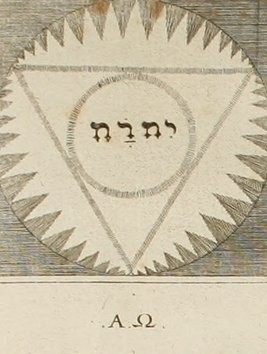
It opens before Genesis does. The first roundel gives a burst of rays with a triangle in it and the four Hebrew letters of the Name inside the triangle, and the cell engraved underneath holds no verse at all: only “. A. Ω .”, alpha and omega. The second roundel repeats the triangle with its circle gone dark, and there the verses start, “Terra autem erat inanis et Vacua, et Tenebrae erant super faciem Abyssi”, the earth void and empty and darkness on the face of the deep.
The top row spends all five of its roundels on the first day. The deep, the Spirit on the waters, the light made, the light seen to be good, the light divided from the darkness. Then the medium changes. The five days that follow are not engraved at all: they are set in letterpress under the second row, one column to a roundel, beginning “Gen. 1. v. 6. Dixit quoque Deus, fiat firmamentum.” What the engraver could fit he engraved, and the printer took the rest.
One roundel of the lower row breaks the pattern. Every other one draws a place, a sea or a shore or a field of animals. The fourth day gets a wheel: a sun at the centre, a ring of flame round it, and the twelve signs of the zodiac cut outside that with the planets among them. Its column says only “Fiant Lumina”, let there be lights. The zodiac comes from the engraver, and Genesis never mentions it.
Under all ten the sheet finally says what it is for. The passage is headed “Georgius Riplaeus prolog. XII. portarum” and it starts as a prayer, “O Lumen Incomprehensibile! Gloriosum in Majestate, cujus radiorum claritas offuscat nostra Lumina”. Then it turns: “Ex una massa confusa creata sunt omnia quae nunc sunt”, out of one confused mass were created all the things that now are, and “sic in nostra practica hoc ipsum esse debet”, so it must be in our own practice. The creation sits on the sheet as a precedent. A reader gets shown how the world was made so as to be told how the stone comes.
Decoded: every motif is marked, and each mark carries the reading its author gave it, quoted from the text, or says that it is observed on the picture and not read. The reading above is the archive's own, made from those sources and no others.
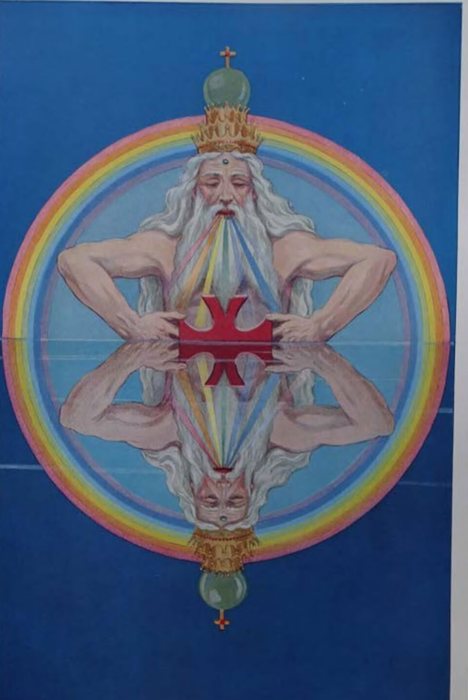
God shown, or pointed at. Look for what stands where a face would be: a name in a cloud, a circle above the top of a diagram, a ring of verses, a sign over a head.
In plain words The series opens on a burst of rays with a triangle in it, and inside the triangle a circle holding the four Hebrew letters of the Name. The cell engraved underneath carries no verse, only two Greek letters, alpha and omega. The second roundel repeats the triangle with the circle gone dark, and from there the row runs through the first day: the deep, the Spirit on the waters, the light made, the light divided.
The plate, 1678 “. A. Ω .”
Symbolica, 2026 Alpha and omega, the first and last letters of the Greek alphabet. The plate sets them where every other cell in the strip sets a verse of Genesis, so the series begins before the first verse does.
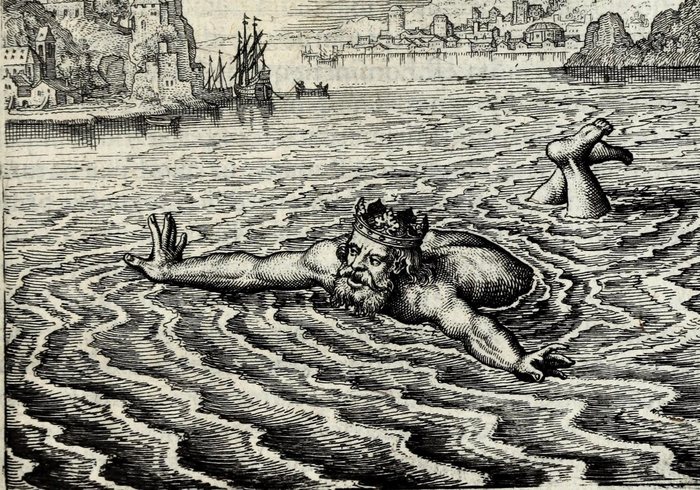
Where a thing is taken apart rather than destroyed. Note whether the figure is in the water, on it, or pouring it.
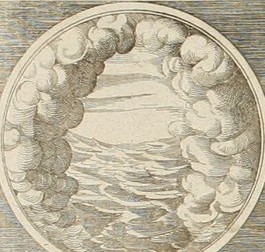
In plain words Water appears twice and differently. In the top row it is dark under a fan of rays, the Spirit moving on the face of it. In the bottom row the clouds have lifted and the sea lies open under them, gathered into one place.
The plate, 1678 “Gen. 1. V. 2. Et Spiritus Domini ferebatur super Aquas.”
The plate, 1678 “Gen. 1. v. 9. Dixit vero Deus, congregentur aquae.”
Symbolica, 2026 The plate's Latin, put into English here: and the Spirit of the Lord was borne over the waters. And then: God said, let the waters be gathered together.
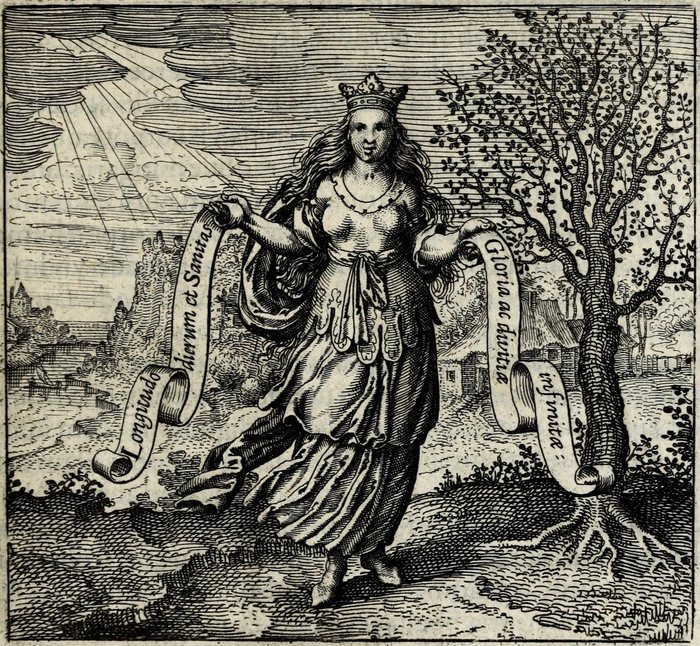
A body drawn as growth. Note which way it grows and what is at the root rather than at the top.
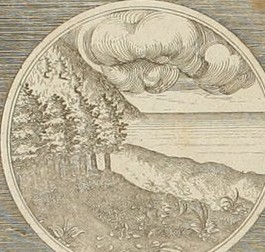
In plain words Dry land comes up out of the water with trees already standing on it, a river running down to the sea and cloud piled over the whole thing.
The plate, 1678 “Gen. 1. v. 24. Dixit quoque Deus, producat terra.”
Symbolica, 2026 The plate's Latin, put into English here: God said also, let the earth bring forth.
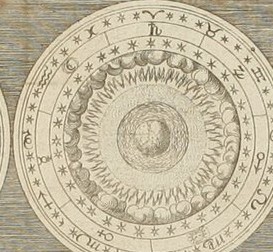
A diagram of everything, drawn so that a person can be found inside it. Note where the human figure stands in the scheme.
In plain words The fourth day is drawn as a wheel rather than a scene. A sun burns at the middle, a ring of flame and cloud goes round it, and outside that the twelve signs of the zodiac are cut with stars between them, the planets set among them.
The plate, 1678 “Gen. 1. v. 14. Dixit autem Deus: Fiant Lumina.”
Symbolica, 2026 The plate's Latin, put into English here: and God said, let there be lights. Every other roundel on the sheet is a picture of a place. This one is a diagram, and the zodiac is in it, which Genesis never mentions.
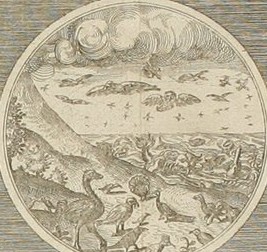
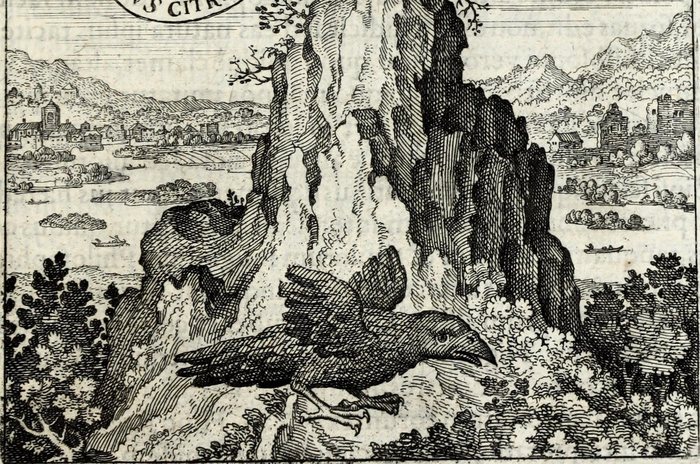
What rises and what comes back down. Note whether the bird is flying, caught, or paired with a second one.
In plain words Birds fly in a band across the middle of the roundel with fishes and sea creatures under them and more birds standing on the shore below, all in one picture.
The plate, 1678 “Gen. 1. v. 20. Dixit etiam Deus, producant.”
Symbolica, 2026 The plate's Latin, put into English here: God said also, let them bring forth. The verse goes on to the waters bringing forth the creeping creature and the fowl over the earth, and the engraver has drawn both halves of it in one roundel.
Also carrying the Divine
39 works carry it. The 6 where it is the central motif are here. The symbol.
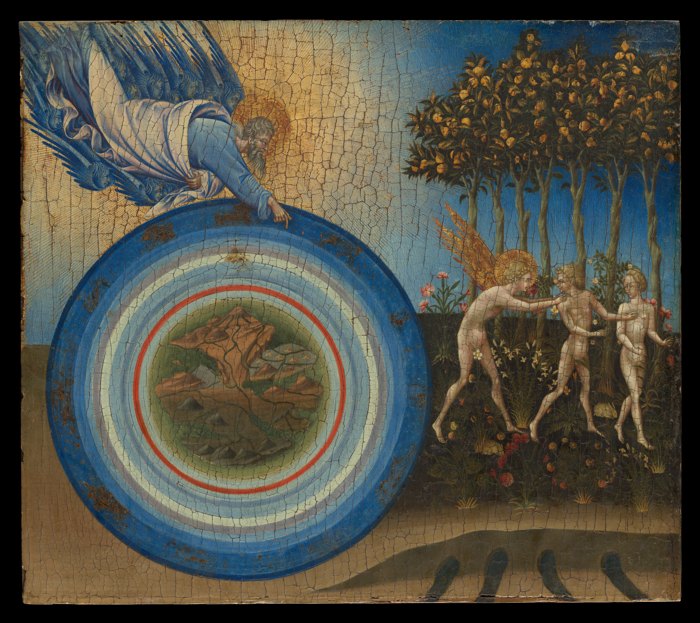
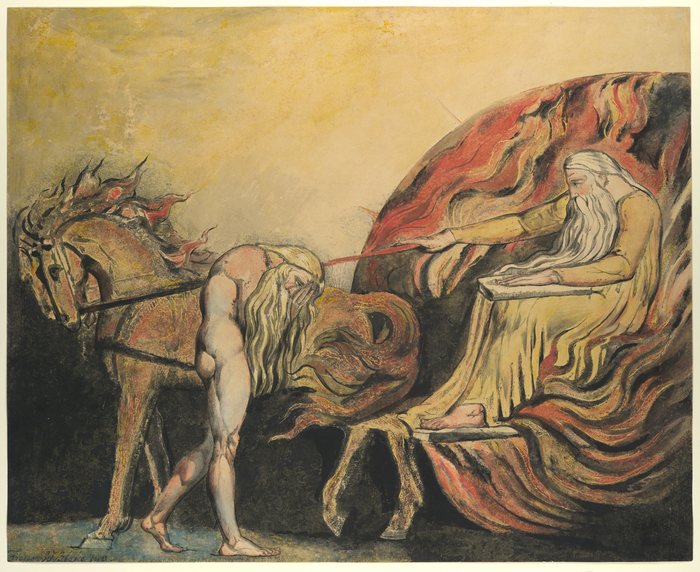
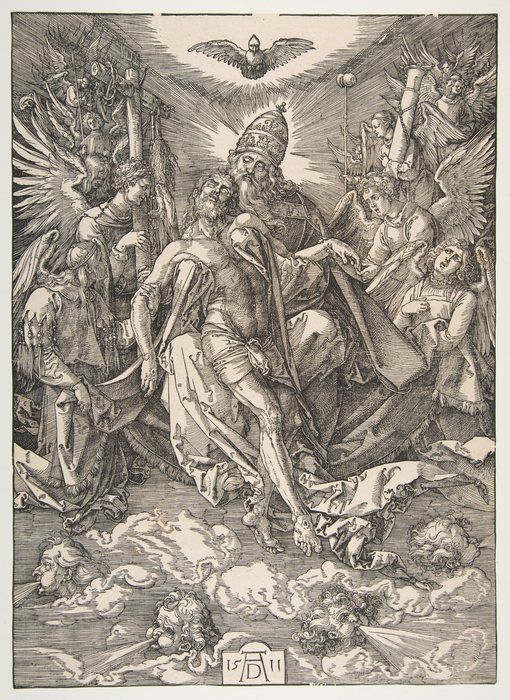
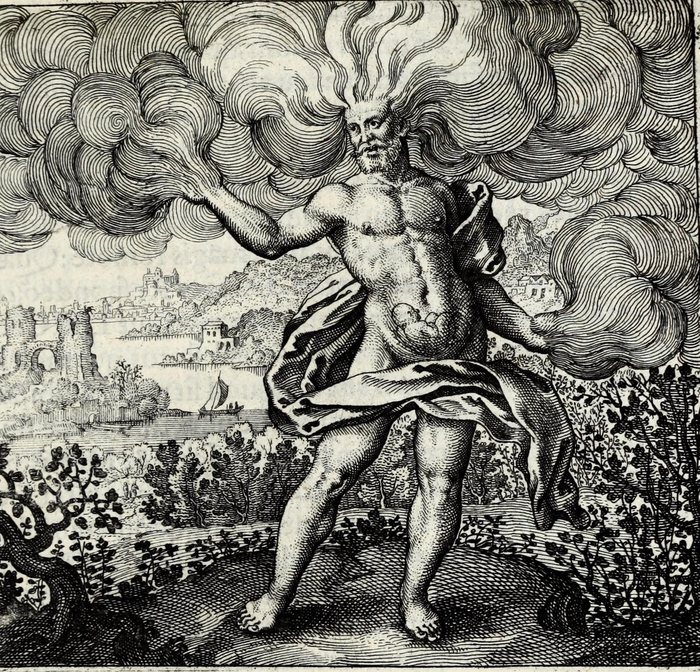
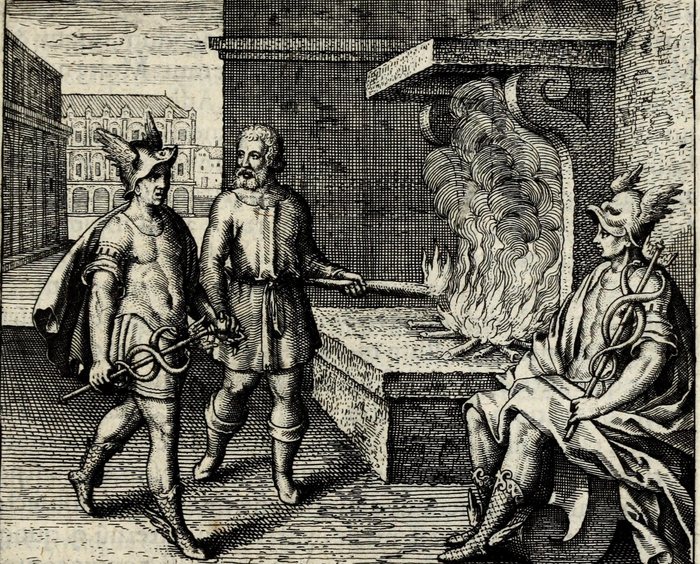
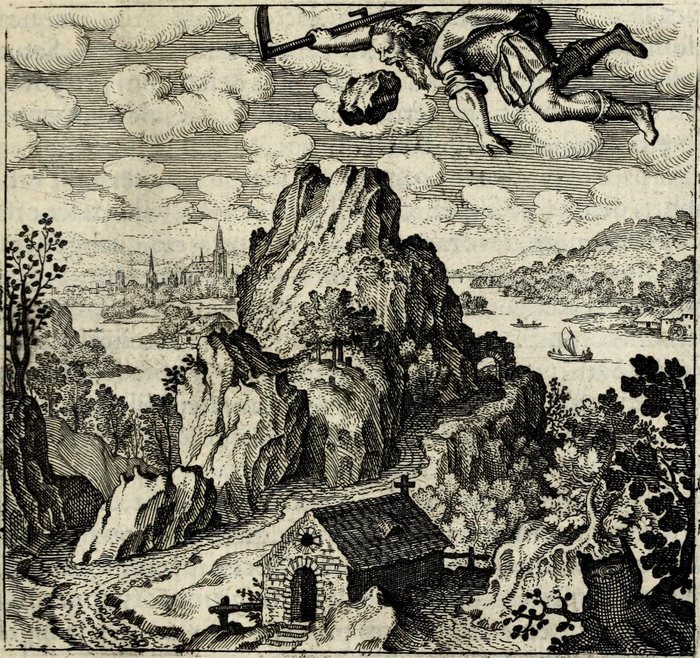
Where the detail is the subject
the Water · the Tree · the Heavens · the Bird
Each of these is in the picture without being what it is about. Below, one work that is about each.
In the same series
Record
One symbol a week, decoded.
This picture is free at full size from its source, linked above. What an address gets is the Sunday letter: one picture, one symbol marked on it, what it meant and who said so, and the master files of the decoded plates as they are verified. Leave any time.
Free, one letter a week, unsubscribe in one click. How the address is used.
Scroll or pinch to zoom · drag to move · double-tap for 1:1 · 1400 by 651 pixel web copy; the source file is linked under Record