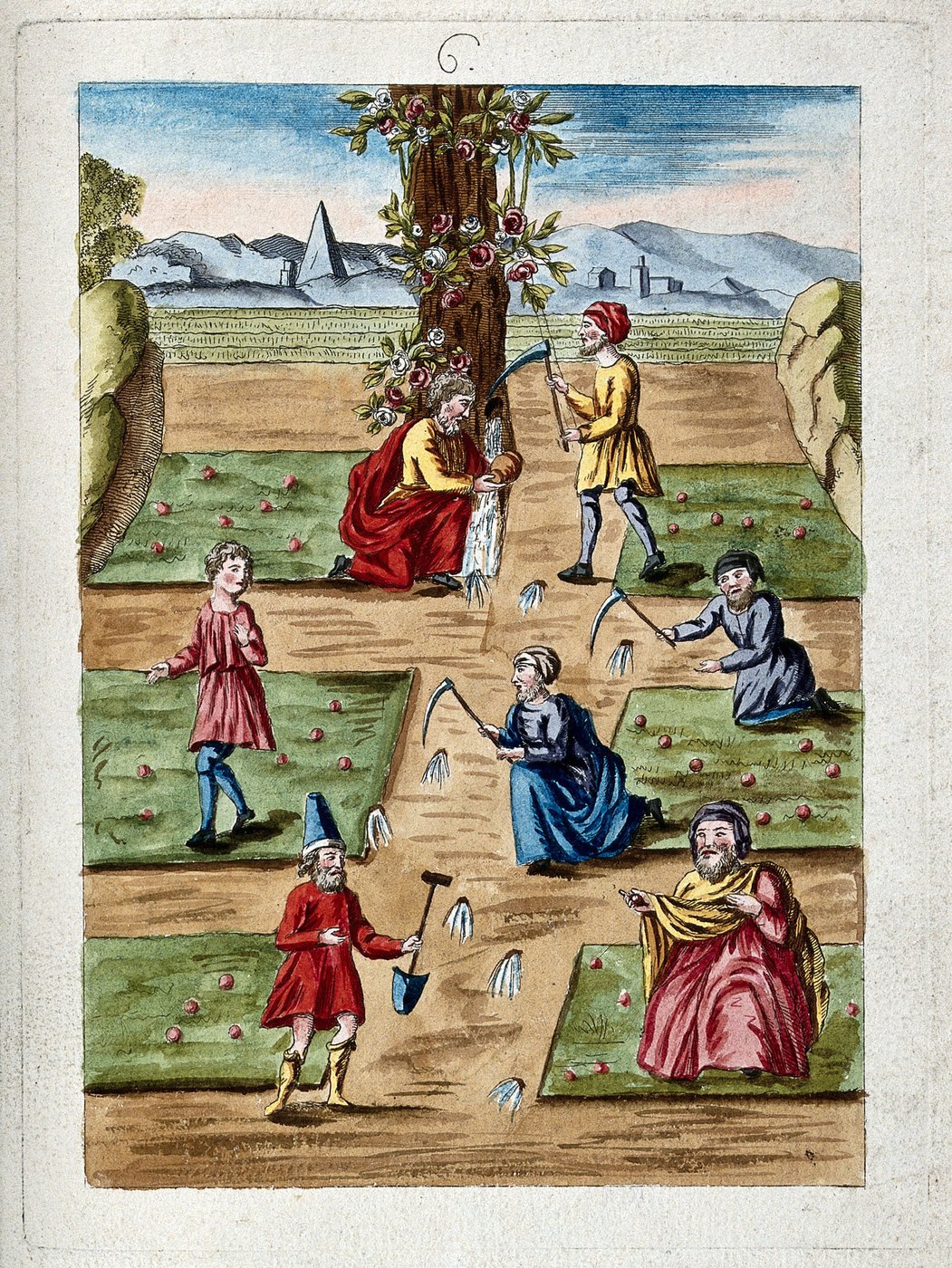
The Rose Tree on the Hollow Oak, and the Blind Diggers
The Tree as the central motif, with the Water and the Vessel in a secondary part. From The Flamel figures.
What is happening
Wellcome Collection, 2026 “The Livre takes its inspiration from a text by Nicolas Flamel (ca. 1330-1417) first published in France in 1612, then in England in 1624. Flamel tells of how a book written by one Abraham the Jew fell into his hands and goes on to describe its illustrations, which he does not attempt to reproduce. Only in 1672, in W. Salmon's edition of the book, did the images come to be actualised.”
Symbolica The museum reads the diggers as men seeking the white mercurial water and failing to find it. Flamel's own sentence says why they fail.
Key · 3 motifs
Tap a motif on the picture, or a line below. Its note opens under the line, with the reading its author gave it.
- Primary motif
- Secondary motifs · 2
The picture
A rose in red and white flower climbs a thick bare trunk in the middle of a garden of beds; a white stream runs from the foot of the trunk and breaks into tufts across the bare ground; six figures dig with mattocks, a spade and a hammer, none of them looking at the water; one kneels at the trunk and catches it in a bowl. By eye
The reading
The picture read whole, in the archive's words, from the sources quoted on the marks. Read on, and the picture follows: the motif under discussion keeps its colour.
Six people are digging for something that is running past their hands, and the engraver has made sure you can see it and they cannot. That is the whole joke of the sheet, and it is Flamel's joke first.
Flamel sets two plants in one place: “a faire Rose-tree flowred in the middest of a sweet Garden, climbing vp against a hollow Oake”. The sheet draws them as a single object, a thick bare trunk with roses winding up it in red and white, standing in a garden laid out in beds. Nothing else in the landscape is doing anything.
At the foot of it, Flamel says, boiled a fountain of most white water, which ran headlong down into the depths. The engraver drew the water white and left it white, so it reads as spilled light rather than as a stream, and then scattered it in tufts across the bare ground between the beds. It has already gone everywhere. It is under every one of them.
And they cannot find it, for the reason Flamel gives without apology: “it first passed among the hands of infinite people, which digged in the Earth seeking for it; but because they were blinde, none of them knew it”. A man in a blue hat swings a hammer. A woman in blue works a mattock. A man in red walks away empty-handed with his palms turned up. Every one of them is within a yard of it.
All except one. At the foot of the trunk a man in a red cloak has stopped digging, gone down on one knee and put a shallow bowl under the water. His is the only vessel on the plate. Flamel's sentence ends with him, and the phrase is stranger than it looks: “except here and there one which considered the weight.”
Not one who looked harder. One who weighed it. Whatever Flamel meant by that, the engraver did not try to draw it, and the man with the bowl is as far as the picture will go.
Decoded: every motif is marked, and each mark carries the reading its author gave it, quoted from the text, or says that it is observed on the picture and not read. The reading above is the archive's own, made from those sources and no others.
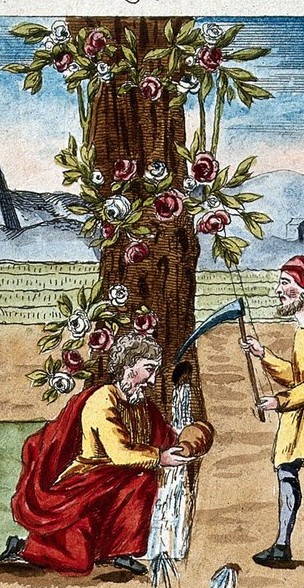
A body drawn as growth. Note which way it grows and what is at the root rather than at the top.
In plain words Two trees drawn as one. The trunk is the hollow oak and the roses are the rose-tree climbing it, exactly as Flamel sets them, one plant growing on the body of another.
Nicolas Flamel, 1624 “On the fifth leafe there was a faire Rose-tree flowred in the middest of a sweet Garden, climbing vp against a hollow Oake;”
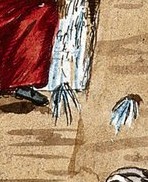
Where a thing is taken apart rather than destroyed. Note whether the figure is in the water, on it, or pouring it.
In plain words The water is drawn white and left white, so it reads as spilled light rather than as a stream. It runs from the foot of the trunk and then breaks into tufts all over the open ground, which is the engraver's way of saying it went everywhere and nobody saw it.
Nicolas Flamel, 1624 “at the foot wherof boyled a fountaine of most white water, which ranne head-long downe into the depths, notwithstanding it first passed among the hands of infinite people,”
Nicolas Flamel, 1624 “which digged in the Earth seeking for it; but because they were blinde, none of them knew it, except here and there one which considered the weight.”
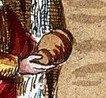
Never the subject. What is inside it is.
In plain words Six people are digging the ground with mattocks, a spade and a hammer, and not one of them is looking at the water. One man has stopped digging, knelt at the trunk, and put a bowl under it. He is the exception in Flamel's sentence, and the engraver marked him by giving him the only vessel on the plate.
Nicolas Flamel, 1624 “except here and there one which considered the weight.”
Also carrying the Tree
20 works carry it. The 6 where it is the central motif are here. The symbol.
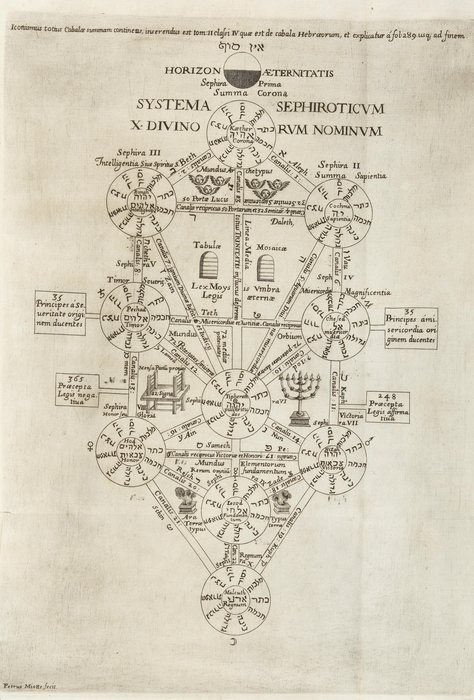
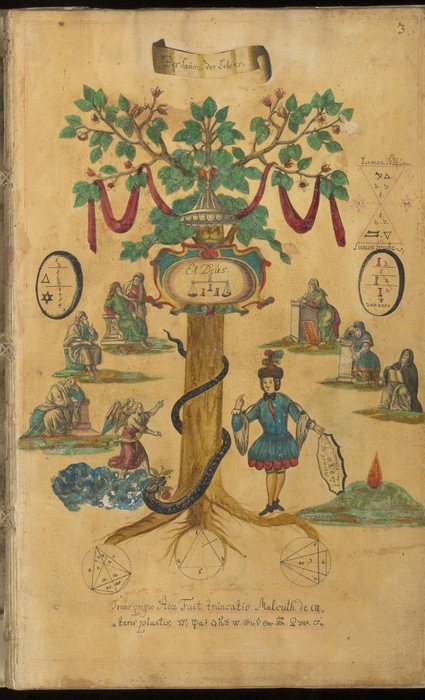
Where the detail is the subject
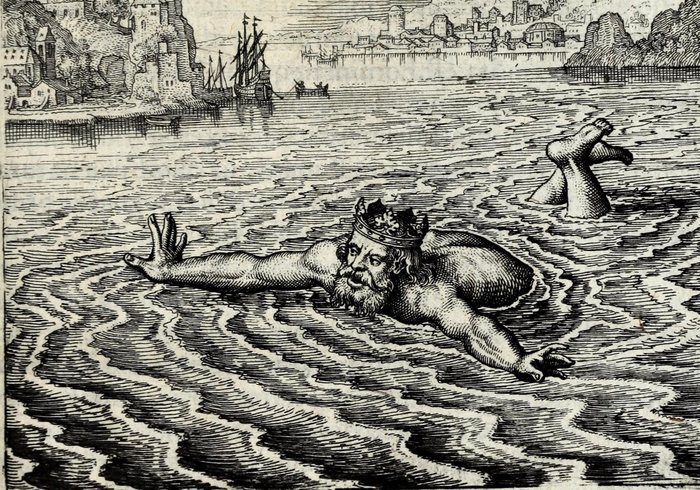
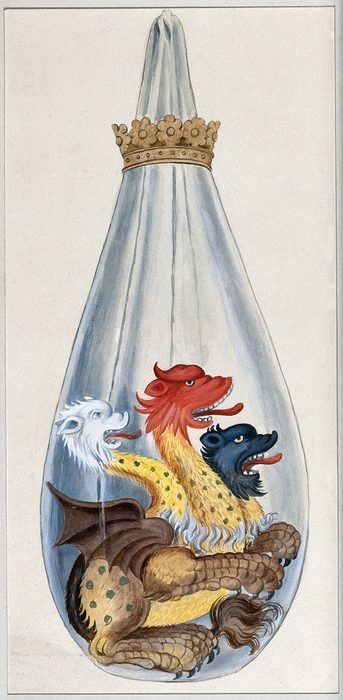
Each of these is in the picture without being what it is about. Below, one work that is about each.
In the same series
Record
One symbol a week, decoded.
This picture is free at full size from its source, linked above. What an address gets is the Sunday letter: one picture, one symbol marked on it, what it meant and who said so, and the master files of the decoded plates as they are verified. Leave any time.
Free, one letter a week, unsubscribe in one click. How the address is used.
Scroll or pinch to zoom · drag to move · double-tap for 1:1 · 1051 by 1400 pixel web copy; the source file is linked under Record