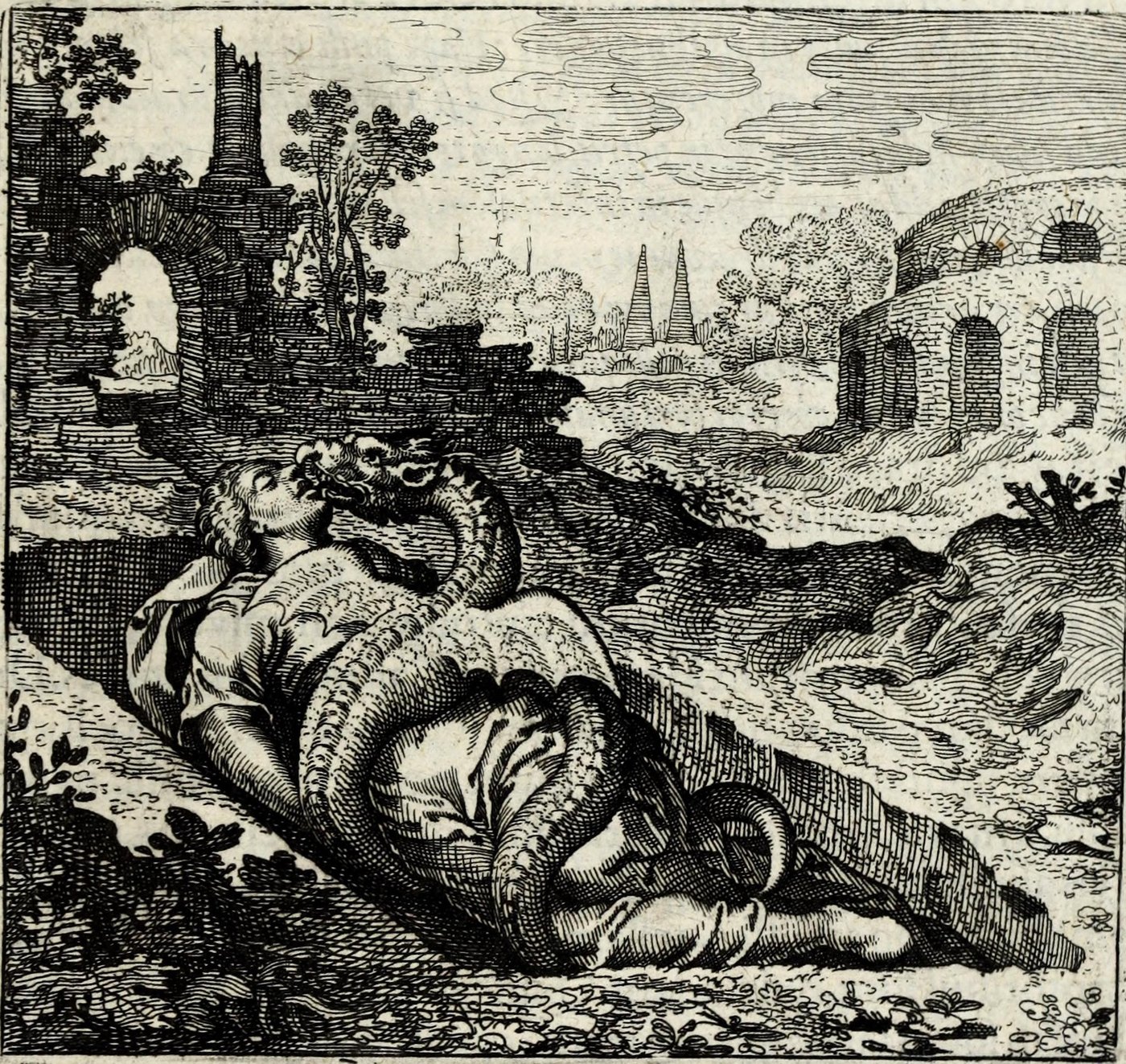
Draco mulierem, & hæc illum interimit, simulque sanguine perfunduntur
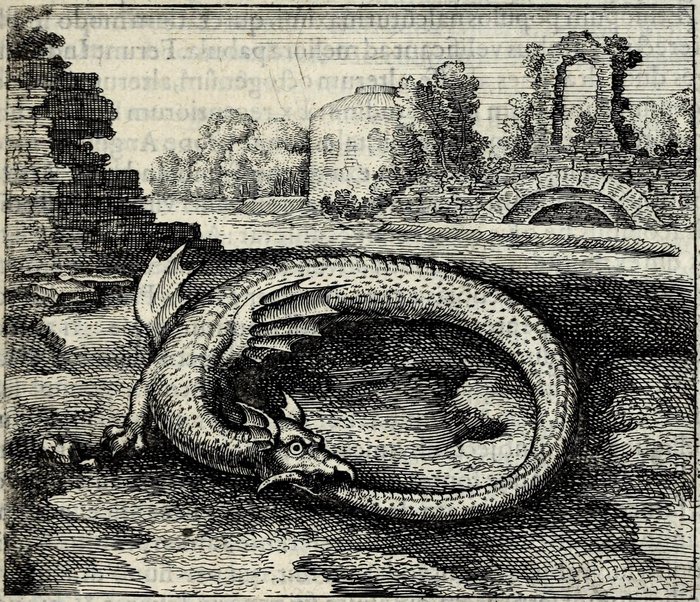
The Serpent and the Dragon as the central motif, with Death and the Skull in a secondary part. From Atalanta Fugiens.
What is happening
Michael Maier, 1618 “Draco mulierem, & hæc illum interimit, simulque sanguine perfunduntur.”
Symbolica, 2026 Maier’s Latin, put into English here: The dragon kills the woman and she him, and they are drenched together in blood.
Michael Maier, 1618 “Alta venenoso fodiatur tumba Draconi,
Cui mulier nexu sit bene vincta suo:
Ille maritalis dum carpit gaudia lecti,
Haec moritur, cum qua sit Draco tectus humo.
Illius hinc corpus morti datur, atque cruore
Tingitur: Haec operis semita vera tui est.”
Symbolica, 2026 Maier’s epigram, put into English here: Let a deep tomb be dug for the poisonous Dragon, and let the woman be bound fast to him in his coils. While he takes the joys of the marriage bed, she dies, and the Dragon is covered with earth along with her. From this his body is given over to death, and is stained with her blood. This is the true path of your work.
Key · 2 motifs
Tap a motif on the picture, or a line below. Its note opens under the line, with the reading its author gave it.
- Primary motif
- Secondary motifs · 1
The picture
The dragon coiled over the fallen woman before a ruined arch. By eye
The reading
The picture read whole, in the archive's words, from the sources quoted on the marks. Read on, and the picture follows: the motif under discussion keeps its colour.
‘Draco mulierem, & hæc illum interimit, simulque sanguine perfunduntur’: the dragon kills the woman and she him, and they are drenched together in blood. The fiftieth and last emblem is a grave with two bodies in it, a dragon and a woman, before the ruins of a town.
‘Alta venenoso fodiatur tumba Draconi’, let a deep tomb be dug for the poisonous dragon, ‘Cui mulier nexu sit bene vincta suo’, and let the woman be bound fast to him in his coils. The dragon of the fourteenth emblem ate itself; the dragon of the twenty-fifth was clubbed by its brother and sister; this one is married and buried.
‘Ille maritalis dum carpit gaudia lecti, / Haec moritur’, while he takes the joys of the marriage bed, she dies, ‘cum qua sit Draco tectus humo’, and the dragon is covered with earth along with her. ‘Illius hinc corpus morti datur, atque cruore / Tingitur’, from this his body is given over to death, and is stained with her blood. And the last line of the last epigram, which is the book's signature: ‘Haec operis semita vera tui est’, this is the true path of your work.
The woman and the dragon are the pair of the whole book at its end, the volatile and the fixed, the mercury and the matter, dying into each other in a sealed place. Maier put a ruined arch behind every one of his dragons, and this is the last of them.
Decoded: every motif is marked, and each mark carries the reading its author gave it, quoted from the text, or says that it is observed on the picture and not read. The reading above is the archive's own, made from those sources and no others.
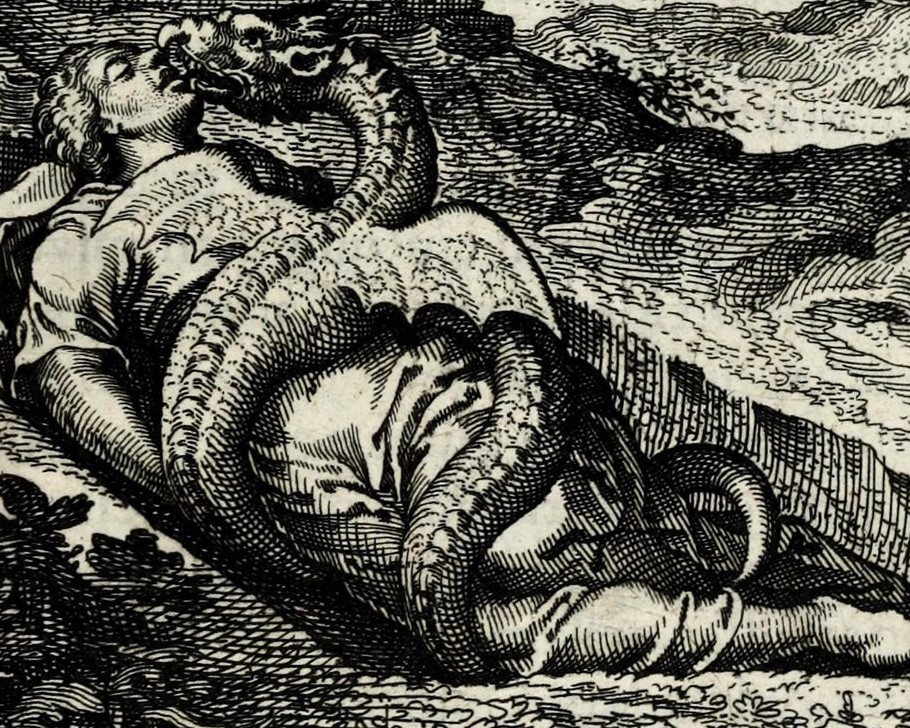
The alchemists' dragon is not an enemy. It is the matter, and it has to die three ways.
In plain words A dragon lies coiled round a woman in a dug grave, its head at her mouth. Maier's instruction is to dig the tomb, bind the woman to the dragon, and bury them together: he dies of her and she of him, and they are covered with earth and drenched in one blood. The dragon is the matter, and this is its last death in the book.
Michael Maier, 1618 “Alta venenoso fodiatur tumba Draconi, / Cui mulier nexu sit bene vincta suo:”
Symbolica Maier's Latin, put into English here: Let a deep tomb be dug for the poisonous Dragon, and let the woman be bound fast to him in his coils.
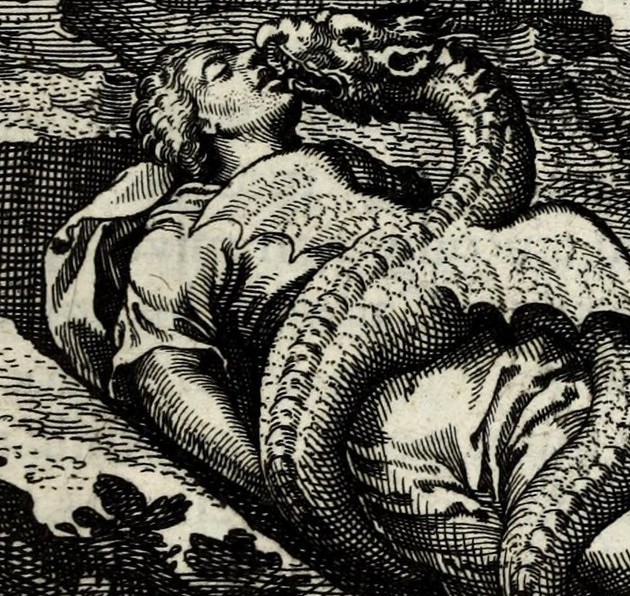
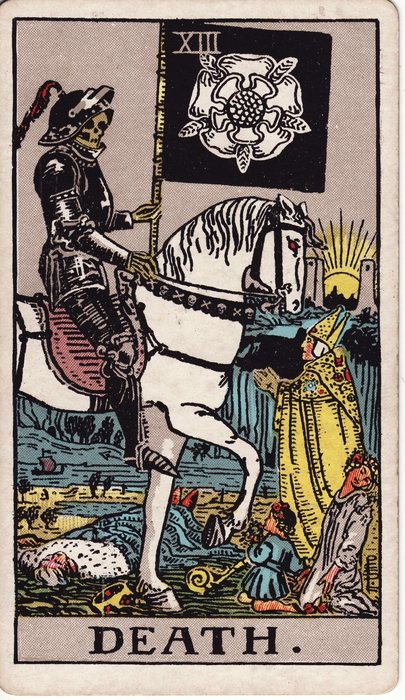
An office, not an ending. Note what Death is holding and who is being made to look at it.
In plain words The woman is dead in the dragon's embrace, and the grave is their marriage bed. She kills him by dying: the dragon is buried with her and his body is given over to death, stained with her blood. Maier ends the book here and calls it the true path of the work.
Michael Maier, 1618 “Ille maritalis dum carpit gaudia lecti, / Haec moritur, cum qua sit Draco tectus humo.”
Symbolica Maier's Latin, put into English here: While he takes the joys of the marriage bed, she dies, and the Dragon is covered with earth along with her.
Also carrying the Serpent and the Dragon
30 works carry it. The 6 where it is the central motif are here. The symbol.
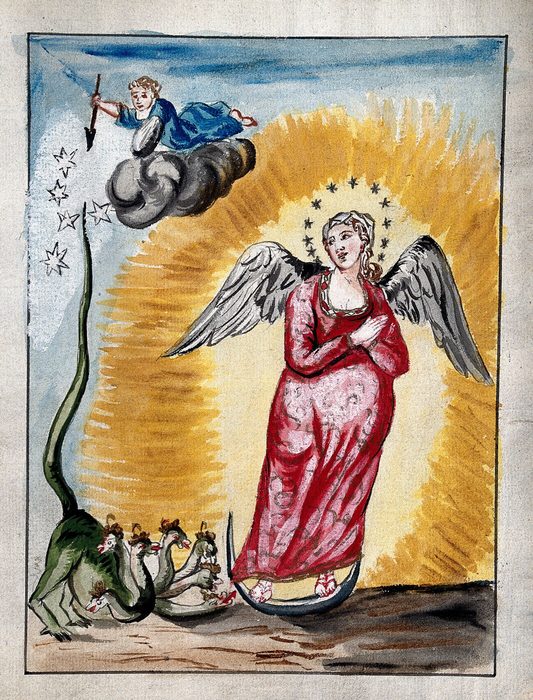
Where the detail is the subject
This is in the picture without being what it is about. Below, one work that is about it.
In the same series
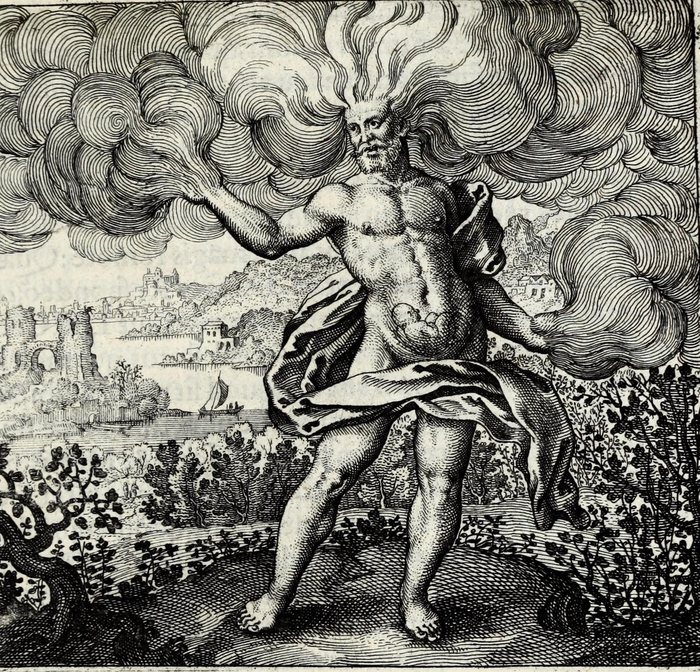 Portavit eum ventus in ventre suo
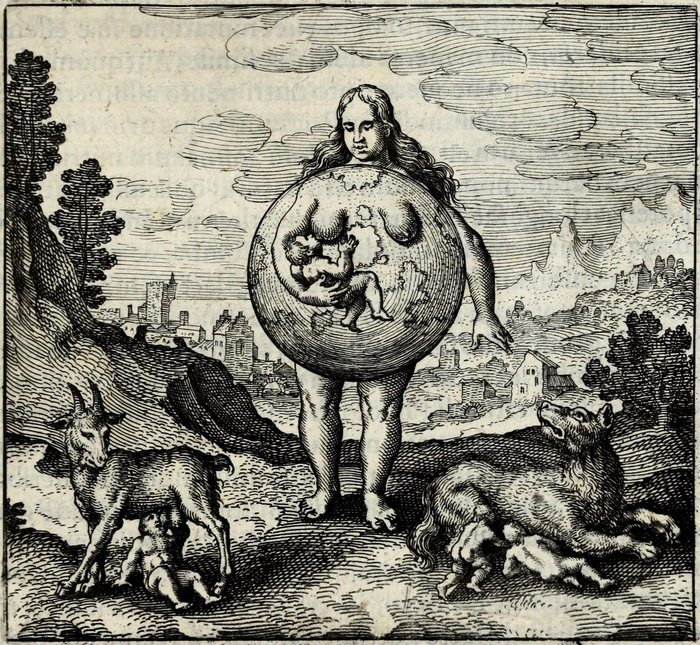 Nutrix ejus terra est
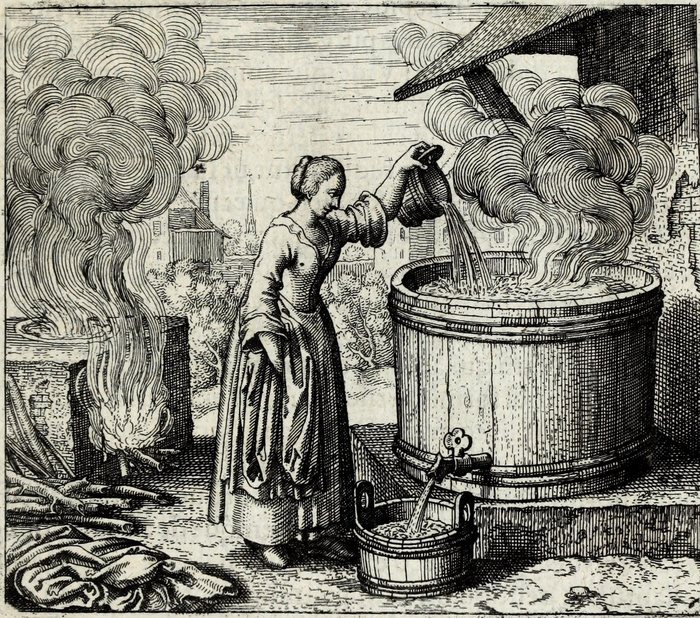 Vade ad mulierem lavantem pannos, tu fac similiter
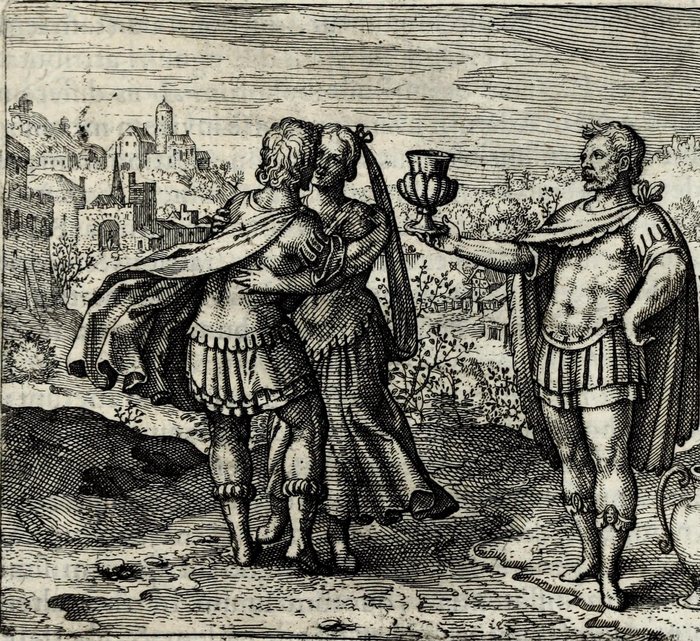 Conjunge fratrem cum sorore & propina illis poculum amoris
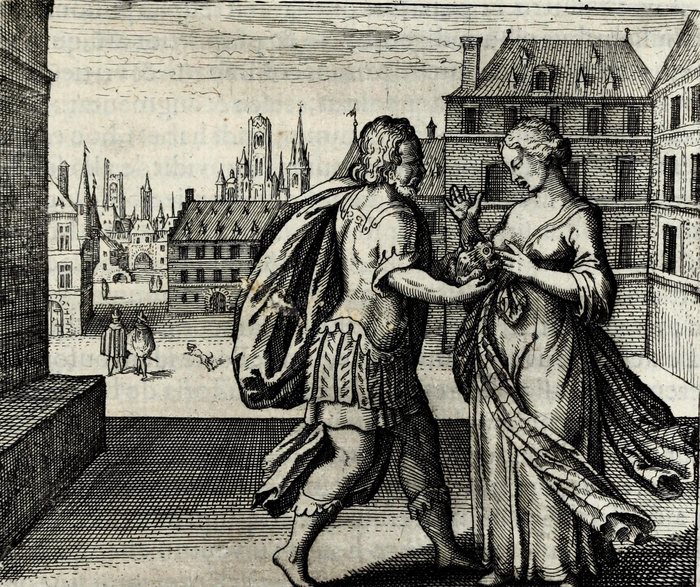 Appone mulieri super mammas bufonem, ut ablactet eum, & moriatur mulier, sitque bufo grossus de lacte
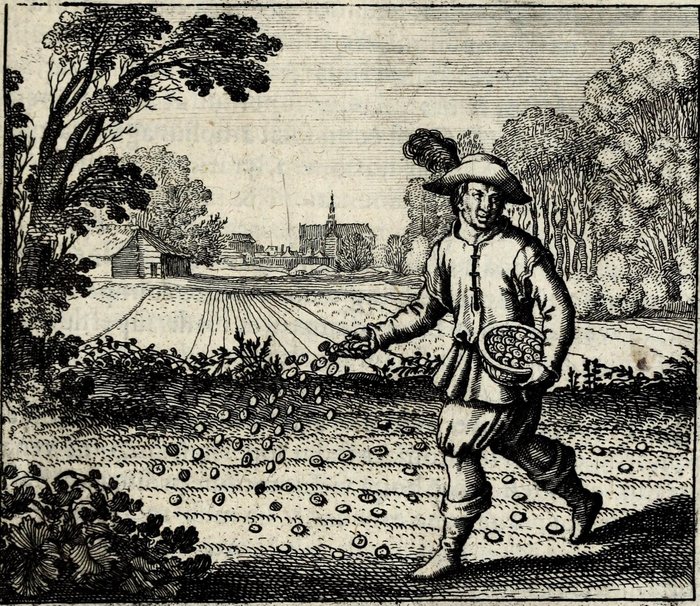 Seminate aurum vestrum in terram albam foliatam
Record
One symbol a week, decoded.
This picture is free at full size from its source, linked above. What an address gets is the Sunday letter: one picture, one symbol marked on it, what it meant and who said so, and the master files of the decoded plates as they are verified. Leave any time.
Free, one letter a week, unsubscribe in one click. How the address is used.
Scroll or pinch to zoom · drag to move · double-tap for 1:1 · 1400 by 1323 pixel web copy; the source file is linked under Record