The Point Where the Sky and the Earth Touch
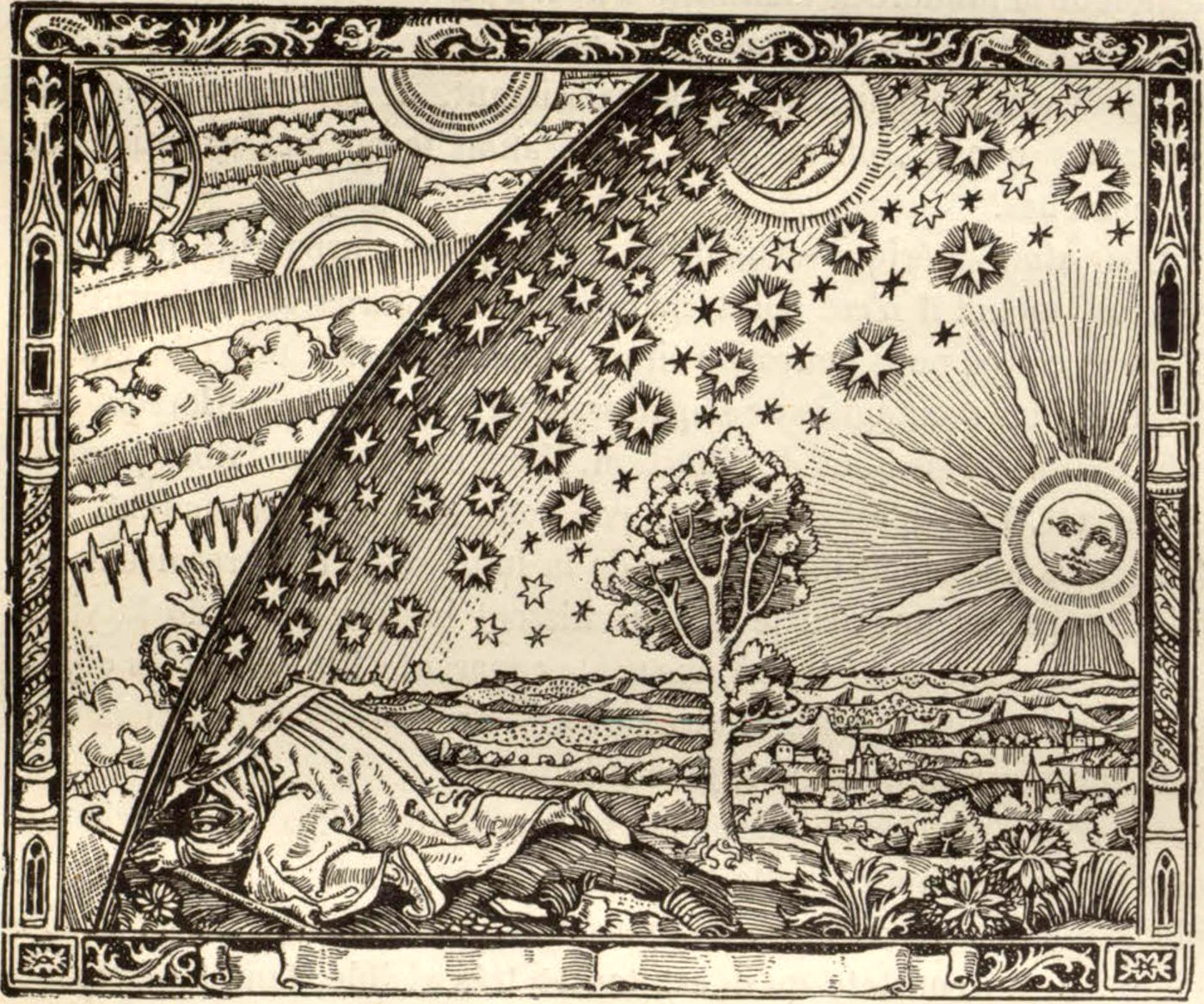
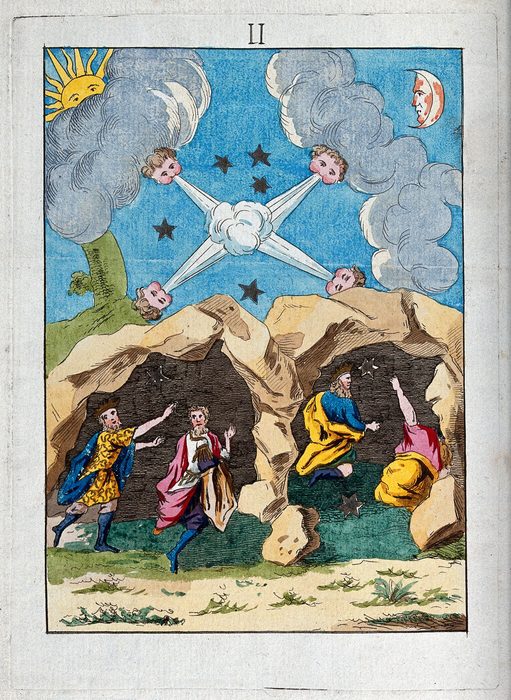
The Heavens as the central motif, with the Sun and the Moon in a secondary part. From L'atmosphère.
What is happening
Camille Flammarion, 1888 “Un missionnaire du moyen âge raconte qu'il avait trouvé le point où le ciel et la Terre se touchent...”
Camille Flammarion, 1888 “Un naïf missionnaire du moyen âge raconte même que, dans un de ses voyages à la recherche du Paradis terrestre, il atteignit l'horizon où le ciel et la Terre se touchent, et qu'il trouva un certain point où ils n'étaient pas soudés, où il passa en pliant les épaules sous le couvercle des cieux....”
Symbolica Flammarion's French, put into English here. The caption: A missionary of the Middle Ages tells that he had found the point where the sky and the Earth touch. The passage on the facing page, which the engraving illustrates: A naive missionary of the Middle Ages tells even that, on one of his journeys in search of the earthly Paradise, he reached the horizon where the sky and the Earth touch, and that he found a certain point where they were not joined, where he passed through, bending his shoulders under the lid of the heavens. The sentences of the same chapter that the marks carry are put into English on the marks.
Symbolica The engraving carries no title and no engraver's name. The title on this page is the archive's, taken from the caption. The block is usually called the Flammarion engraving, and is usually reproduced cropped out of its border and coloured; this is the whole block as the page carries it, uncoloured. The archive holds no printing of it earlier than this one.
Key · 2 motifs
Tap a motif on the picture, or a line below. Its note opens under the line, with the reading its author gave it.
- Primary motif
- Secondary motifs · 1
The picture
A man in a pilgrim's robe kneeling at the edge of the world and pushing his head and one hand through the join where the starry vault meets the earth, a spoked wheel and ringed arcs in the space beyond it, the sun with a face on the horizon and the crescent moon among the stars, a tree and a town in the landscape, the whole in a decorative border. By eye
The reading
The picture read whole, in the archive's words, from the sources quoted on the marks. Read on, and the picture follows: the motif under discussion keeps its colour.
‘Un missionnaire du moyen âge raconte qu'il avait trouvé le point où le ciel et la Terre se touchent...’ A man in a pilgrim's robe kneels at the edge of the world with his staff on the ground beside him, and pushes his head and one hand through the place where the starry sky meets the earth.
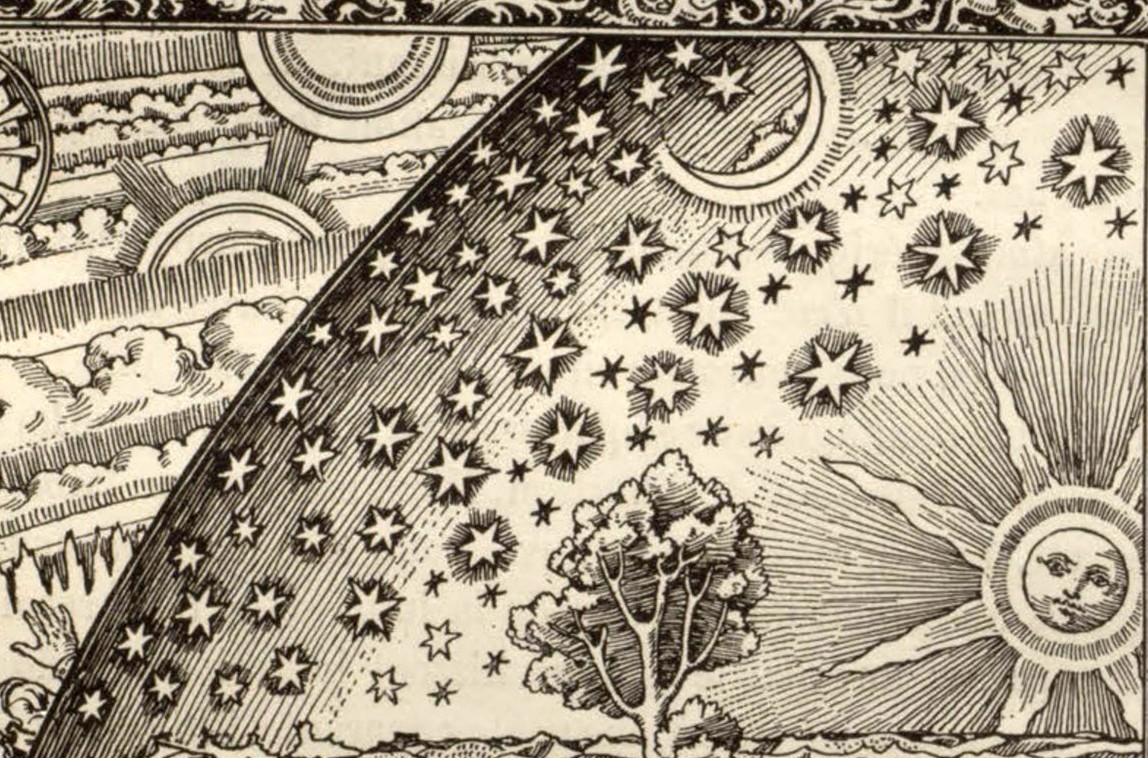
The sky is a shell with a thickness, and the whole argument of the picture is in that. Its inner face carries the stars; its broken edge runs across the plate as a hard diagonal; where the pilgrim has got his shoulders under it, it does not quite meet the ground. Flammarion's chapter is called La forme du ciel and it opens with the illusion the engraving draws: ‘Que le ciel soit pur ou couvert, il se présente toujours à nos yeux sous l'aspect d'une voûte surbaissée.’ Then the history of taking it literally. ‘Les anciens avaient pris cette voûte bleue au sérieux. Mais, comme le dit Voltaire, c'était aussi intelligent que si un ver à soie prenait sa coque pour les limites de l'univers.’ The Greeks gave the illusion a substance, ‘une substance cristalline solide’, and until Copernicus, he says, most astronomers held the sky to be as material as glass melted and hardened. Then they furnished it: ‘Les poètes latins placèrent sur cette voûte, au-dessus des planètes et des étoiles fixes, les divinités de l'Olympe et l'élégante cour mythologique’, and the theologians put the Trinity and the whole heavenly host in the empyrean above that. Beyond the broken edge the engraver drew what that furniture looks like from underneath once a head is through: a great spoked wheel, three ringed arcs, banded cloud, and nobody at home. Flammarion's next sentence is what the plate was cut for. ‘Or cette belle voûte n'existe pas!’
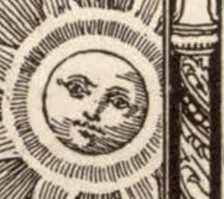
Both lights are inside the shell. The sun stands on the horizon at the right, a face in its disc, its rays lying flat across the fields; the crescent moon is high among the stars. They are where the old scheme kept them, below the gods and on the vault, and the picture leaves them there while the man climbs out past them.
The story is Flammarion's own, told two sentences earlier: a naive missionary of the Middle Ages who went looking for the earthly Paradise, reached the horizon, found one point where sky and earth were not welded together, and passed through bending his shoulders under the lid of the heavens. Flammarion tells it as a joke about believing your own eyes, and then answers it with a fact about himself: he has gone up in a balloon higher than the Greek Olympus and never touched the tent, which flees as fast as it is chased, like the apples of Tantalus.
The block is usually called the Flammarion engraving and is usually called medieval. This is where it appears: page 163 of L'atmosphère: météorologie populaire, Paris, Hachette, 1888, a text figure in the chapter on the shape of the sky. The book names no engraver, and the archive holds no printing of it earlier than this one. It is almost always reproduced cropped out of its border and coloured in; the copy here is the whole block as the page carries it, in black on the paper, because the border is part of the evidence and the colour is somebody else's.
Two things in it are left unmarked. The tree at the centre stands in the landscape because a landscape needs one, and nothing in the chapter names it. The row of pendant forms hanging under the arcs at the left, which could be flames or ice or falling rain, is named by nobody, so the archive leaves it alone.
Decoded: every motif is marked, and each mark carries the reading its author gave it, quoted from the text, or says that it is observed on the picture and not read. The reading above is the archive's own, made from those sources and no others.
A diagram of everything, drawn so that a person can be found inside it. Note where the human figure stands in the scheme.
In plain words The sky is drawn as a thing with a thickness. Its inner face carries the stars, its broken edge crosses the plate as a hard diagonal, and where the kneeling man has got his shoulders under it there is a gap. Beyond the edge are a great spoked wheel, three ringed arcs and banded cloud, which is the machinery the old scheme put above the fixed stars. Flammarion drew the vault in order to say, on the facing page, that it is not there.
Camille Flammarion, 1888 “Que le ciel soit pur ou couvert, il se présente toujours à nos yeux sous l'aspect d'une voûte surbaissée.”
Camille Flammarion, 1888 “Les anciens avaient pris cette voûte bleue au sérieux. Mais, comme le dit Voltaire, c'était aussi intelligent que si un ver à soie prenait sa coque pour les limites de l'univers.”
Camille Flammarion, 1888 “Les astronomes grecs la représentaient comme formée d'une substance cristalline solide, et jusqu'à Copernic un grand nombre d'astronomes l'ont considérée comme aussi matérielle que du verre fondu et durci.”
Camille Flammarion, 1888 “Or cette belle voûte n'existe pas! Déjà je me suis élevé en ballon plus haut que l'Olympe grec, sans être jamais parvenu à toucher cette tente qui fuit à mesure qu'on la poursuit, comme les pommes de Tantale.”
Symbolica Flammarion's French, put into English here. Whether the sky is clear or covered, it always presents itself to our eyes with the look of a lowered vault. The ancient writers had taken this blue vault seriously; but, as Voltaire says, that was about as intelligent as a silkworm taking its cocoon for the limits of the universe. The Greek astronomers represented it as formed of a solid crystalline substance, and until Copernicus a great many astronomers held it to be as material as glass melted and hardened. And then: But this fine vault does not exist! I have already gone up in a balloon higher than the Greek Olympus, without ever managing to touch that tent which flees as fast as one pursues it, like the apples of Tantalus.
Gold, the perfected metal, and the illuminated intellect. The most overloaded symbol in the tradition.
In plain words Both lights are inside the vault. The sun stands on the horizon at the right with a face in its disc and its rays laid across the fields; the crescent moon rides among the stars near the top. In the scheme Flammarion is describing they belong to the storey below the gods: planets and fixed stars on the vault, Olympus above it. The engraving keeps that order and then puts a hole in it.
Camille Flammarion, 1888 “Les poètes latins placèrent sur cette voûte, au-dessus des planètes et des étoiles fixes, les divinités de l'Olympe et l'élégante cour mythologique. Avant de savoir que la Terre est dans le ciel et que le ciel est partout, les théologiens avaient installé dans l'empyrée la Trinité, le corps glorifié de Jésus, celui de la vierge Marie, les hiérarchies angéliques, les saints et toute la milice céleste...”
Symbolica Flammarion's French, put into English here: the Latin poets set on this vault, above the planets and the fixed stars, the divinities of Olympus and the elegant mythological court.
Also carrying the Heavens
61 works carry it. The 6 where it is the central motif are here. The symbol.
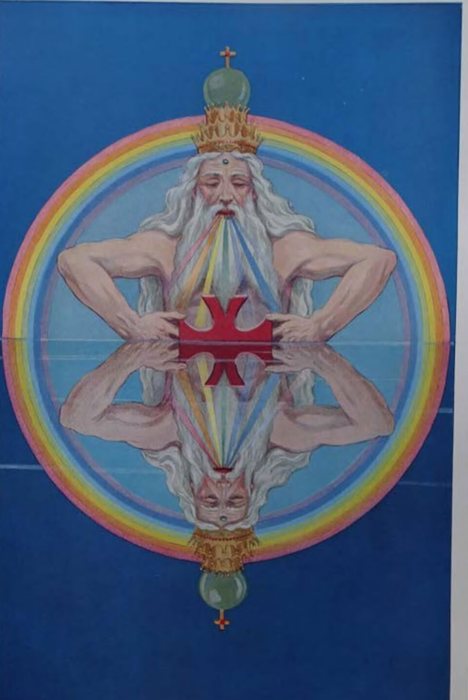
Where the detail is the subject
This is in the picture without being what it is about. Below, one work that is about it.
Record
One symbol a week, decoded.
This picture is free at full size from its source, linked above. What an address gets is the Sunday letter: one picture, one symbol marked on it, what it meant and who said so, and the master files of the decoded plates as they are verified. Leave any time.
Free, one letter a week, unsubscribe in one click. How the address is used.
Scroll or pinch to zoom · drag to move · double-tap for 1:1 · 1400 by 1167 pixel web copy; the source file is linked under Record