The Hand of the Mysteries, and the two men who read it
The same seven signs on the same seven places, explained twice, two and a half centuries apart. One man saw a shelf of chemicals and the other saw a mind. Neither was reading carelessly.
An open right hand stands against a field of night. A key sits on the little fingertip, a lantern on the ring, a sun on the middle, a star on the index, a crown on the thumb, and in the palm a fish swims inside an oval of flame. J. Augustus Knapp painted it in 1928 for Manly P. Hall, and Hall printed a credit line under it that most reproductions cut away: Redrawn from an early 18th century water color. (Artist unknown.)
Redrawn is the word to hold on to. The picture is a copy, and the thing it copies had already been read by somebody else, in print, with the same seven signs in the same seven places. That older emblem circulated in the seventeenth century under the name of Isaac Hollandus as Die Hand der Philosophen. Hall knew it and says so.
So there are two decodings of one picture, roughly two and a half centuries apart, and they do not agree. That disagreement is the most useful thing in this archive, and it is worth going through slowly.
Where they agree
Exactly one place: the palm.
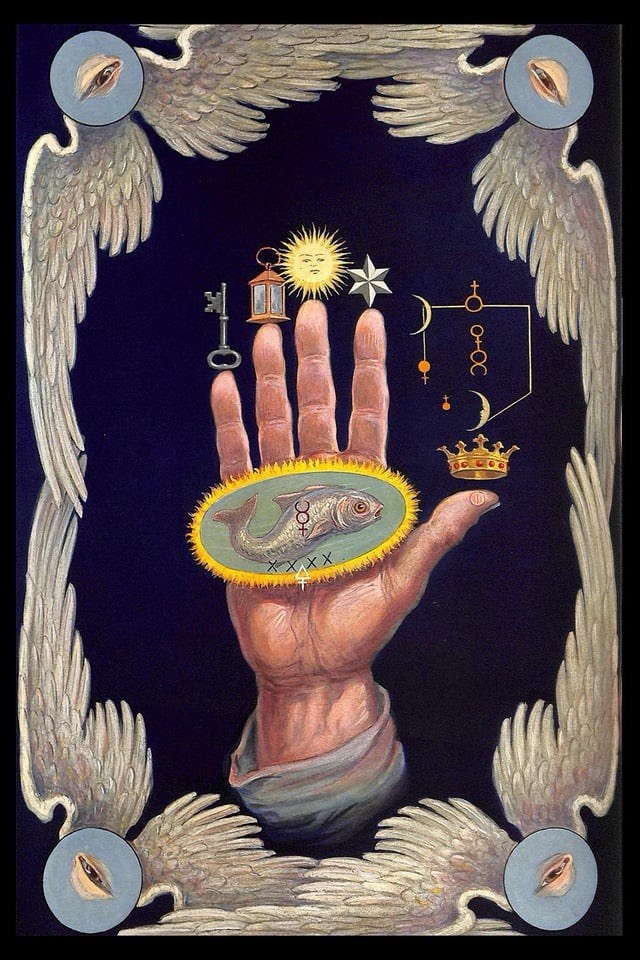
The fish is mercury and the flame-bounded sea in which it swims is sulphur.
Manly P. Hall, 1928, the caption to the plate
The older hand says the same, and goes further: the fish is mercury and it is the beginning. Two readings separated by two hundred and fifty years, working from the same drawing, land on the same two substances in the same oval. On every other part of the hand they pull apart.
Where they part
For Hollandus the fingers are a shelf. Saltpetre, vitriol, sal ammoniac, alum, common salt. They are things you can weigh out, and the text is blunt about who is allowed to know which is which: nobody understands the hand, he writes, without first taking the philosophers' oath.
For Hall the same five fingers are not substances at all. They are grades of light.
The key is the Mysteries themselves, without whose aid man cannot unlock the numerous chambers of his own being.
Hall, on the little finger
The lantern is human knowledge, for it is a spark of the Universal Fire captured in a man-made vessel.
Hall, on the ring finger
Every word in that second line is doing work. It is a spark and not the fire. It is captured and not given. And the vessel is man-made, which is Hall telling you what he thinks human knowledge is worth and what it is worth against. Then the middle finger carries the sun, the light of the world; the index carries a six-pointed star, the Universal Light; and the thumb carries the crown.
Absolute Light, unknown and unrevealed, whose power shines through all the lesser lights.
Hall, on the thumb
Read the two lists side by side and the difference is not a difference of opinion about symbols. It is a difference about what kind of thing the picture is. Hollandus is describing a procedure with materials in it. Hall is describing a mind with faculties in it. The drawing did not change. What a reader was expected to be looking for did.
What Knapp added
Knapp's plate carries two things neither text mentions. Four eyes, set in pale roundels at the corners, and the wings that frame the whole picture and run down both sides. Hall's caption names neither.
So the archive marks the eyes and leaves the wings unmarked, and says on the page that it is leaving them unmarked rather than guessing. There are readings available for both. They are somebody's readings, and nobody who wrote them was in the room.
Hall does not agree with himself either
The other thing worth noticing is that Hall reads the whole hand three ways in one caption and never chooses. It is the hand of the philosopher extended to those who enter the Mysteries, which is an offer. It is a Master Mason's grip, which is a test. And it is the four worlds of the Qabbalah laid on one body, which is a diagram. Those are three different pictures.
This archive does not choose for him. Whether they are one idea or three borrowed ideas laid over the same drawing is not answered by anything held here, and the record says so.
What is not settled
Both texts reach us at one remove, and it would be dishonest to write this without saying so. Hall's caption here is a transcription that has not yet been read against the printed 1928 page; only its title and credit line have, on the Internet Archive's photograph of leaf 24. Hollandus reaches us through Leone Muller's English of 1986, not against a seventeenth-century printing, and the authorship of the Hollandus texts is disputed in any case.
What the archive holds of the older hand, then, is a reading of it rather than a quotation from it. Every note on the plate says which of the two it is quoting, and where the ground is soft it says that too.
Which is the point. The picture has not changed since 1928, or since whenever the watercolour behind it was painted. Everything that has changed is what people brought to it. A symbol is not a fixed meaning waiting to be looked up. It is a place where readings accumulate, and the only honest way to show one is to name who said what, in which book, and when.