Nolan changed the Odyssey. So had everyone by 1648.
Circe as a warning about harlots, Sirens with fish tails, and a magic herb that turns out to mean public speaking. The Odyssey was being rewritten in print four centuries before this film, by a man who signed it.
The argument about Christopher Nolan's Odyssey is whether he was faithful to Homer. The scene it keeps returning to is Circe, who is described as the most frightening thing in the film and who changes men into animals by a method the reviews will not spell out.
Here is a fact that ought to change the shape of that argument. The pictures most people carry in their heads as the Homeric ones are already departures, and some of them were departures four hundred years ago. This archive holds three of them: a Circe, a set of Sirens and a moly plant, cut into wood and printed at Antwerp in 1648, in a book whose author signed his changes and printed his reasons underneath.
Circe, and the name a 1648 book files her under
Andrea Alciato was a Milanese lawyer who invented the emblem book. His Emblemata first appeared in 1531 and was still being printed a century later. His Circe is not headed with her name. It is headed with a warning.
Cauendum à meretricibus.
Andrea Alciato, Emblemata, the motto over the woodcut, Plantin, Antwerp, 1648, page 95. Beware of harlots.
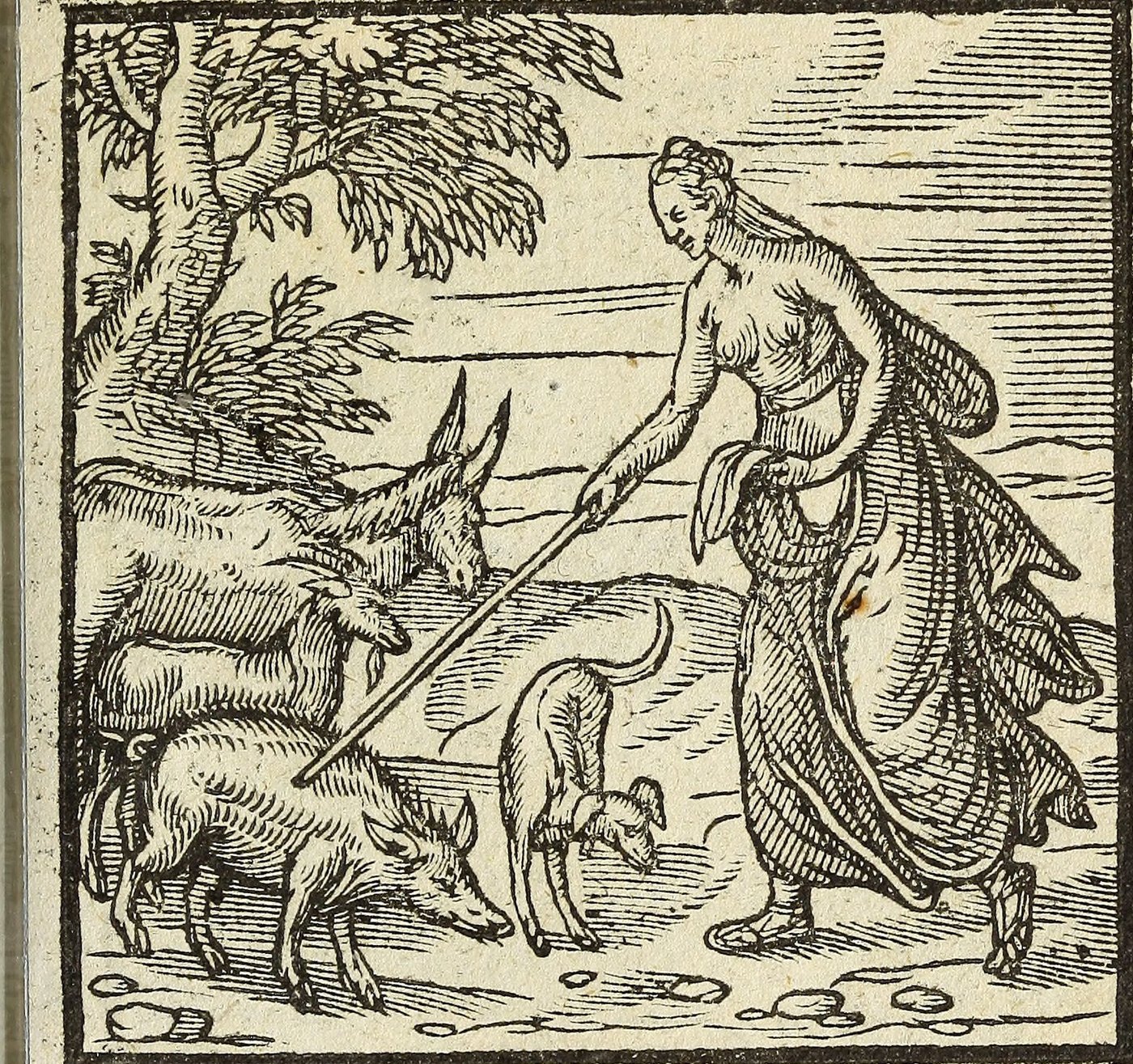
The woodcut under it shows a woman in a long gown leaning forward with a wand held out toward a stag, a goat and a boar crowded under a tree. The epigram produces witnesses, as a lawyer would: Picus who was turned into a bird, two-formed Scylla, and the Ithacan's crew after they drank. Then it states the moral it wants.
Indicat illustri meretricem nomine Circe, et rationem animi perdere, quisquis amat.
Alciato, page 95. Circe, by her famous name, points to the harlot, and shows that whoever loves loses the reason of his mind.
Which is worth holding against what Nolan actually put on screen. His Circe lives alone on a cliff, is terrified when armed men climb up to her door, and keeps her own sister in a cage. Reviewers have called her a vindictive witch and asked why he changed her.
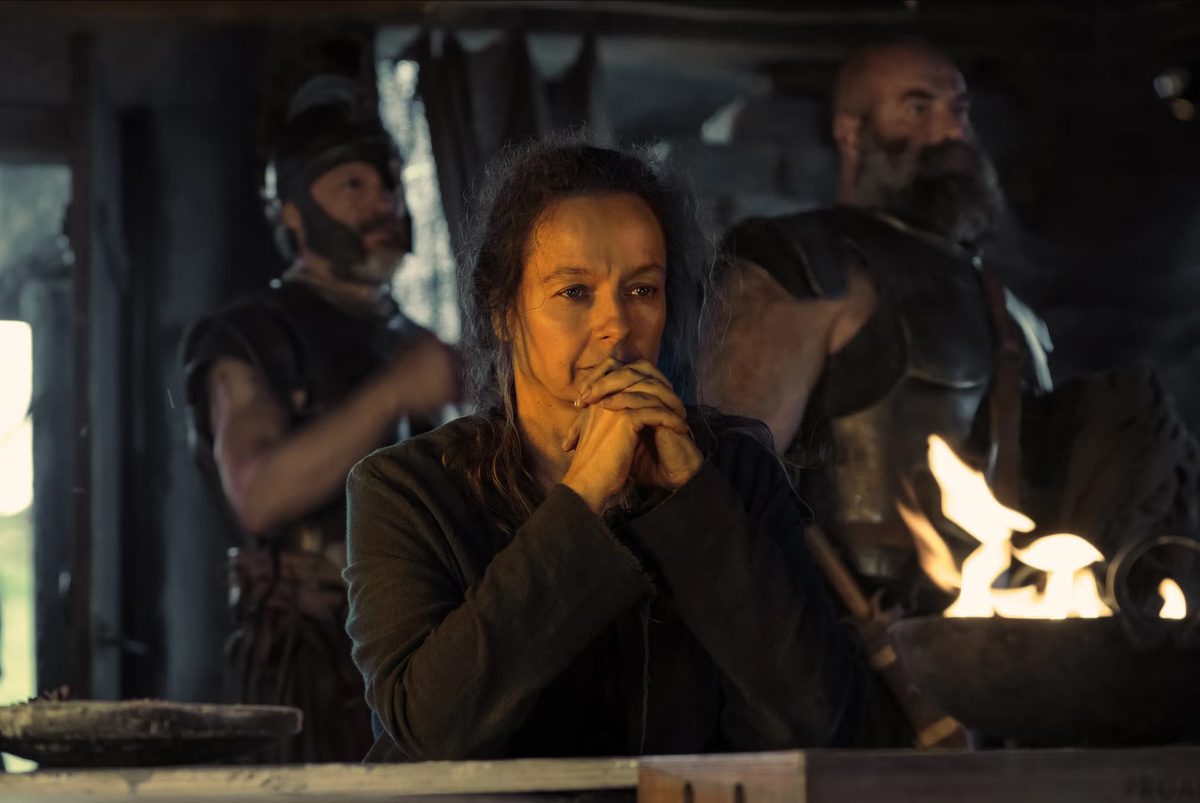
He changed her away from this. The 1648 book is the one that files her under harlots and says the fault is in the man who wants her. Whatever Nolan did to Circe, making her the villain of her own scene is not the innovation here; it is the older reading, and it was printed with the reason attached.
That is not Homer's Circe. Homer's Circe is a goddess who becomes an ally, gives Odysseus sailing directions and sends him on. She is not a harlot and Homer draws no moral about losing your reason to love. Alciato has taken the episode and used it for something else entirely, and he has done it in public, over his own name, with the reason printed under the picture.
The Sirens Homer never described
This one is sharper, because it can be checked in a single move. Homer never says what the Sirens look like. Not once, anywhere in the poem. Greek art gave them feathered wings and taloned feet, and that came from the vase painters rather than from the text.
Now look at what Antwerp printed in 1648.
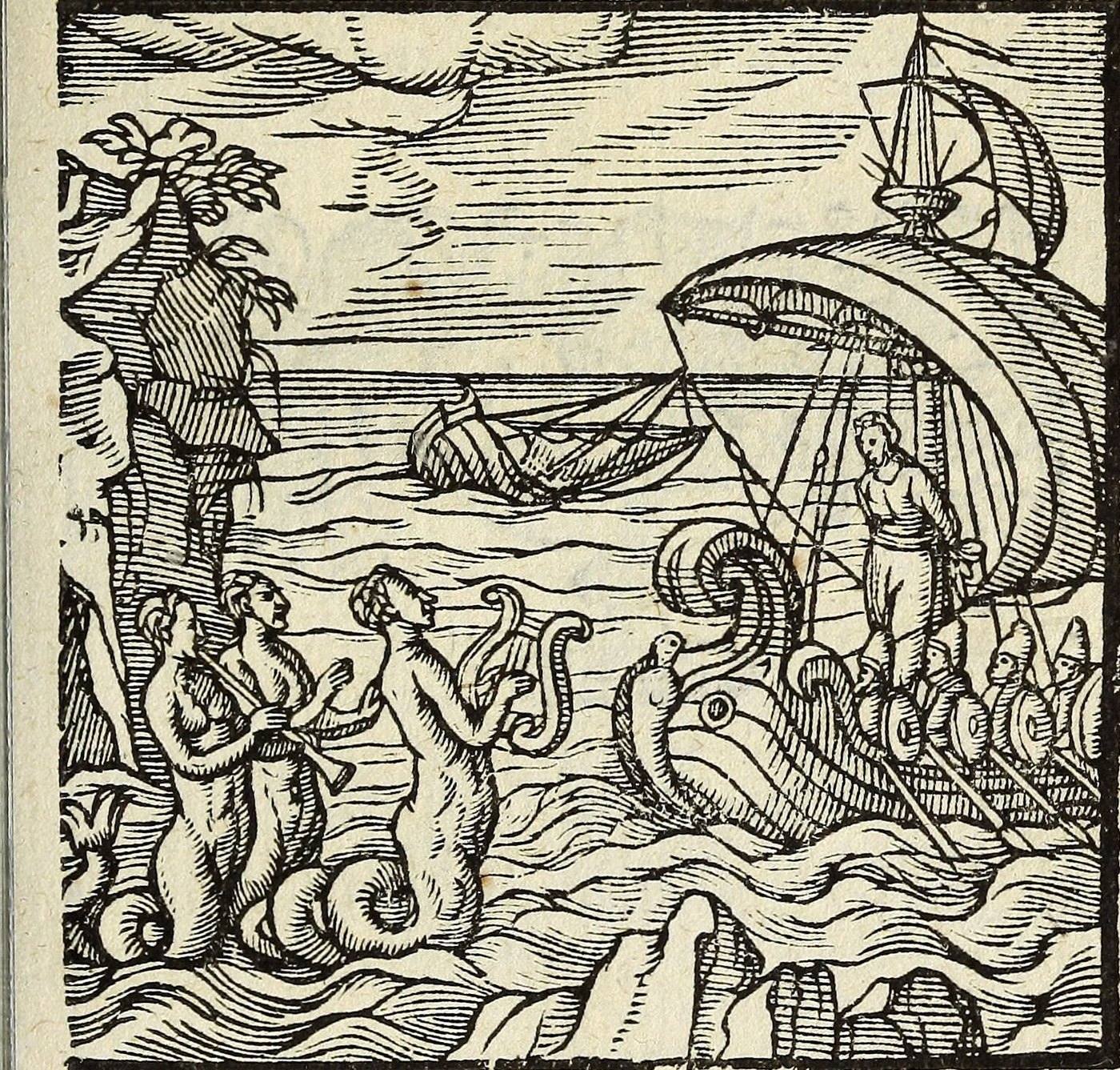
Fish tails. The mermaid siren that almost everybody pictures when they hear the word is not Homer's, and it was already the standard picture in a learned Latin emblem book in the middle of the seventeenth century. Alciato knows precisely what he is handling. His first line names three natures at once and asks whether such a thing can exist.
Absque alis volucres, & cruribus absque puellas, rostro absque & pisces, qui tamen ore canant, quis putat esse ullos? iungi hæc Natura negauit: Sirenes fieri sed potuisse docent.
Alciato, page 139. Birds without wings, and girls without legs, and fish without a snout, which nevertheless sing with their mouths. Who thinks any such things exist? Nature denied that these be joined: but the Sirens teach that it could be done.
What the book changed, and what it kept
Set the two side by side and the pattern is consistent. Alciato keeps the episodes exactly. Circe transforms, the Sirens sing, Mercury brings the herb. What he replaces is the meaning, and he replaces it with something a sixteenth-century reader could use on a Tuesday: appetite is dangerous, flattery is dangerous, learn to speak well.
This is not a lapse or a misunderstanding. It is the whole purpose of the form. An emblem exists to turn a story into a rule, and the rule is printed where nobody can miss it. When Nolan gives Circe a method of transformation that departs from the poem, he is doing a version of what the emblem book did, with the difference that the emblem book wrote its reason down.
What actually beats them, according to the same page
The Sirens epigram is ten lines rather than four. It runs over the page break, and the printer's catchword at the foot of page 139 is Illicium, the first word of page 140, so the two halves are one poem. The second half names the three sirens and then says what defeats them.
Has Musæ explumant, has atque illudit Vlysses: scilicet est doctis cum meretrice nihil.
Alciato, pages 139 to 140, the close of the epigram. The Muses pluck these of their feathers, and Ulysses mocks them: which is to say that the learned man has nothing to do with a harlot.
Not wax. Not rope. The Muses, and a man who has read enough to laugh. In this tradition the Sirens are beaten by having lost a singing contest to the Muses, and Odysseus survives because he is educated rather than because he is tied up.
One detail in that line is worth stopping on. Explumant means plucked of their feathers. The block above it draws fish tails, and the poem printed beneath the block still remembers birds. Both traditions are on the same page, and the man who set them there did not think there was a problem.
Moly, or the antidote is a skill
The third emblem is the one nobody covering this film has, and it closes the argument. It shows Mercury in a winged cap and winged heels, holding up a caduceus, handing a small flowering plant across to a soldier in a plumed helmet. This is the herb Hermes gives Odysseus against Circe.
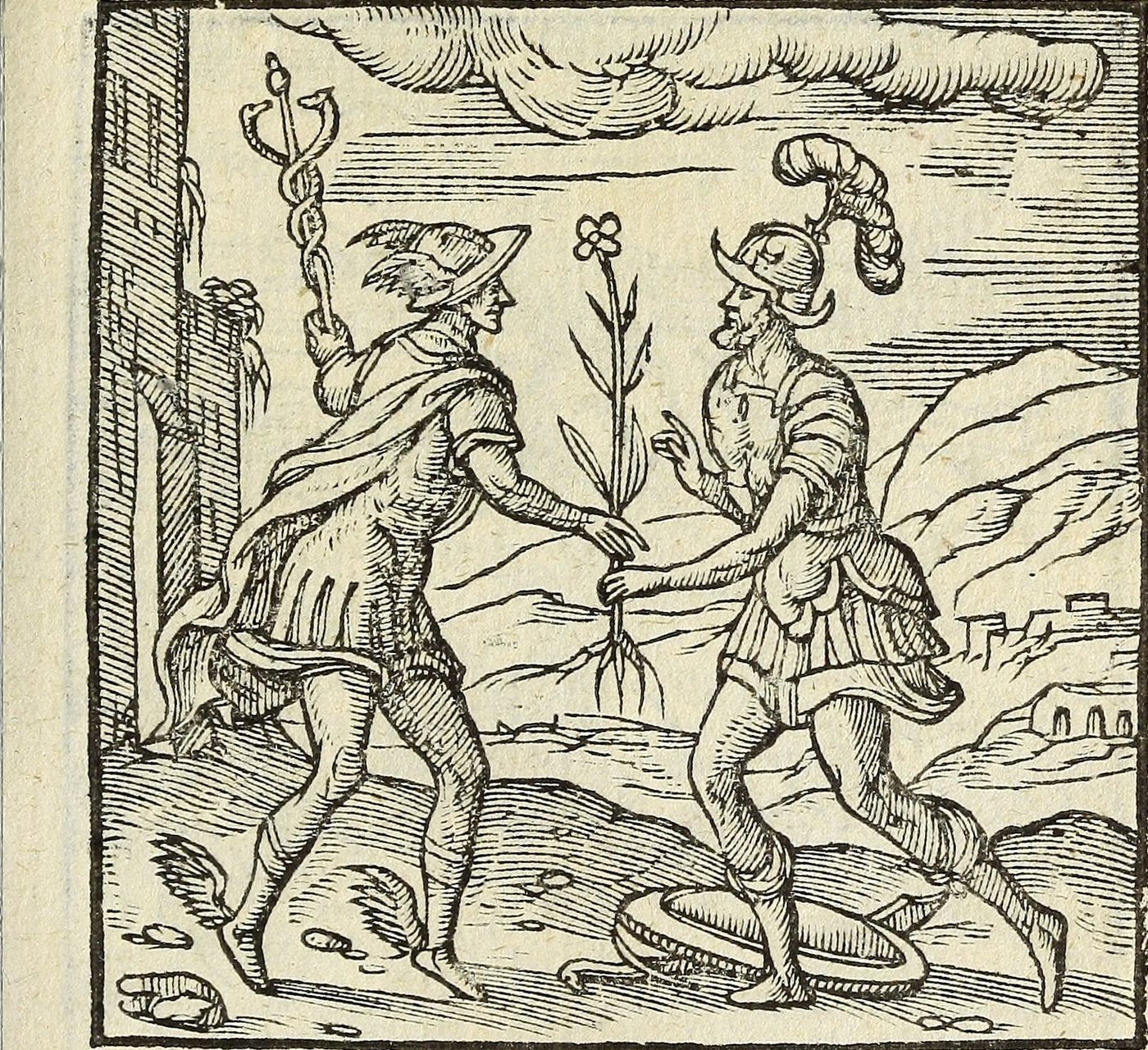
Alciato describes it accurately first, then tells you what it is.
Moly vocant: id vix radice euellitur atrâ, purpureus sed flos, lactis & instar habet. Eloquij candor facundiaque allicit omnes: sed multi res est tanta laboris opus.
Alciato, Emblema CLXXXI, page 215. They call it Moly: it is pulled up only with difficulty by its black root, but its flower is purple and has the likeness of milk. The brightness of eloquence and fluency attracts everyone, but a thing so great is the work of much labour.
The magic herb is public speaking. The god has to dig it up for you because the root is black and deep, which is the emblem's way of saying that the thing which protects you takes years. Two emblems in one book, arrived at separately, and both give the same answer: what defends you against enchantment is something you learned.
Why an emblem book is in this archive at all
Every emblem is four things on one page: a motto, a picture, an epigram and a gloss. That arrangement is the reason this book is here. A picture printed under a motto and over an explanation is a picture whose maker expected to be decoded and said so, which is the only test a work has to pass to be filed in this archive.
It is also why these three can be quoted at all. The film has produced no statement from anyone who made it about what the Circe sequence means, so there is nothing to cite. Alciato left his meaning on the same sheet as his picture, so there is.
An emblem is not evidence about Homer
None of this makes Nolan right, and none of it makes Alciato right either. A 1648 emblem is not evidence about Homer. It is evidence about how Homer was being used a century after printing, by an educated man writing for other educated men, who felt free to keep the story and swap the point.
What it does settle is the shape of the complaint. The Odyssey has been rewritten by everyone who has ever picked it up, and the version people are defending as the authentic one is usually just an older rewriting that has had time to settle. The Sirens with fish tails are proof of that, printed, dated and sitting on a page you can look at.
Until then, the only people in this argument who wrote down their reasons are the ones who died four hundred years ago.